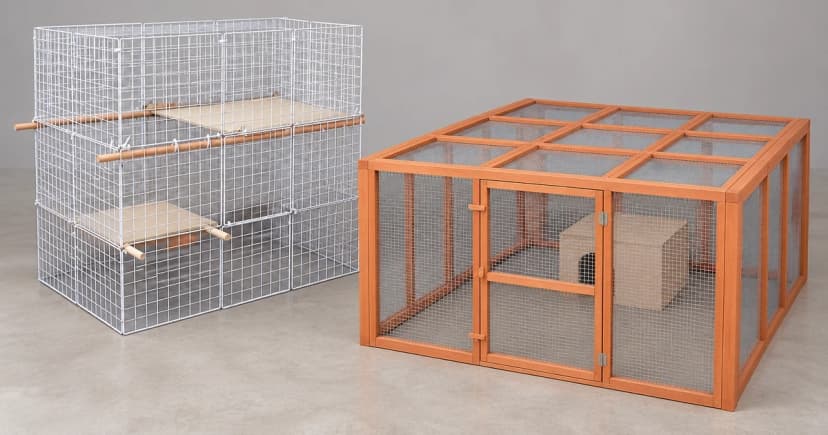
To set up a rat cage for an established compatible group before arrival, work through five linked steps: verify that the cage meets group size and bar-spacing requirements (Woodgreen's rat care guide recommends groups of at least three rats and specifies a minimum of 80 cm high × 50 cm deep × 80 cm wide with 1 cm bar spacing for up to four rats), place the solid-floor enclosure in a quiet draught-free room, arrange climbing levels and multi-exit shelters (including at least one hide large enough for the whole group), separate your three bedding materials by role (base, nest, and litter tray), and mount two independent fresh-water sources at different ends or levels.
Start with the compatible group and enclosure dimensions
In its rat care guide, Woodgreen recommends keeping rats in groups of at least three and states a minimum cage size of 80 cm high, 50 cm deep, and 80 cm wide for up to four rats, with 1 cm bar spacing. Keep those numbers attached to Woodgreen's ”up to four rats” condition—larger groups need more space, and outer frame dimensions still require checking how much usable interior room remains after shelves and shelters are fitted.
Choose the room position and verify a solid-floor structure
The RSPCA rat housing guide calls for a solid floor, secure bar spacing, and zero sharp projections, placed indoors in a well-ventilated spot away from draughts, direct sunlight, strong artificial fragrances, and loud appliances or screens.
Assemble the cage completely according to its manual before adding substrate, checking that every door latch, shelf bracket, and access panel closes securely.
Arrange climbing routes and group-sized multi-exit shelters
Combine horizontal floor room with shelves, ramps, and climbing ropes (RSPCA housing guide) without packing the interior so tightly that rats cannot run or stretch. Provide multiple dark shelters with more than one doorway so rats can choose to sleep together or apart.
The RSPCA's new-owner rat leaflet specifically calls for at least one shelter large enough to hold the entire group at once, with extra exits so no rat can be cornered inside a hide. Test-fit shelves and hammocks first to confirm that a hanging hammock never blocks the only ramp to food or water.
Give each of the three bedding materials its own job
Woodgreen separates rat bedding into three distinct roles—floor base substrate, nest-lining material, and litter-tray pellets—while both Woodgreen and the RSPCA warn against dusty sawdust and cotton-wool-style ”fluffy” bedding that pulls into thin strands:
| Cage Setup Element | Published Material or Equipment Example (Woodgreen & RSPCA) | Placement & Safety Rule |
|---|---|---|
| 1. Floor base substrate | Dust-extracted shredded cardboard across the solid cage base (Woodgreen). | Never use dusty sawdust or coniferous shavings, which irritate sensitive rat airways. |
| 2. Nest-lining material | Soft plain white tissue paper placed inside sleeping boxes and hides (Woodgreen). | Never use cotton-wool or thin-stranded fluffy bedding that can entangle toes or cause blockages. |
| 3. Litter-tray substrate | Non-fragranced paper pellets inside corner litter trays (Woodgreen). | Use a distinct texture from the floor base so rats can distinguish toileting trays from sleeping zones. |
| 4. Two fresh-water sources | Two water bottles or securely mounted heavy bowls placed at different ends or levels (Woodgreen). | Ensures backup access if one nozzle blocks or leaks, and prevents one rat from guarding the sole water point. |
Fit two water sources, plan ongoing enrichment, and prepare for arrival
Mount both fresh-water sources at separate ends or levels of the cage as Woodgreen advises, and test every bottle nozzle before collection using our flow and leak checks guide.
Once the core shelters, three bedding layers, and dual water stations are in place, use our guide to rat enrichment and supervised exploration to plan rotating in-cage foraging and climbing routes alongside rat-proofed out-of-cage time. Before picking up your rats, ask the adoption centre for a small bag of their familiar dry used bedding to carry their scent into the new cage and confirm their current food brand so the transition is smooth for your established group.