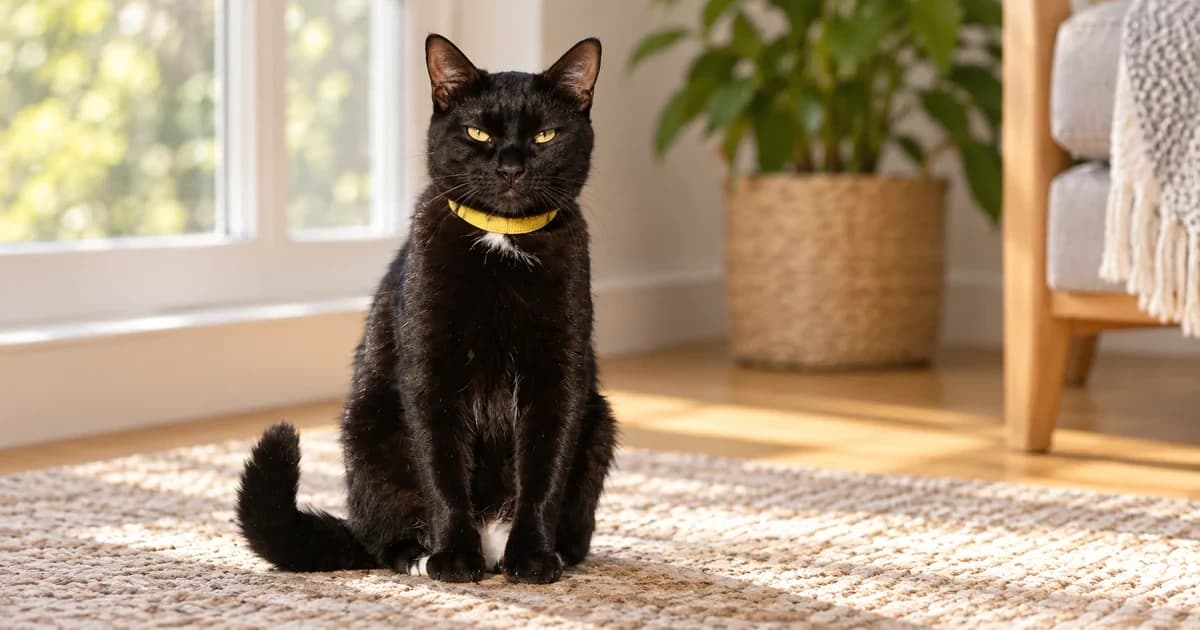
A breakaway cat collar has a closure designed to separate under tension if the collar catches on something. Its purpose is to give your cat a way to come free of the collar. That differs from an ordinary buckle that stays fastened until a person opens it, and from an elastic section that stretches while the collar remains a loop.
The feature can reduce an entanglement risk; it is not a promise that a collar will release in every accident. Choose a cat-specific model, follow its fitting instructions and keep checking its condition. For leash walking, use suitable cat harness equipment instead of relying on a breakaway collar to hold your cat.
Look for the release mechanism, not just a plastic clip
“Breakaway,” “quick-release” and “snap-opening” appear in cat-collar descriptions. A photo of a plastic clip does not answer that question.
Cats Protection's collar guidance favors quick-release or snap-opening designs and advises against elasticated collars. A cat can get a paw involved while trying to free itself from an elastic collar. Stretching the material does not necessarily remove the loop around the animal.
| Closure | What to establish | What its appearance cannot prove |
|---|---|---|
| Breakaway closure | The model's instructions explicitly describe release under tension | That it will release in every snag or suit every cat |
| Manually opened buckle | How a person unfastens it; whether a separate breakaway feature exists | That being easy for you to open makes it automatically breakaway |
| Elastic or stretch section | The material expands while the band may remain closed | That expansion is equivalent to the buckle separating |
When comparing breakaway cat collars, read the description and instructions for each item.
Check the model before checking the fit
Collar dimensions and release specifications are product-specific. For example, LupinePet's Original Designs Safety Cat Collar lists an 8–12-inch adjustment range and an approximately 5-pound release figure. Those are the manufacturer's stated specifications for that collar, not a universal neck range or release threshold.
Before buying, collect four pieces of information:
- Actual adjustment range: compare the collar's usable range with your cat's neck measurement, using the maker's sizing method.
- Intended wearer: check any kitten, minimum-size or weight guidance. An adult collar adjusted shorter is not automatically suitable for a small kitten.
- Closure instructions: find out how the breakaway component fastens and whether the maker specifies an off-cat inspection or demonstration.
Do not substitute a familiar size name, a buckle shape or a high-strength webbing claim for the missing instructions. Keep the model name and sizing information so you can refer to the same collar later.
Fit it calmly, then check it again
Measure a relaxed cat only if they tolerate the handling. Adjust the collar according to its instructions, and start in a secure indoor space where you can supervise. A collar should not be made deliberately loose to make it “safer”: excess space can let a jaw or paw become caught.
Finger-gap advice is a starting check rather than a precise measurement. Cats Protection describes space for two comfortable fingers; the RSPCA Australia's guidance describes one large or two small fingers. Hand size and collar construction vary. Follow the model's instructions and check the actual position, rather than treating a particular number of fingers as a guarantee.
- Check the band: it should lie as intended, without twisting or trapping fur.
- Watch your cat: pause or remove the collar if they become distressed, persistently try to get their mouth or paw under it, or show discomfort.
- Recheck after settling: Cats Protection recommends another fit check after a few minutes because a cat's initial posture can change.
- Keep reviewing: the RSPCA recommends checking fit and condition weekly. Growth or changing body size calls for additional attention.
American Humane's collar advice particularly emphasizes checking growing kittens: the collar does not enlarge with the animal. A size that worked previously may become too tight. If you find rubbing, a wound or persistent discomfort, remove the equipment and seek veterinary advice rather than repeatedly tightening or refitting it.
If the collar keeps coming off, investigate before altering it
A missing collar tells you that it is gone; it does not tell you exactly what happened. It may have released, slipped over the head or developed a fault. Inspect a recovered collar for damage and check the fit against its instructions.
LupinePet advises frequent fit and condition checks, including checking for fraying or tightening from scratching. Replace damaged equipment rather than treating its release behavior as dependable. If the instructions describe a check, do it off the cat as directed. Do not tighten a collar around a cat's neck to test it or conduct your own hanging-weight experiment.
Do not glue the buckle shut, secure it with another fastener or otherwise defeat the release feature to prevent loss. You would be changing the very behavior for which you chose the collar. If the model is unsuitable, seek guidance or choose another documented design instead.
Plan identification that survives a lost collar
A collar can make identification visible to someone who finds your cat, but that identification goes with the collar if it comes off.
Microchipping provides a separate identification route. American Humane explains that a scanner reads the chip's identifier and connects it with registered owner information; keep those database details updated. A microchip is not GPS. A collar tag, microchip and tracking device serve different functions, so buying one does not establish that the others' job is covered.
Extra attachments deserve their own assessment. A tag or bell is not useful if its attachment creates a new snag problem. Use the maker's accessory instructions rather than improvising a bulky arrangement. This guide covers collar choice, not wildlife-deterrent effectiveness or tracker compatibility.
Keep leash restraint separate
A collar designed to separate under tension is a poor basis for restraining a cat on a leash. LupinePet explicitly identifies its breakaway cat collar as identification equipment and says it must not be used with a leash. An identification ring is therefore not permission to clip a lead to it.
For supervised walks, investigate a suitable cat harness and the instructions for that separate setup. If your goal is transportation instead, look at cat travel equipment for that task. A breakaway collar explains how identification equipment may release; it does not establish walking restraint or safe vehicle containment.