When deciding what size cage does a parakeet need, the space depends on the actual bird, how much time it spends in the cage and how much open clearance remains inside. Start with usable length, width and height, then compare guidance for that keeping routine. A cage's advertised overall height, including a stand or roof, cannot answer the question on its own.
This guide uses budgerigar and small-parakeet keeping plans as its focus. Confirm the bird's species before using a size recommendation. It brings together published housing guidance and a way to check cage specifications; it does not certify a cage, measure a bird or report a housing trial.
Define the keeping plan before choosing a number
Write down which bird the enclosure is for, whether other birds would share it and how the cage fits into its day. An overnight enclosure, a home where a bird spends much of its time and an aviary are different settings. A recommendation for one setting should keep that setting attached to it.
Do the same with the bird's identity. A retailer's broad “parakeet” label does not resolve the individual species, its movement needs or whether several birds can share the space. Ask an avian veterinarian about those needs when they are uncertain, rather than selecting the smallest number from several unrelated charts.
Read the conditions beside the size guidance
The Merck Veterinary Manual's pet-owner housing guide gives a general recommendation of at least one and a half times the bird's wingspan in every direction. It also calls for more room when birds share a cage. The RSPCA's bird-environment page distinguishes different keeping conditions:
| Published guidance | Dimensions described | Condition to retain |
|---|---|---|
| Merck pet-owner guide | At least 1.5 times the bird's wingspan in all directions | General bird housing guidance; sharing birds need more room, plus safe supervised exercise outside the cage. |
| RSPCA: mostly outside the cage | Height, width and depth at least 1.5 times wingspan | The bird spends most of its time outside the cage (paired with the RSPCA description of at least six hours of safe indoor flying time daily). |
| RSPCA: mostly inside the cage | Height, width and depth at least twice wingspan | The bird spends most of its time in the cage. |
| RSPCA: a group in a cage | Height, width and depth at least twice the largest bird's wingspan | Its colony-breeding group context; extra birds require further consideration. |
These are attributed recommendations, not US legal minimums or proof that a particular cage works. Do not average them. The RSPCA page also describes at least six hours of free, safe indoor flying time each day; its smaller-cage condition should not be detached from that broader routine. Merck likewise calls for safe, supervised exercise outside a cage.
A multiplier still needs an appropriate wingspan reference for the actual bird. This article supplies no guessed species measurement. Do not restrain a bird or force its wings open to produce one. When a reliable wingspan reference has not been established, bring the confirmed species identity, daily keeping routine and candidate cage dimensions to an avian veterinarian for review, and keep the figure open rather than filling in a generic budgie number or treating all small parakeets as a single species.
Find the usable dimensions in the cage specification
Check which way each number runs. Some listings show overall dimensions prominently while leaving the enclosed portion unclear; a photograph does not resolve the missing measurement.
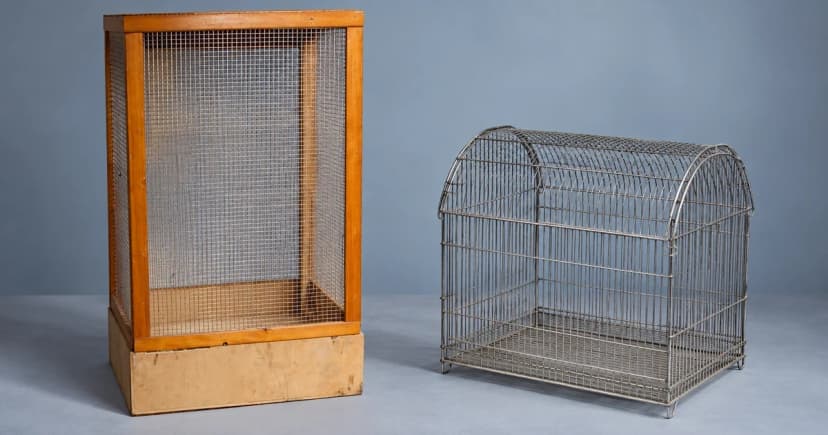
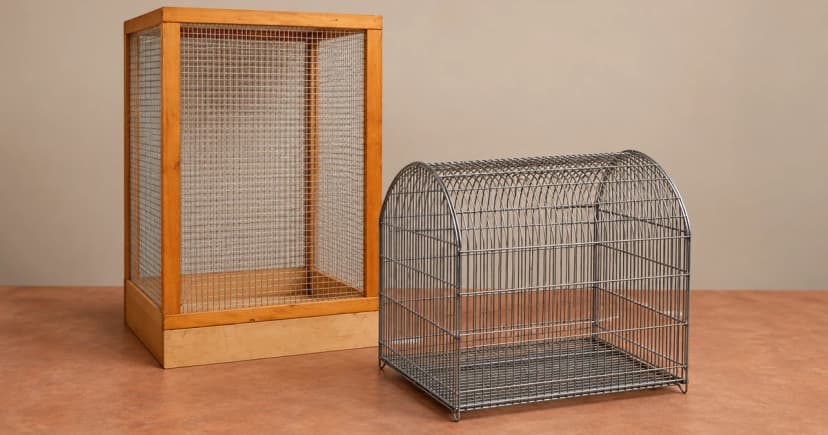
Separate the cage from its stand, casters, roof decoration and any playtop. Record what the maker actually specifies rather than subtracting guessed allowances from a product title. A measurement to an outer frame is not automatically the clear space between the inner surfaces.
| Measurement category | What to count or exclude | Why it matters for wingspan comparisons |
|---|---|---|
| Usable interior length, width and height | Clear horizontal and vertical span between the inner bar walls above the floor grille | Directly determines whether the bird can stretch, flap and move across all three directions |
| Exterior stand, casters and seed guards | Exclude rolling bases, storage shelves, wheel height and flaring outer skirts | Adds external footprint and height without adding a single inch of interior flight or perching space |
| Decorative roof peaks and playtops | Exclude ornamental arches, finials and exterior top perches from interior height | Inflates advertised overall height while the enclosed living area remains much lower |
Check each direction separately. A tall structure can still leave little room across it. Multiplying three dimensions into a volume hides which direction is restrictive, so a volume total should not replace the length, width and height checks in the cited guidance.
Keep a short specification note for each candidate: exact model, measurement diagram, usable dimensions, bar spacing and the maker's information about construction and finish. Mark missing or conflicting details as unknown. A stated material name or an attractive finish does not establish the safety of an unidentified coating or fitting.
Consider what occupies the interior
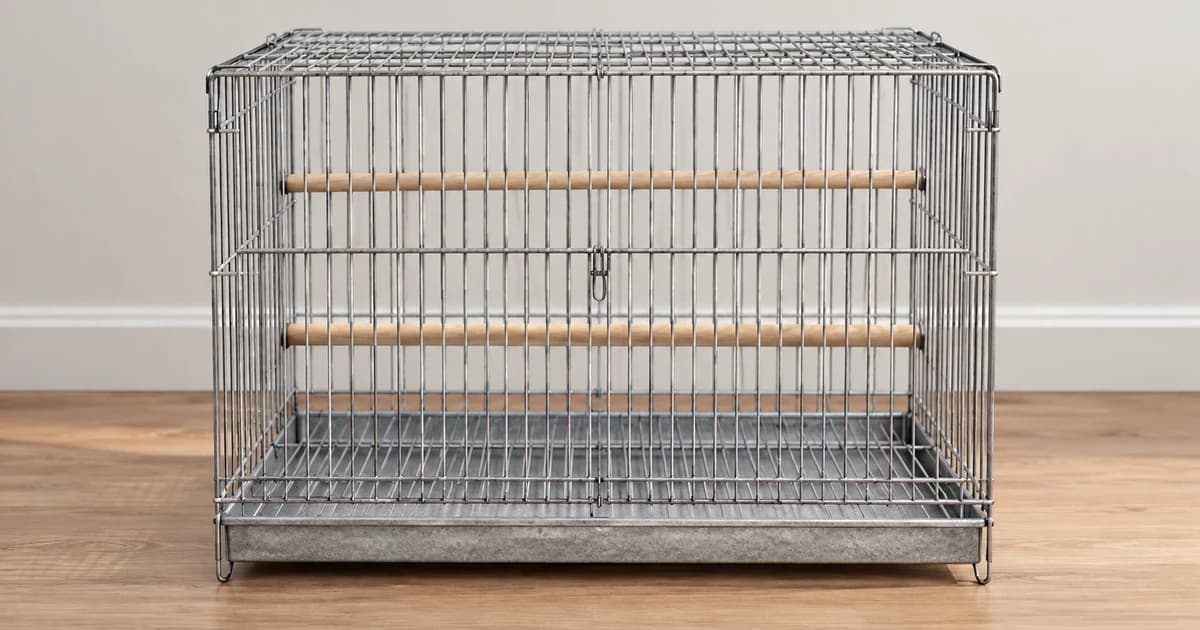
An empty enclosure and the same enclosure filled with furniture offer different clearances. RSPCA guidance calls for uncluttered room to stretch and flap. Before adding accessories, consider the space their complete shapes occupy, not only the points where they attach.
Our bird-perch placement guide covers the separate task of arranging furniture around bowls and open space. Use it after checking the enclosure itself. Repositioning a perch does not turn an unresolved cage-size specification into a verified one.
Watch ordinary movement without staging a clearance demonstration. A brief movement or a neat layout sketch is an observation, not a test proving long-term suitability. If movement appears restricted or the bird's needs are unclear, reconsider the enclosure with appropriate avian veterinary advice.
Ask a different question when birds share a cage
The RSPCA's company guide says birds housed together need room to fly and to get out of one another's space. It names budgies among colony-breeding species while retaining the need for compatible birds. Merck also advises discussing compatibility with a bird veterinarian.
That makes “How many fit?” an incomplete question. A cage volume, a photograph of two birds or a label listing several species does not establish that particular birds should live together. Identify the birds and their keeping needs before choosing shared accommodation; this is not an introduction or breeding plan.
Compare cages using verified information
Use Pawlivy's bird-cage category to browse equipment forms, then check the exact model's published specifications. Category membership is not a statement that every cage suits a budgerigar, shares one bar spacing or has a verified usable interior.
Put each candidate beside the same keeping plan. Can you identify all three usable dimensions? Do the product specification and listing describe the same model? Are the bar-spacing and construction details documented? Is the open interior still clear after the intended furniture is accounted for? Leave a candidate open when a necessary answer is missing.
The useful result is a documented choice with its conditions intact, rather than the largest advertised height or an unsupported “safe for two birds” claim. These checks organize information; they do not replace individual husbandry advice, verify inventory or demonstrate product performance.
Sources and editorial scope
This guide uses complete current RSPCA UK environment and company pages and Merck's pet-owner housing page, checked in October 2026. Merck lists a full review in April 2025 and an update in March 2026. No shelter-size formula, covering instruction, lighting prescription or unverified product dimension is adopted. Read our editorial policy for research and illustration practices.