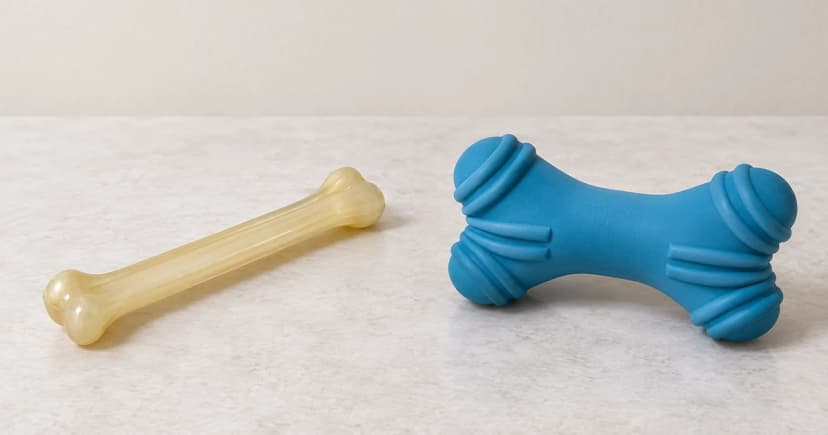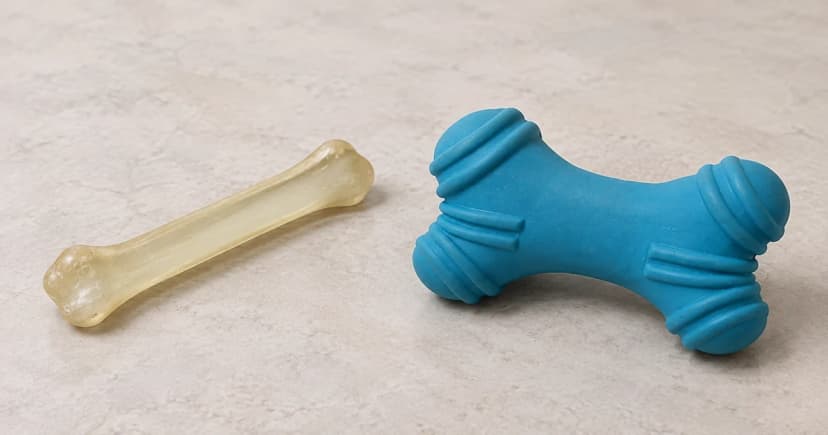
Rubber toys can be a suitable option for some dogs, but the material name alone does not establish that an individual toy is suitable. Check the exact product's formula, intended activity, sizing and use instructions. A toy advertised as durable or nontoxic still needs to match the way your dog uses it.
Start by finding out what the maker actually tells you. This guide separates material and label evidence from the decisions about use; it does not report a chemical test or a hands-on comparison of rubber toys.
Identify the product behind the word rubber
A product description that says only “rubber toy” leaves important questions unanswered. Find the maker and exact product line, then look for its material description and the activity it is designed for. Record a missing answer instead of identifying a compound by its colour, shine or smell.
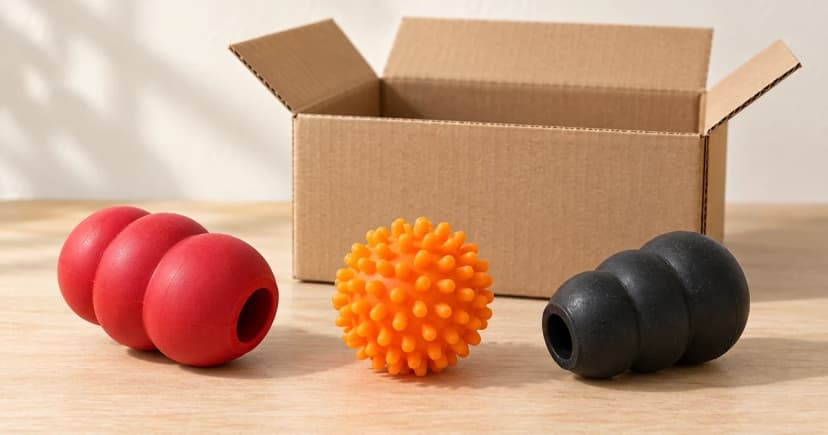
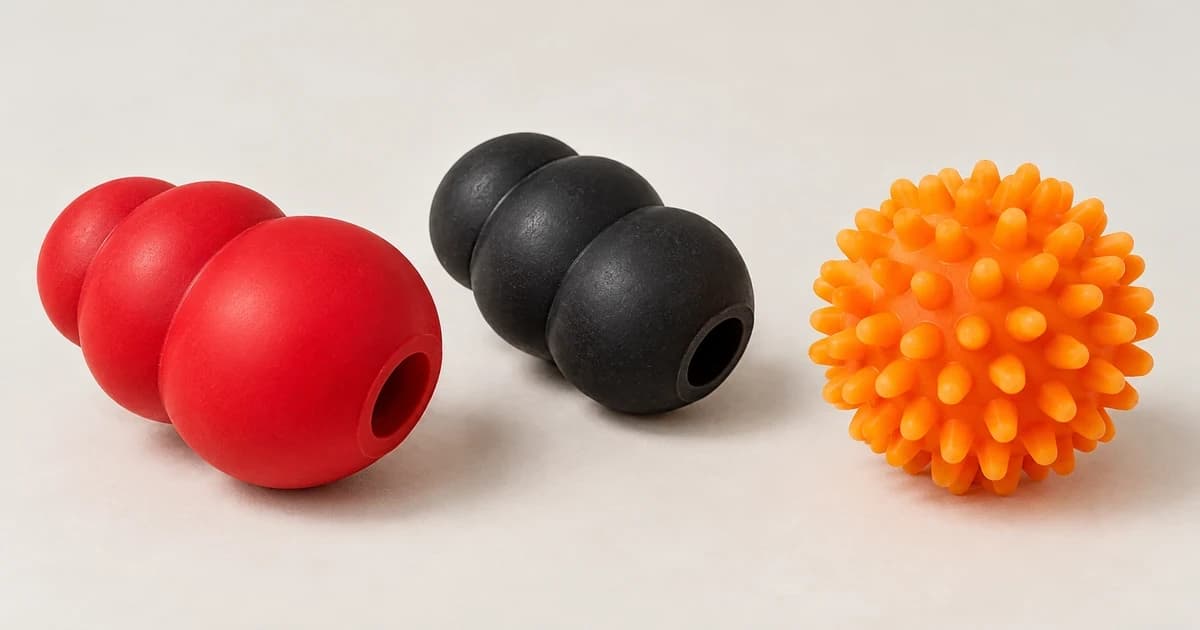
For example, KONG's own FAQ describes its natural-rubber products in several formulas and distinguishes them from other interactive product lines. That information belongs to those named KONG products. It does not identify the composition of another red toy, an orange textured ball or an unbranded item with a similar outline.
A recycled photograph or a generic illustration cannot supply an ingredient declaration, a weight guide or the purpose of a particular opening.
A formula distinction is more useful than a colour guess
In its article about durability and rubber selection, KONG describes red Classic rubber for average chewers and black Extreme rubber for power chewers. Its FAQ also describes softer Puppy and Senior formulas. These are manufacturer descriptions of its own range, not a colour code shared by every toy company.
That distinction helps you ask a more specific question: is this exact formula intended for your dog's chewing style? Do not replace it with “black rubber must be tougher” or assume that a softer-looking toy is appropriate for every puppy or older dog. Use the current product instructions and individual advice when dental discomfort affects the choice.
Choosing a more durable formula is also different from choosing the hardest possible object. In PetMD's 2018 reporting on toy labels, veterinarian Rory Lubold discusses both chemical questions and the problem of overly rigid chew toys damaging teeth. That reporting supports asking about the whole product and use, rather than treating toughness as a complete safety result.
Ask what a material label actually covers
“BPA-free,” “phthalate-free” and “nontoxic” are not interchangeable descriptions. PetMD's article recommends contacting the company about the information behind its claims.
A chemical-absence claim does not answer whether the toy fits your dog's mouth, withstands their style of use or is intended to be swallowed. Likewise, a photograph of an intact toy does not verify the claim on its packaging.
| Information you find | Question it helps you ask | What it does not settle |
|---|---|---|
| A rubber material description | Which compound or product line is actually identified? | The intended chewing style, size and complete use conditions. |
| A named formula such as KONG Classic or Extreme | How does this maker describe that line's intended user? | The formula of an unrelated toy with the same colour. |
| A BPA-free, phthalate-free or nontoxic statement | Which material, claim and supporting information does the company specify? | Permission to ingest the toy or a guarantee against physical damage. |
| A size and activity guide | Which documented size and purpose match the proposed use? | That an individual dog will use it gently or never damage it. |
The PetMD piece is dated 2018. We use its advice about investigating labels, not its regulatory discussion as a statement of current law or its linked research as a chemical-exposure calculation. The table is an information record, not a home toxicity test.
Match the activity as well as the size
KONG's FAQ explains that some interactive lines are not advertised as heavy dedicated chew toys, even though they come in different sizes. A toy for retrieving or interactive play does not become a dedicated chew simply because it feels rubbery.
Blue Cross's play guidance also separates different games and advises using suitable, correctly sized toys. Decide whether you want a supervised chewing item, a retrieving object or shared play, then check the instructions for that job. For the handling and release skills in shared play, use the separate tug-game guide.
Follow the exact toy's size guide rather than substituting a size letter or another dog's breed. The brand's formula description and its size instructions are separate information; neither makes the other unnecessary.
Non-edible remains non-edible
KONG explicitly states that no dog toy is completely indestructible and recommends supervision and regular inspection. Its FAQ advises removing a damaged toy and contacting your veterinarian if you think your dog swallowed a fragment. “Natural rubber” is not permission to eat it.
Keep the original product details if use reveals a problem, so you can describe the item and what happened. When comparing chew toys, prioritize clear material, formula, sizing and intended-use information. A listing name supplies none of the missing testing or model-specific answers.