Every time a video about a generic, off-brand automatic litter box goes viral, our inbox fills up with the same anxious question from cat owners: are automatic litter boxes safe, or am I putting my cat at risk just to avoid scooping? After living with self-cleaning machines alongside traditional open pans in a multi-cat home, here is our honest answer: reputable, open-entry machines from established brands are safe for healthy adult cats—provided every single cat in your house meets that machine's minimum weight and age cutoff, and you never rely on weight sensors when a tiny kitten is roaming the house.
The problem is that store listings lump every "self-cleaning" box into one category, even though their mechanical designs and sensor limits are completely different. Before you leave a motorized litter box plugged in while you are at work, here is what actually keeps your cat safe—and when you need to pull the plug and switch to manual mode.
Why Design Matters: Open-Entry Globes vs. Closing-Door Traps
First, let's address the elephant in the room. The tragic accidents that rightly horrified cat owners online involved cheap, unbranded imports where a motorized chamber rotated upward and closed off the entry hole like a guillotine door, relying on a single bargain infrared sensor to stop the motor.
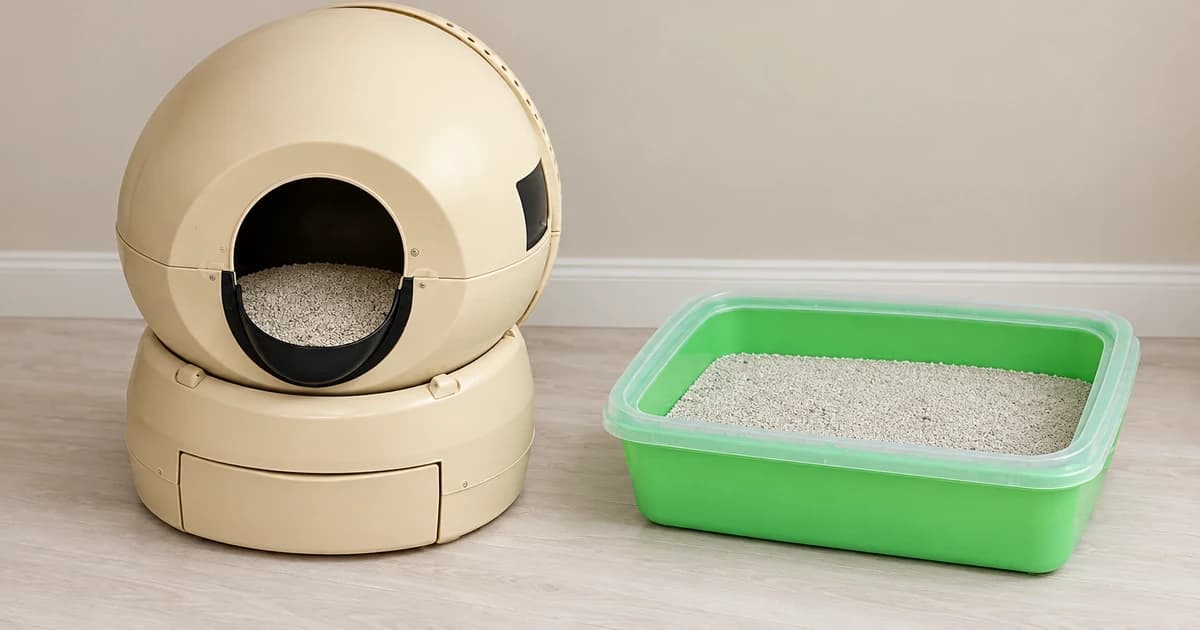
Established designs—like Whisker's open-front rotating globe on the Litter-Robot 4 or the open-top rotating sieve on the PetSafe ScoopFree SmartSpin—never seal off the exit doorway while turning. Even if every sensor failed at once, a healthy adult cat has an open archway to hop straight out. Where real-world trouble happens on legitimate machines isn't a closing door—it's underweight kittens that fail to trigger the scale, or carpeted floors that blind the weight sensors.
The "Smallest Cat in the House" Rule
Here is the trap we see multi-cat households fall into all the time: you buy an automatic litter box for your 13-pound adult tabby, set it up in the laundry room, and two months later you bring home a 2-pound foster kitten. Even if you put a tiny kitten tray in the bathroom, if that kitten can waddle down the hallway into the laundry room, your automatic litter box is no longer safe to leave in automatic mode.
Why? Because self-cleaning boxes rely on weight thresholds or age rules to know a cat is inside. Look at how two popular machines draw the line in their official support guides:
| Machine Model & Official Rule | Minimum Cutoff for Auto Mode | What You Have to Do If a Smaller Cat Lives With You |
|---|---|---|
| Whisker Litter-Robot 4 (Litter-Robot 4 FAQ) | At least 3 lb (1.4 kg) in weight. Below 3 lb, the SmartScale weight sensors cannot reliably register that a kitten is inside the globe. | Keep the unit powered off or unplugged. Let your cats use it like a regular unpowered pan, and only plug it in to run a manual clean cycle while you are standing right there watching the doorway. |
| PetSafe ScoopFree SmartSpin (SmartSpin Acclimation Guide) | At least 6 months old. PetSafe sets an explicit age threshold rather than just a pound rating for unattended operation. | Leave the SmartSpin unplugged until the youngest kitten turns 6 months old, running cleaning cycles only by hand when the kitten is out of the room. |
Notice that Whisker uses a weight rule (3 lb) while PetSafe uses an age rule (6 months). You cannot assume a 3.5-pound, 14-week-old kitten automatically qualifies for every machine on the market. Always check the manual for your exact model, and set your household rule by the smallest, youngest, or frailest cat that can reach that room.
Three Setup Mistakes That Confuse Weight Sensors
Even with a 12-pound adult cat, a weight sensor is only as accurate as the floor underneath it. When we first set up a globe-style unit, we pushed the back of the base lightly against the laundry room baseboard and left one front foot resting on the edge of a woven litter mat. Suddenly, the app failed to register half of our cat's visits.
To keep the scale and optical sensors working the way the engineers intended:
- Keep it off carpet and thick mats: Soft carpet pile or a foam mat underneath the base absorbs downward weight so the scale reads several pounds lighter than your cat actually is. Always set the machine on bare tile, vinyl, or hardwood—or buy the manufacturer's rigid carpet tray if you have no hard floor available.
- Leave two inches of breathing room around the shell: If the back or side of the globe brushes against drywall, a washing machine, or a hanging towel, friction supports part of the weight and prevents the pinch-detect bars or weight sensors from tripping cleanly.
- Wipe cat hair and litter dust off the top bezel: Curtain lasers (like Whisker's OmniSense optical sensors) sit right inside the upper lip of the entryway. A single cobweb or a layer of clay dust across that lens can trigger phantom pauses—or keep the optical beam from seeing a curious head poking in cleanly.
How We Introduce a Skittish Cat Without Scaring Them Off
Nothing ruins litter box habits faster than a machine suddenly groaning to life and spinning while a nervous cat is still sniffing the step. Both Whisker and PetSafe recommend the exact same trick we use at home: leave the machine completely unplugged for the first few days.
- Scoop a cup of used litter from their old pan into the new globe: Cats navigate by scent. Fresh plastic smells like a strange appliance; a scoop of their own clean-ish clumping litter tells them immediately what the globe is for.
- Keep their old open pan right next to it at first: Stop scooping the old pan quite as fast so the new, clean machine becomes the more appealing bathroom choice—never take the old pan away on Day 1.
- Run your first test cycles only when your cat is in another room: Once your cat is using the unplugged globe comfortably, run a manual cycle while they are eating in the kitchen so their first impression of the motor isn't a surprise ambush.
When an Automatic Box Is the Wrong Choice (Even for Adult Cats)
Mechanical safety isn't the only reason to keep a classic open litter box around. As feline welfare specialists at Cats Protection point out, a cat's comfort comes down to easy entry, room to turn around, and zero pain when squatting. High thresholds and enclosed globes can be tough on:
- Senior cats with stiff hips or arthritis: Climbing up a 7-inch step into a wobbling globe hurts sore joints. A low-entry open tray is far kinder for older cats.
- Large-framed cats (like Maine Coons or long-bodied mixes): If your cat has to curl their spine or press their tail against a plastic ceiling just to posture, they will eventually start peeing on the bathmat instead.
- Cats recovering from urinary blockages or GI flare-ups: When you need to monitor exact urine clump sizes or watery stool for your vet, an automatic box that dumps everything into a dark waste drawer makes it much harder to spot early warning signs until you open the bin.
Even in homes where our adult cats love their automatic box, we still keep at least one plain, open cat litter box in a quiet corner as a zero-stress backup—and follow a regular litter box cleaning schedule so a power outage or sensor fault never leaves anyone without a clean place to go.