Answering how often should you clean a litter box requires pairing each time interval with the exact equipment, part, and task: for a standard open or covered pan, scoop clumps and solid waste one to two times every day and empty the pan for a full wash every one to four weeks (at least weekly according to Cats Protection and International Cat Care). For a self-cleaning litter box, an automatic sifting cycle never replaces emptying the waste drawer or washing removable parts on that model's published schedule—and electronic bases must never be submerged or sprayed.
1. Master schedule: litter box cleaning frequency by device and task
Use this comparison table first to match your specific tray or powered unit to its published maintenance schedule and safety boundaries:
| Equipment & component | Specific cleaning task | Published frequency & source | Exceptions & critical boundaries |
|---|---|---|---|
| Standard litter tray (open or hooded pan) | Scoop solid waste and urine clumps using a litter scoop; top up litter level as needed | Twice daily (Cats Protection) or at least once daily (International Cat Care; AAFP/ISFM guidelines) | Scoop sooner whenever visible waste accumulates; daily scooping does not wash the tray floor or walls. |
| Standard litter tray (empty pan & detachable hood) | Empty all used litter, wash pan with hot soapy water or a cat-safe cleaner, rinse, and dry completely (how often to change a cat litter box) | At least once a week (Cats Protection; International Cat Care) or every 1 to 4 weeks depending on litter type and clumping vs. non-clumping use (AAFP/ISFM) | Wash immediately if the floor or walls are soiled; avoid harsh bleach, ammonia, citrus, or strong perfumes that can deter cats. |
| Whisker Litter-Robot 4 (removable globe vs. electronic base) | Basic globe cleaning and deep globe cleaning (Whisker Litter-Robot 4 care guide) | Every 1 to 3 months for basic globe cleaning; at least every 3 months for deep globe cleaning | Never submerge, spray, or soak the base or control panel; waste drawer emptying remains a frequent separate task. |
| PetSafe ScoopFree Clumping Self-Cleaning Box (tray, bin, rake, & sensors) | Disassemble and clean removable components (PetSafe ScoopFree Clumping guide) | Monthly full component cleaning alongside routine waste bin emptying | Unplug from wall and disconnect power first; tray, waste bin, and cover are hand- or dishwasher-safe, but the rake must be hand-washed only and all 6 sensors wiped dry. |
2. Step-by-step: how to clean a litter box (standard removable pan)
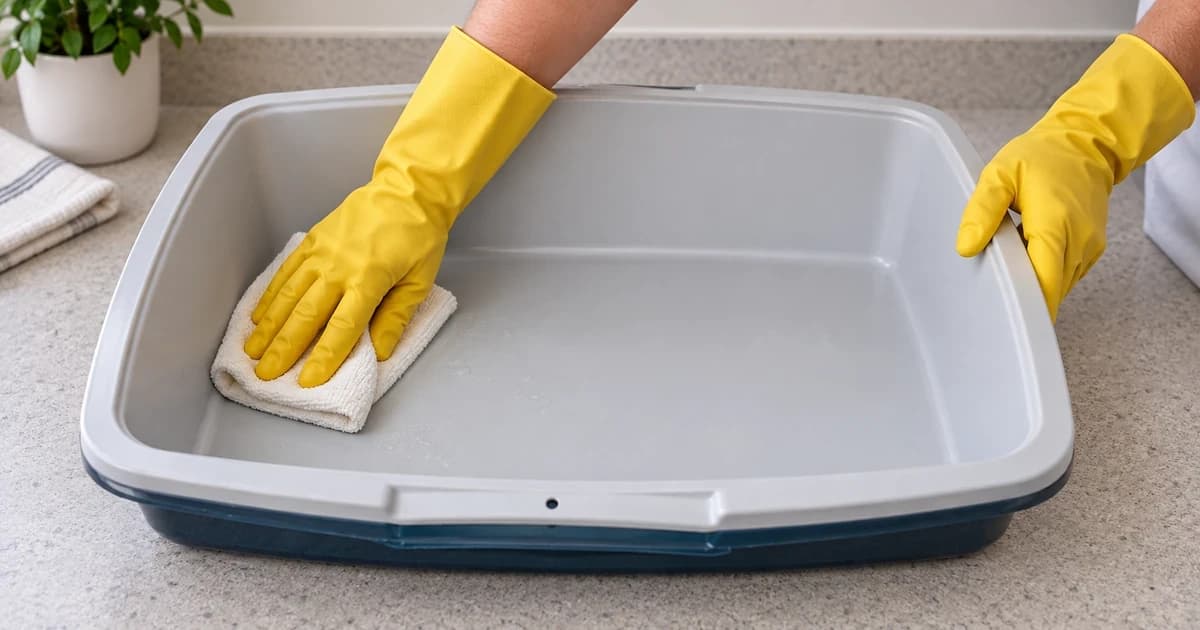
When performing a full pan wash on a non-electric tray, keep your cat out of the washing area and follow these five steps:
- Check cleaner compatibility: Use hot water and mild, unscented dish soap or a vet-approved cat-safe cleanser—fragrance is not proof of cleanliness and strong scents can cause box avoidance.
- Empty all used granules: Bag and dispose of old litter according to local waste rules rather than washing over a layer of remaining litter.
- Wash interior corners, walls, and rims: Scrub the tray floor, corners, and any detachable hood or rim clip with a dedicated sponge or soft brush that does not gouge the plastic.
- Rinse away all soap residue and dry completely: Rinse thoroughly with clean water and wipe or air dry the pan before refilling so fresh clumping litter does not stick to wet plastic corners.
- Refill to the recommended depth: When checking how much cat litter should i put in the box, follow your litter bag or pan fill line (typically 2 to 3 inches for standard trays, or the molded fill line inside an automatic globe). If you plan to switch formulas rather than refilling with the same brand, change litter type gradually so your cat is not surprised by an unfamiliar texture after a wash.
3. Keep powered components and sensors on their own checklist
Never treat an automatic unit as a single washable bucket. On the PetSafe ScoopFree Clumping model, for example, PetSafe instructs unplugging the unit, hand-washing the metal rake separately from the dishwasher-safe tray and bin, wiping all six sensors even when they look clean, and letting every part dry completely before reassembly. On the Litter-Robot 4, Whisker separates washable globe maintenance from the electronics housed in the base.
4. Use a four-field maintenance log card
To prevent a quick scoop from being misremembered as a full wash, track four fields on a note near your supplies: (1) Equipment & specific part (e.g., "Main hallway tray" or "LR4 globe vs. waste drawer"), (2) Task completed ("Scooped clumps" vs. "Emptied, washed, dried, and refilled"), (3) Date completed, and (4) Next scheduled check. See our editorial policy for how veterinary guidelines and product manuals are cited.