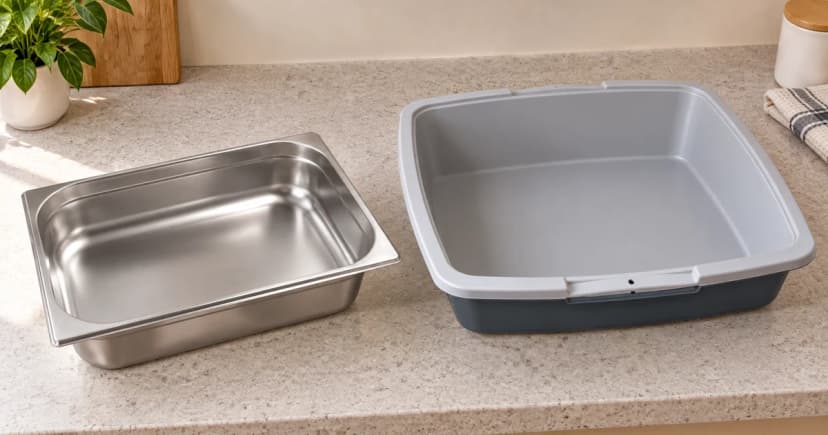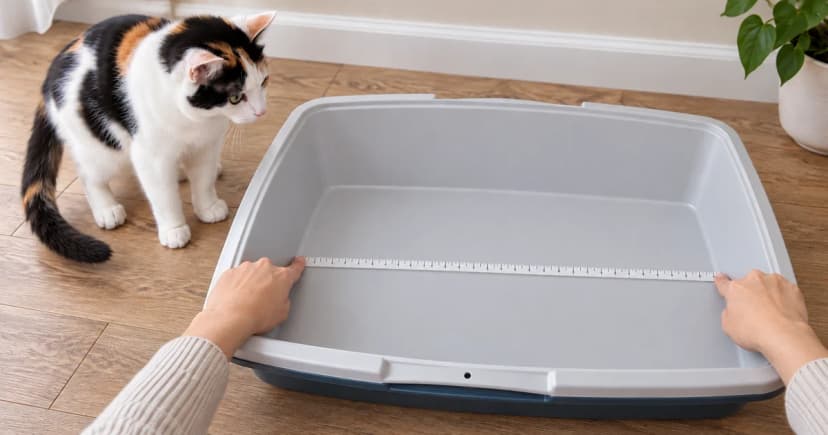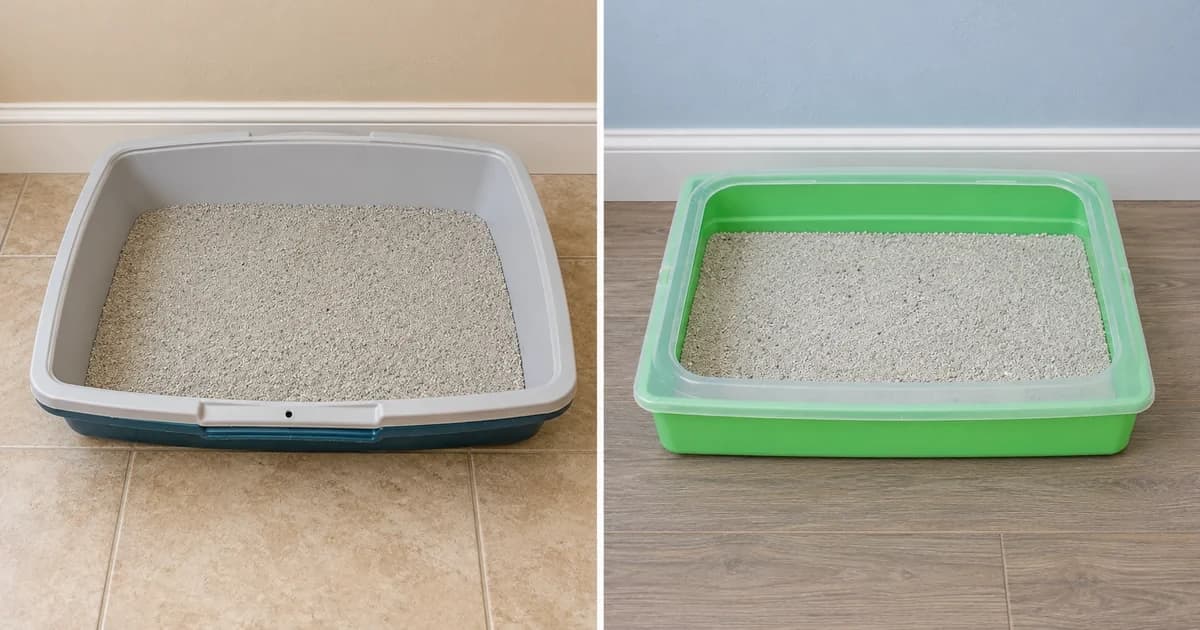
When asking how many litter boxes per cat a home needs, the widely cited veterinary starting rule is one litter box per cat, plus one extra, placed in separate accessible locations. That formula gives 2 boxes in separate accessible locations for 1 cat, 3 boxes in separate accessible locations for 2 cats, and 4 boxes in separate accessible locations for 3 cats. Because physical tray count and usable station count are not the same thing, a practical how many litter boxes per cat locations check must verify that trays sit in independent spots with unblocked approach routes across every floor your cats use.
Lining three plastic pans side by side in one laundry room provides three trays on paper, but only one shared toileting station in practice.
Use the “one per cat plus one” rule with separate locations attached
Both FelineVMA's Cat Friendly Homes litter-box guide and Cats Protection's toileting guidance start with one box per cat plus one additional box, placed in distinct locations around the home:
| Cats in the Home | Starting Box Count (n + 1) | Required Location & Route Condition |
|---|---|---|
| 1 cat | 2 boxes in separate accessible locations | Second box sits in a different room or level so a closed door or sudden noise never cuts off both options at once. |
| 2 cats | 3 boxes in separate accessible locations | Placed out of direct line of sight of one another so neither cat has to walk past the other through a single choke point to reach every box. |
| 3 cats | 4 boxes in separate accessible locations | Distributed across rooms and floors with independent entry routes and consideration for how the cats share space. |
Never assume an oversized pan or an automatic self-cleaning litter box replaces the extra location—hardware features do not create a second doorway when another pet or closed door blocks the room.
Map independent stations vs. shared doorway bottlenecks
Cat Friendly Homes advises placing boxes in separate areas out of direct view of other trays and away from dead-end corners where a cat can be trapped. Likewise, the Arizona Animal Welfare League's litter-box setup guide emphasizes keeping routes clear of dogs, young children, and routinely shut doors.
To see why physical tray count differs from independent station count, compare the two illustrative two-cat, two-floor, three-box floor plans below:
| Illustrative Two-Floor Layout (2 Cats, 3 Trays Total) | Upstairs & Downstairs Placement | Doorway Bottleneck & Closed-Door Effect | Effective Independent Stations |
|---|---|---|---|
| Scenario A — Downstairs trays share one room/doorway | Upstairs: 1 tray in quiet hall alcove. Downstairs: 2 trays placed in the same utility/laundry room reached through one doorway. | Both downstairs trays depend on the same laundry-room doorway. If that door latches shut—or one cat sits in the doorway—both downstairs trays become unreachable at once. | 2 stations when open; drops to 1 station if the downstairs utility door closes or is guarded (and 0 on the main floor for a senior cat that avoids stairs). |
| Scenario B — Three separate rooms & entry routes | Upstairs: 1 tray in quiet bedroom/hall corner. Downstairs Site 1: 1 tray in guest bath alcove. Downstairs Site 2: 1 tray in separate study/living zone with a different approach path. | Downstairs trays do not share a single hallway choke point or doorway; closing one downstairs door still leaves another downstairs station and the upstairs station open. | Up to 3 independent stations while doors stay propped open—still requires observing stairs comfort and social dynamics between the two cats. |
Check each floor without inventing a multiplicative formula (you do not automatically multiply cats × floors), while making sure every level has at least one accessible option—especially on the floor where a senior or mobility-impaired cat spends most of the day. Never carry or force a cat up stairs or into a tray to test a layout.
Account for multi-cat social groups without cutting resources prematurely
The 2021 AAHA/AAFP Feline Life Stage Guidelines state the one-box-per-cat-plus-one rule of thumb alongside social-group considerations when feline social groups are clearly established. Similarly, the Cat Protection Society of NSW multi-cat factsheet recommends one tray per cat plus one extra in separate spots so one cat cannot monopolize access to all trays.
Do not assume two cats belong to a single harmonious social group simply because they are littermates or occasionally sleep on the same sofa. Keep social-group compatibility marked as an open observation rather than an excuse to provide fewer boxes or cluster trays in one closet.
Keep a station-by-station household access log
For every existing or proposed tray location, record five practical checks:
- Floor and room: Exact level, room name, and how the door is kept from swinging shut.
- Entry and exit lines: Whether the cat has a clear sightline and more than one way around furniture, without passing directly in front of another litter tray.
- Bottleneck check: Whether two trays rely on the same narrow hallway, stair landing, or doorway.
- Observed traffic: Which cats voluntarily use the station and whether any approach is interrupted.
- Veterinary follow-up trigger: Any sudden toileting outside the box warrants a prompt veterinary check—never punish a cat or treat box counting as a medical diagnosis.
Match box dimensions and accessories to your verified locations
Once your station map is set, browse litter boxes and accessories to fit each room. Use our litter-box sizing guide to check usable interior length and entry height, and our litter-tracking guide for mat placement. Read our editorial policy on how we cite veterinary and welfare guidelines.