A cat litter scoop needs to do two jobs together: retain the waste you want to remove and let the litter you want to keep return to the box. Choose it for the litter you actually use, then check whether its head and handle can reach the box floor and corners comfortably. A large head, narrow slots or metal construction can each be useful, but none settles the choice alone.
Start with three questions: What is supposed to stay in the scoop? What is supposed to pass through? Can you reach it without levering against the box? These checks are more useful than picking a tool because its listing says “universal” or “extra large.”
Define the separation job before comparing slots
Read your litter's removal instructions first. With a clumping litter, you generally want to lift the formed clump while loose, usable litter falls back. With pellets or another non-clumping system, the material you remove and the material you retain may differ. A scoop cannot turn one maintenance system into another.
Look at the actual clean litter rather than its broad label. “Natural” could describe very different particle shapes. Catit's PIXI scoop, for example, is marketed with large openings for lightweight natural clumping litters. Litter-Lifter offers a separate Pellet-Scoop for pellet and thick litters. These are named product descriptions, not proof that every scoop with a similar appearance will suit your bag of litter.
Before shopping, write down the litter's name and whether the instructions call for removing clumps, solid waste, spent material or a combination. Keep the packaging available when checking compatibility. Changing the litter solely to justify a scoop purchase creates a second decision that this tool guide does not resolve.
Compare the openings and the material between them
The useful question is whether the material you intend to keep can pass through the openings while the material you intend to remove stays supported. Examine both sides of the scoop. Long slots, a crossing grid and parallel tines can have different support surfaces even when their outside dimensions are similar.
For a scoop you already own, inspect it clean and empty first. During ordinary use, notice whether loose clean litter remains in the bowl, whether small unwanted fragments fall back, or whether the openings bridge with material. These observations can narrow the problem. They do not establish a universal slot width or a controlled performance result.
| What you notice | What to inspect before replacing it |
|---|---|
| Much of the clean litter stays in the scoop | Opening shape and spacing, the underside, and the amount lifted at once |
| Small pieces you wanted to remove fall through | Whether that waste-removal job needs a different aperture pattern or the litter maker's method |
| Material lodges across several openings | Whether the slots match that litter's shape and whether buildup is obstructing them |
| The head reaches the clump but cannot get underneath it | Front-edge shape, head depth, approach angle and the box's access |
Do not read aperture width from a photograph without a scale. A listing's total width is also not a slot measurement. If compatibility is unclear and the seller cannot supply the missing information, treat it as an unanswered purchase question.
Choose a head that can enter, turn and lift
A broad head may carry a substantial load, but check the narrowest part of the route into your box. A hood opening, curved wall or internal partition can matter more than the pan's maximum width. You need space to place the head, approach the material and lift it out without catching the rim.
Compare usable head dimensions with total tool dimensions. Catit lists its scoop surface separately from the whole PIXI tool. That distinction helps you compare the working end with the box, rather than assuming the entire listed length is the shovel.
Bowl depth deserves the same attention. A deeper scoop can provide a retaining wall; a shallower design changes how you approach and lift. On its comparison page, Litter-Lifter describes a shallow head with parallel triangular tines and a scraping edge. The page also makes promotional speed claims. Use the stated geometry as a design example; it does not establish that this design is fastest or that a deep scoop is always the wrong choice.
If the opening makes access awkward, consider whether permitted removal of the hood gives you a workable cleaning position. Follow that box's instructions rather than bending the scoop or prying against its walls. For the broader pan and entrance decision, use our litter-box size and placement guide.
Check the handle and scraping edge as a pair
Handle length should help you reach the working area while keeping the head controllable. A longer handle alone does not establish a comfortable grip or good leverage. Check where your hand rests, whether the tool twists as you lift, and whether you can see the edge you are guiding.
Van Ness's long-handled Extra-Giant scoop combines an extended handle, a large head and an open grid. That is one configuration to compare with your access needs, not a prescribed size for every household.
Look at the edge that meets the floor, the connection between handle and head, and any coating. Metal is not permission to scrape aggressively, and plastic is not automatically too weak for your routine. Check the scoop and box makers' instructions for compatible use. Stop using a tool with a broken edge, loose joint or damage that interferes with normal handling; do not rely on more force to finish the job.
Make a practical shortlist without inventing specifications
When browsing Pawlivy's litter-scoop category, compare the features needed for your own setup:
- Litter compatibility: the exact litter or removal method the maker identifies, plus anything still unknown.
- Openings: their visible pattern, any supplied measurements, and whether clean litter and waste have the intended separation route.
- Head access: usable width and depth, approach to the floor, and clearance through your box opening.
- Handling: grip position, head-to-handle connection, and a controllable lift rather than the longest available handle.
- Care and storage: permitted cleaning, accessible surfaces and a place to keep the used tool away from unrelated household items.
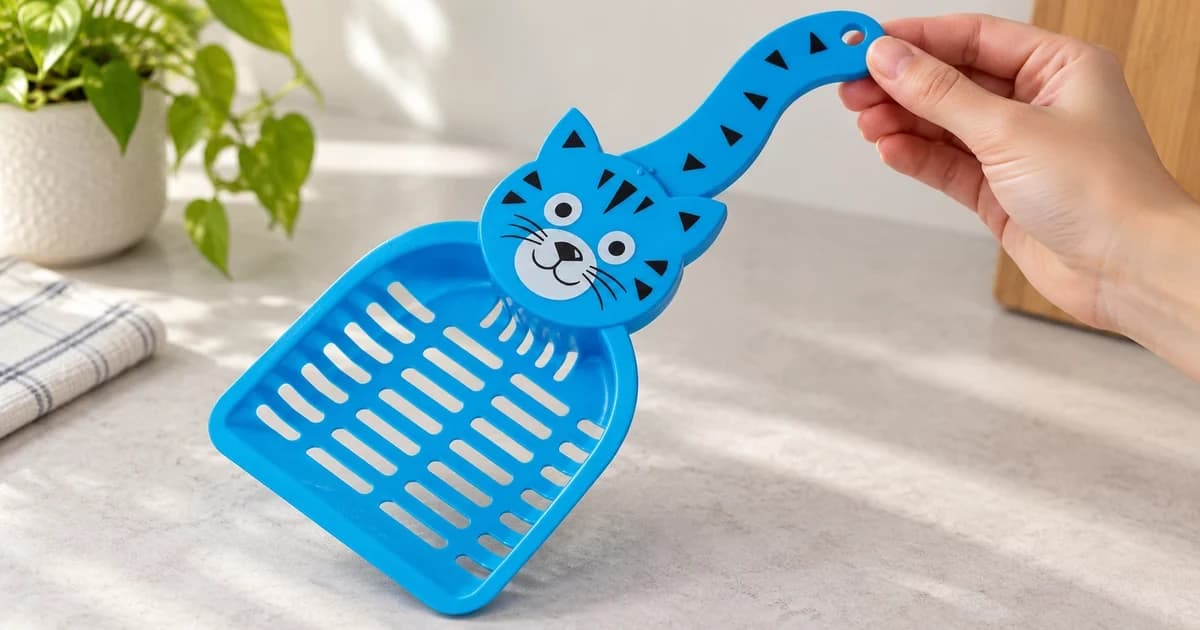
Record a missing slot measurement as missing. Do the same when a listing gives conflicting dimensions. The blue scoop in this article's edited illustration shows aperture and head geometry; it is not the aluminum scoop in the category and does not demonstrate litter compatibility.
Once selected, follow the tool and box instructions for use and care. For the separate question of how to organize routine removal, full box cleaning and parts care, see our litter-box cleaning guide. A suitable scoop makes the intended separation and access possible; your actual litter, box and handling determine whether that choice works in practice.