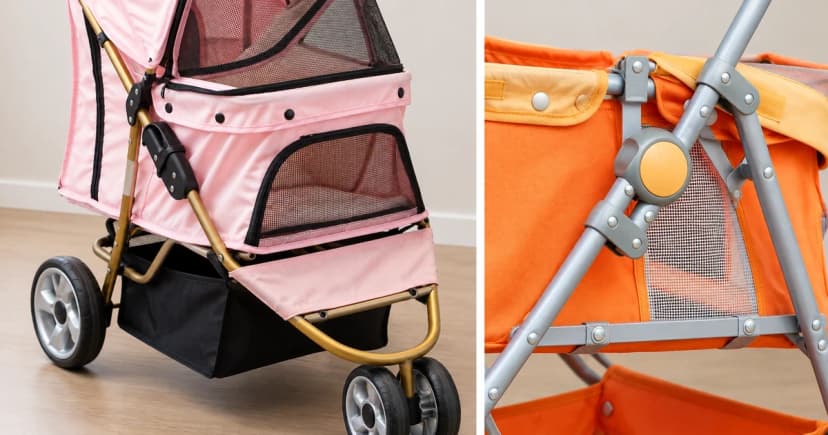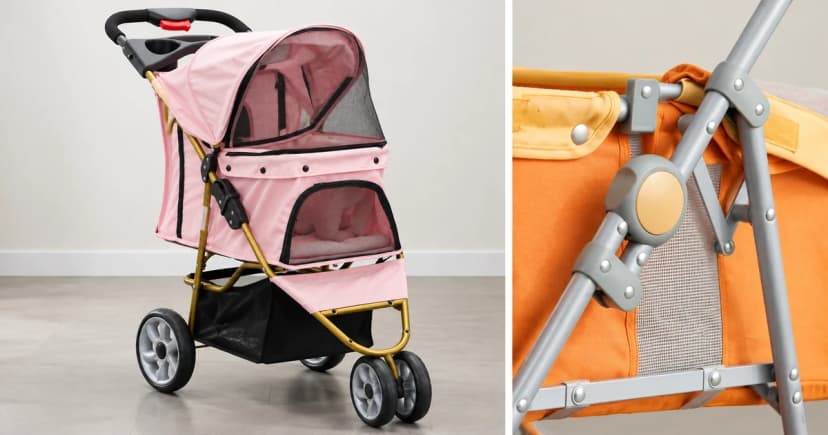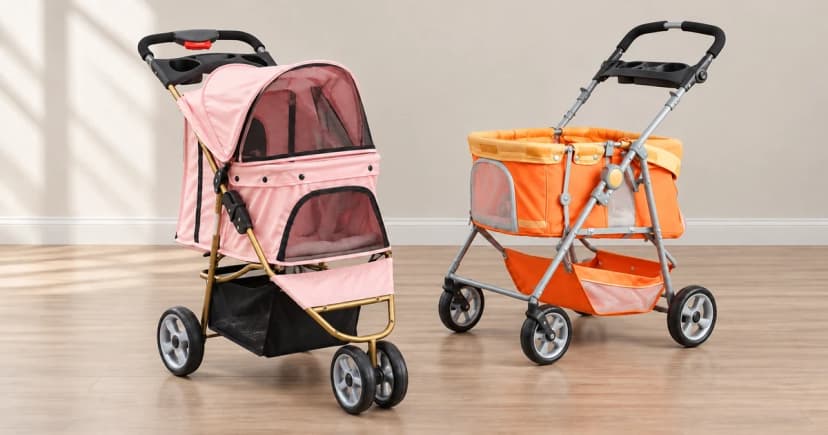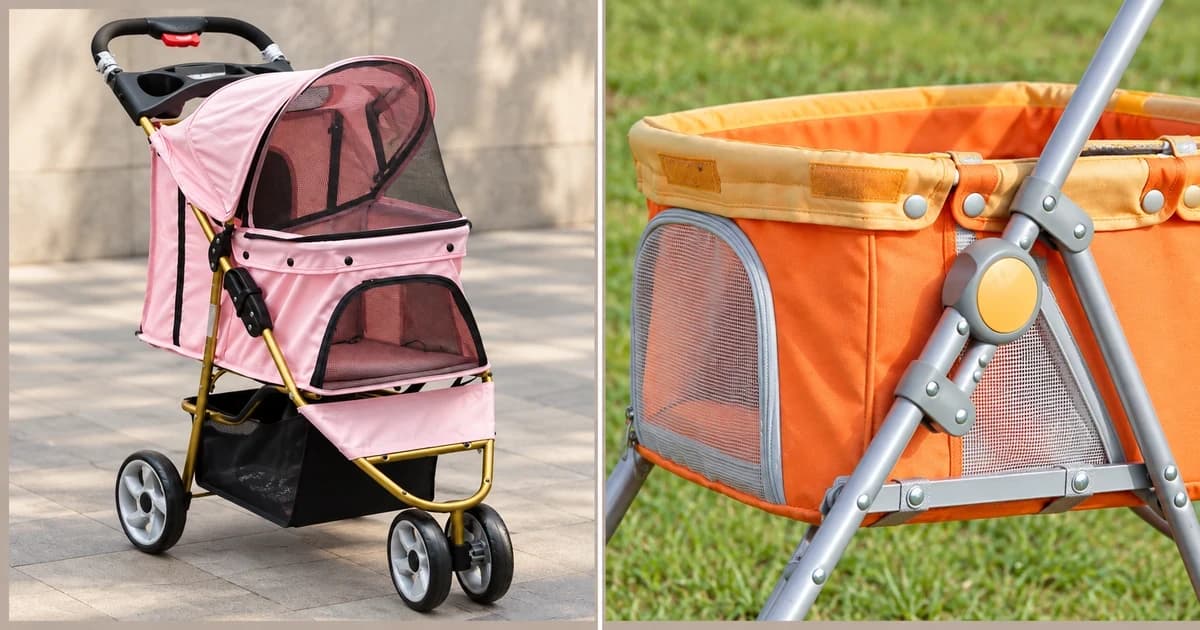
Learning how to get a dog used to a stroller involves more than putting the dog inside. Separate investigation, being in the cabin, changes to its enclosure and the sensation of moving. Watching an empty stroller roll nearby and riding inside a closed cabin are distinct movement paths with separate prerequisites, and every session ends by stopping completely, applying your model's parking method before unloading, and removing your dog before making any frame or folding adjustments. You can finish a useful session before taking a ride.
Prepare the equipment before inviting your dog
Find your model's occupant, restraint and operating instructions first. For example, the Pet Gear PG8250 manual requires engaged locks before loading, supervision and the parking brake when parked. Keep the pet clear during adjustments. Its limits belong to that model.
Our empty-stroller setup guide covers mechanical checks. Check any uncertain latch, restraint attachment or entry arrangement in your stroller's operating manual before passenger practice; willingness to enter cannot settle those mechanical points.
Let investigation stay voluntary
Begin with the assembled stroller stationary in familiar surroundings, with its parking brake applied. Let your dog investigate without requiring entry. Reward comfortable approaches. If your dog withdraws or seems uneasy, increase the distance rather than bringing the stroller closer.
InnoPet suggests familiar bedding or toys, but only add items your own stroller's instructions allow. The PG8250 manual restricts extra goods and accessories to those recommended in its instructions; a general familiarization tip does not override that model-specific restriction.
Build acceptance of the cabin and its closure
Use the entry and support arrangement allowed for your stroller, with your dog's cooperation. Do not force entry or staying. If your dog refuses, stop and return to outside investigation. Seek practical help if you cannot manage entry and exit.
When your dog accepts being inside, introduce the model-required harness, tether and cabin closure separately. If a change brings attempted exit or distress, stop and return to the accepted earlier stage.
Keep the two movement routes separate
The ibiyaya guide offers an earlier option: watch the empty stroller move while comfortable nearby. Keep room to move away and increase distance if uneasy. Do not progress to occupied movement while worried, and do not treat comfort around a moving empty stroller as readiness for an outdoor occupied ride.
InnoPet adds indoor rolling after accepted sitting and cabin closure. Begin with a short movement, then pause. If your dog becomes worried, stop and return to the easier accepted setup.
| Stage / Movement Branch | Prerequisite Before Starting | Accepted State to Record | Immediate Step-Back Point if Uneasy |
|---|---|---|---|
| Stage 1: Stationary outside investigation | Assembled stroller checked and parked with brake applied in a familiar room. | Approaches and sniffs willingly without retreating. | Increase distance from the stationary stroller; do not bring it closer. |
| [◇ Movement Branch A] Empty-stroller rolling observation (ibiyaya option) | Comfortable near the stationary stroller with room to move away. | Watches the empty stroller move nearby while remaining relaxed. | Stop rolling and increase distance; never jump from empty observation to occupied riding. |
| Stage 2: Voluntary cabin entry & sitting | Calm outside investigation with the stroller stationary and braked. | Enters via the permitted opening and sits comfortably in the open cabin. | End entry attempt and return to outside investigation. |
| Stage 3a: Model-required harness & tether | Relaxed sitting inside the stationary open cabin. | Accepts the model-required harness and interior tether attachment while stationary. | Unclip and return to unrestrained sitting in the stationary open cabin (or exit if unsettled). |
| Stage 3b: Cabin closure | Calm sitting with the required restraint attached in the stationary stroller. | Remains settled while the canopy or cabin closure is fastened. | Reopen the cabin and return to the accepted open-cabin stage before adding movement. |
| [◆ Movement Branch B] Short indoor occupied roll (InnoPet route) | Accepted sitting, restraint, and cabin closure inside the stationary stroller. | Stays calm during a brief indoor roll followed by a stationary pause. | Stop rolling immediately and return to the stationary accepted cabin setup. |
| Stage 4: Short quiet outdoor outing | Indoor occupied rolling and pausing accepted without signs of worry. | Remains comfortable during a short ride in a familiar, low-distraction outdoor spot. | Pause or return indoors to the last accepted stationary or indoor stage. |
| [✓ Finish Check] Parking, unloading & clear frame | End of any occupied stage or outing. | Stop completely, apply your model's parking brake before unloading, supervise exit, and keep your dog clear before any frame or folding adjustments. | Do not unload on an unbraked frame or adjust latches while your dog is inside or beside the hinges. |
Try a short outing, then finish deliberately
After the indoor stages are accepted, choose a familiar outdoor location with few distractions. Start with a short, manageable outing and keep watching your dog. Pause for suitable breaks instead of treating distance as the goal. A new setting can be harder even when indoor movement went well.
If your dog accepts an open cabin but withdraws during closure, return to that accepted stage before adding movement or outdoor changes.
To finish, stop and park using your model's instructions before unloading. Keep supervising while your dog exits through the permitted arrangement. Remove the pet before equipment adjustments; do not hang belongings from the handle or copy another model's brake direction.
Only then move to the separate empty folding and storage task. When comparing pet strollers, look for usable operating instructions and an entry arrangement you can manage, alongside what your dog actually accepts.