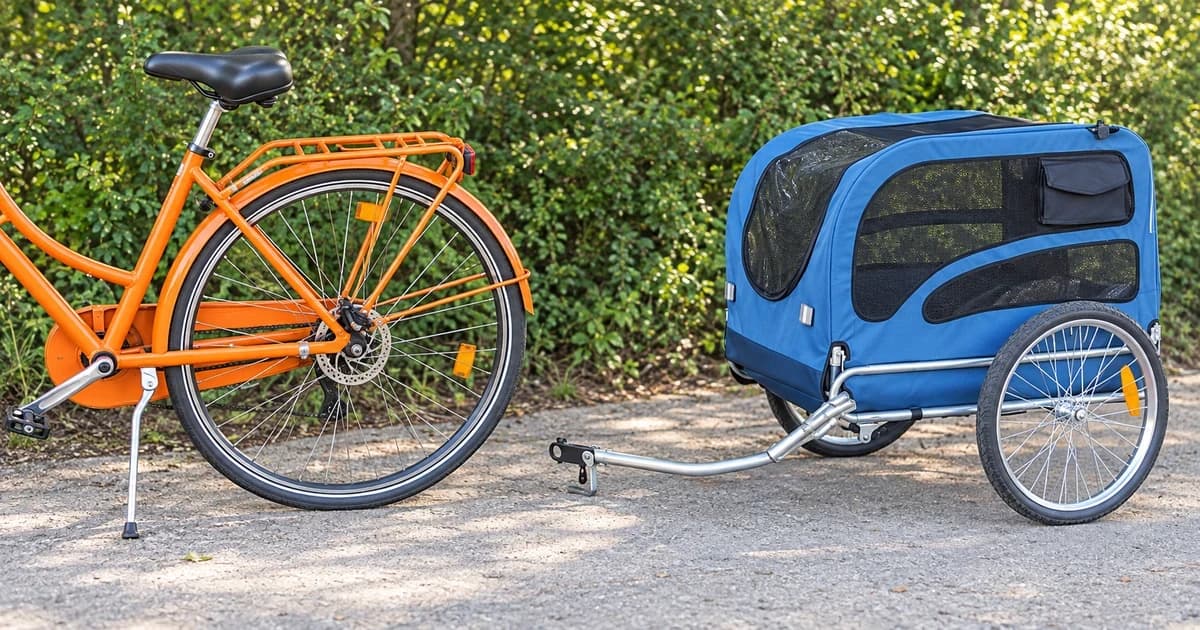
Check a dog trailer hitch against the exact bicycle rear axle, frame dropout and trailer hitch system before ordering parts.
A “universal coupler” title is not a compatibility report for your combination.
Start with two model records
Write down the bicycle's make, model and year, then the trailer's exact model and supplied hitch or part number. Find the instructions for both. Keep any axle or hub identification with the bicycle record rather than assuming that another bike with the same wheel size uses the same hardware.
Record changes from the original specification, such as a replacement rear wheel or axle, when you can establish them.
Category membership and published product descriptions establish a topic to investigate; they do not prove manufacturer identity, approved bicycle combinations or load and speed limits.
Identify the rear axle from documentation
The Burley hitch guide distinguishes quick-release, nutted and thru-axle systems. It describes levers on quick-release axles and on some thru axles, so one visible lever is not enough to settle the identification.
| Documented system | Information to record | |
|---|---|---|
| Quick-release skewer | The actual skewer/hub specification and frame clearance around the mounting location | Does this exact hitch arrangement use the supplied hardware, or a named replacement or adapter? |
| Nutted or bolt-on axle | The documented axle diameter, thread pitch and intended hitch position | Which specified part, if any, is approved for this axle and frame? |
| Thru axle | The stock axle identification, specified diameter, length and thread pitch |
Copy the manufacturer's dimension labels as well as the numbers. Different descriptions can measure a part differently; an unspecified overall length should not silently become a usable shaft length. A diameter alone does not supply thread pitch or resolve the complete match.
This record does not require dismantling the wheel to guess a specification. Use their stated identification method or ask a qualified shop.
Check the dropout and surrounding clearance
The dropout is the frame area where the rear axle connects. Burley's guide separates standard, hooded and open-horizontal designs. A protruding hood can affect where its Steel Hitch sits; its guide does not recommend axle-mounted trailers on open-horizontal dropouts.
Keep that restriction attached to Burley's system. Do not override it with another company's broad compatibility sentence or assume that a spacer cures every frame issue. If your frame differs from the examples, send its exact model and suitable photographs to the relevant maker or dealer.
Use the full fit table and adapter instructions together. Burley's guide includes both case-specific fit information and a broadly worded quick-release adapter section.
Keep each manufacturer's hitch solution separate
Croozer's hitch-selection page describes alternatives for thru axles, quick-release skewers and solid axles when its supplied Universal Hitch does not fit.
Those are Croozer options for Croozer equipment. They do not approve a Croozer part with an unidentified trailer, or establish that a Burley restriction no longer matters. “Practically any bike” is not a model-specific answer for the bike in front of you.
The Robert Axle Project KID214.F instructions provide another example of specificity: the document names a Kid Trailer thru axle for FOCUS R.A.T. 12x142 and BOOST systems and contains parts for different bike model years. It requires the correct stock thread pitch and the bicycle and trailer manufacturers' limits.
That document is not approval of any dog trailer, nor a generic installation procedure for all thru axles. Its torques, tools and assembly steps must not be transferred to another part. It calls for professional installation when an appropriate calibrated torque wrench is unavailable; follow the instructions that actually belong to your selected system.
Send a concrete compatibility question
A useful inquiry gives the manufacturer enough information to identify the combination:
- Bicycle make, model, year and the actual rear axle or hub identification.
- Documented axle dimensions and thread pitch, with their measurement labels.
- Dropout type and clear photographs of the intended mounting location.
- Trailer model, supplied hitch and any proposed exact adapter or replacement part.
Keep the reply and its conditions with the records. An answer about a similar bike or another year's model should not be represented as confirmation of yours.
Separate compatibility from installation and use
Once the combination is confirmed, follow the current bicycle, hitch and trailer instructions for installation and inspection. This guide supplies no torque recipe, drilling method or stack of improvised spacers. An unresolved mechanical question is a reason to obtain the correct advice before attachment.
Mechanical compatibility also does not establish the trailer's suitability for a particular dog or permitted riding conditions. Verify those separate limits from the exact trailer's instructions. No loaded ride or physical hitch test was performed for this guide.
The Pawlivy editorial policy explains how source-based guidance is described.