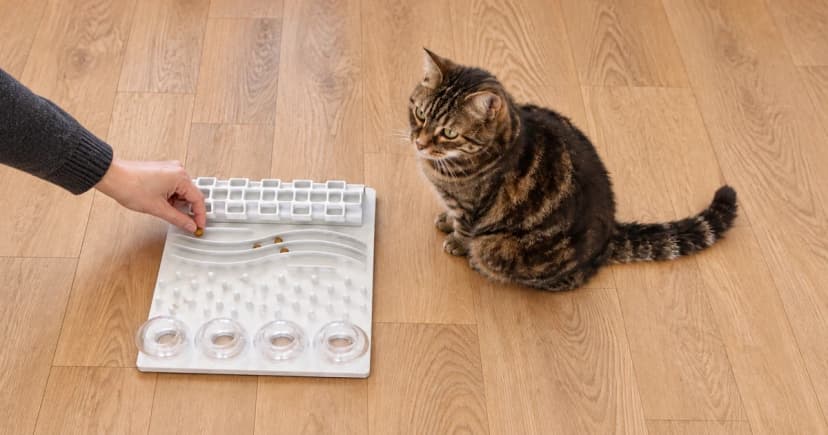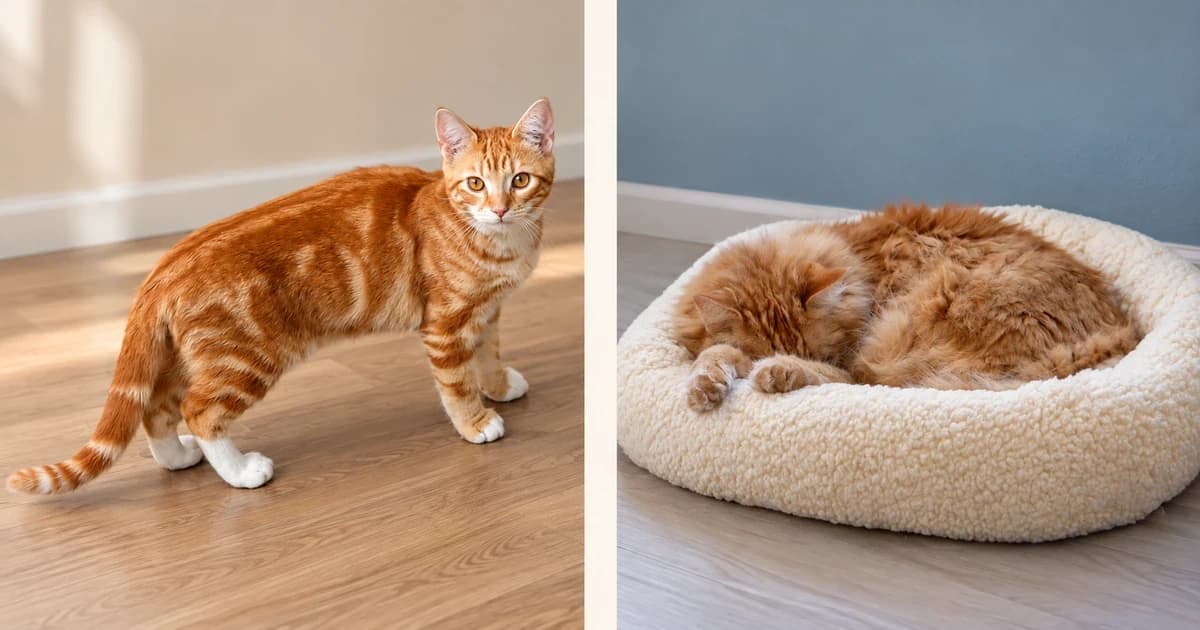
To introduce a new cat to your cat, begin with separate spaces and progress from scent to protected sight before voluntary, supervised meetings. Watch both cats, keep retreat available and return to an earlier stage when either struggles. Use their responses, not a deadline.
This guide covers an unfamiliar adult cat joining a resident adult cat. The practical goal is a manageable introduction with choices for both individuals.
Prepare two places the cats can keep using
Blue Cross’s introduction guide recommends a separate area for the new cat, preferably somewhere the resident cat uses little. Provide the new cat’s bed, food, water, scratching outlet and litter tray there. Both cats need their own accessible retreats as introductions progress.
Keep the resident cat’s access in mind as well as the new arrival’s room. Maintain separate feeding, drinking, resting and toileting options rather than making the cats share essential resources to meet each other. Allow distance and voluntary approaches; do not pick either cat up to bring them closer.
Use the home care plan for everyday responsibilities. For the separate number-and-location question, the guide to independent litter-box locations explains why counting trays alone does not complete the layout decision.
Offer scent with the choice to ignore it
Cats Protection’s staged approach uses a cloth to collect scent gently from a cat’s cheeks or forehead, then leaves it for the other cat to investigate or ignore. Do not make investigation compulsory. Progress to protected visual contact when neither cat reacts to the other’s scent.
Let a barrier provide sight without direct contact
Blue Cross describes short initial sightings through a barrier that keeps the cats apart. Leave space between them and access back to their separate areas. Let each watch from a distance and approach voluntarily. If either appears frightened or shows aggression, return to earlier separation and scent work rather than opening the barrier to finish the meeting.
Review both sides of the encounter. “The new cat approached” describes only one participant. Before another attempt, consider what the resident cat did, whether each could withdraw and which stage you actually reached. Advancing one cat does not require advancing the other.
Keep supervised meetings brief and optional
Battersea’s guidance moves from comfortable visual contact to short supervised meetings. Allow each cat to approach or leave; keep the settling room available. Do not restrain either with a lead, harness or carrier. Ignoring each other can be acceptable—you do not need to create a greeting.
Use the response to choose the next step
| What you notice | Next step in Battersea’s sequence |
|---|---|
| Staring, growling or hiding during visual contact | Return to scent familiarization. |
| The cats ignore each other during a supervised meeting | Keep interaction optional and the meeting short. |
| Persistent growling or aggression during meetings | Pause and return to an earlier stage. |
If conflict continues despite careful introductions, seek a qualified feline behavior professional. Health or welfare concerns also belong with your veterinary team.
For example, suppose the new cat investigates the cloth, but the resident cat hides when visual contact begins. Do not record the pair as ready because the new cat approached. Use the earlier stage indicated above, preserve their separate spaces and describe the different responses when asking for help. This is an illustrative decision, not a test to recreate or a diagnosis of either cat.
Keep a short account of the stage, what each cat actually did and what you changed. “Watched from the doorway, then walked away” is more useful than “passed.” Ordinary observations help you explain the situation; a completed note does not establish compatibility.
Cats Protection gives no predictable completion time. Some cats may never accept another cat; a schedule cannot promise friendship.