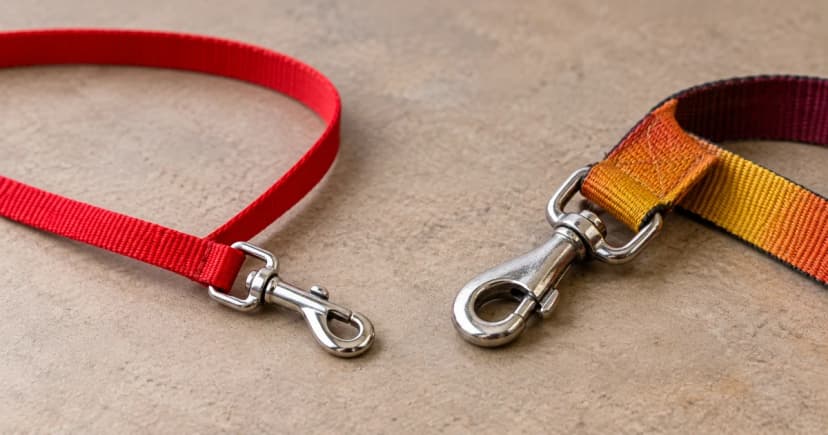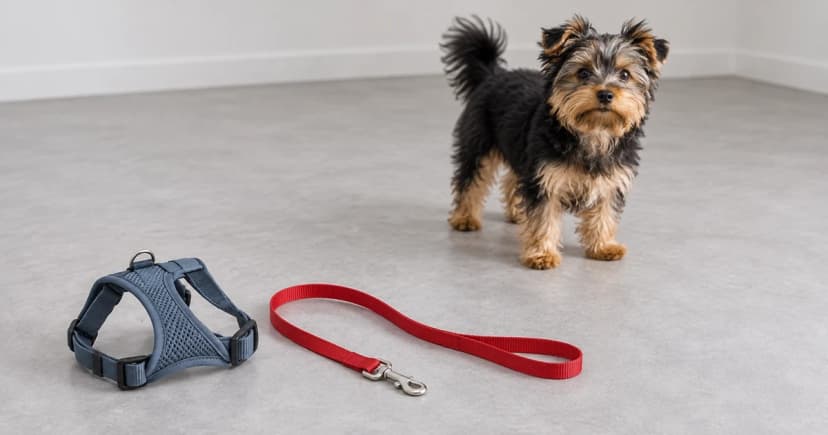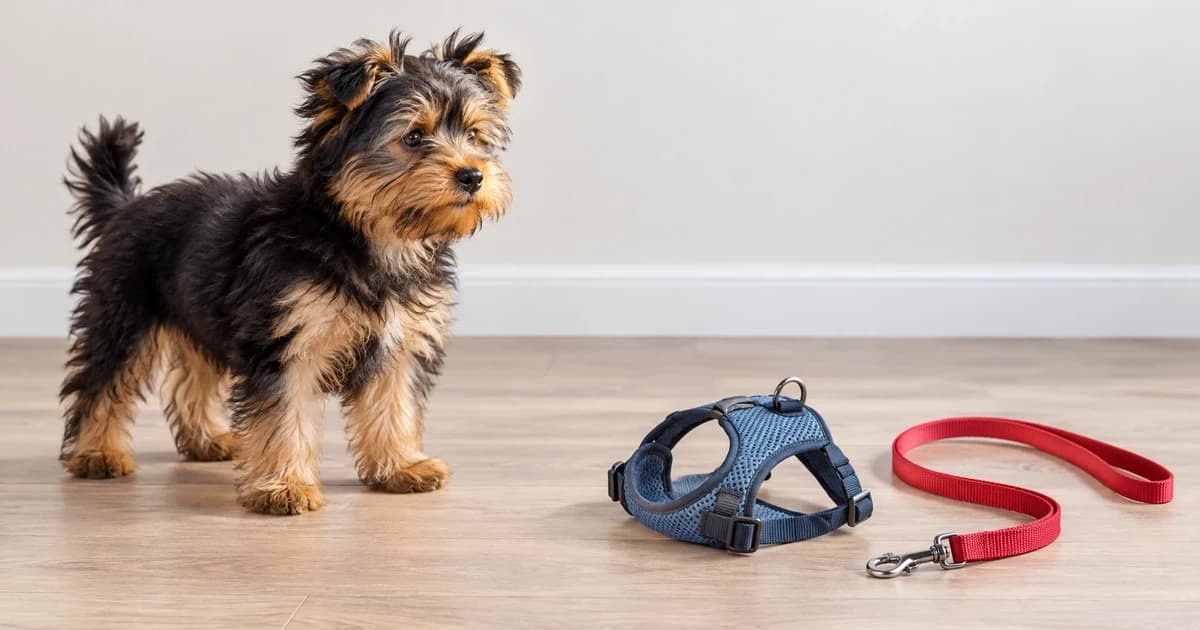
To leash train a puppy, start with comfortable, supervised introductions to the equipment, then reward a few steps near you while the leash stays loose. Practise in a quiet place and increase difficulty according to what your puppy is doing. Wearing a harness, accepting a clip and walking beside you are separate skills; completing one does not establish the others.
The first useful result may be a relaxed investigation of the leash rather than a walk across the room. This guide separates equipment acceptance from movement, so you can choose a smaller next step without imposing a deadline.
Prepare the equipment and the setting separately
Use ordinary walking equipment that fits your puppy now, following its own instructions for adjustment and the intended leash attachment. Our harness measuring and fit guide covers that physical check. A puppy willingly approaching a harness does not prove that its size or strap placement is correct.
Choose a quiet, contained space with room for a few comfortable steps. Put distracting loose objects away and have a suitable reward ready. Keep the session supervised; do not leave a puppy wearing an attached leash to drag around unattended. An introductory exercise is not a reason to let unfamiliar equipment become a chewing toy.
Indoor practice and readiness for public outdoor walking are different questions. Ask your puppy's veterinarian about appropriate places, outdoor timing and exercise for your puppy. There is no vaccination schedule or age-based walking allowance in this guide.
Let the puppy become comfortable before asking for movement
Dogs Trust's first-walk guidance introduces the collar, harness and lead in small stages at a pace the puppy finds comfortable. It describes rewarding a puppy for staying near the handler, then adding a step. For the lead itself, it starts with investigation and progresses to lifting and clipping it on, rewarding along the way. Its preparation takes place at home or in a suitable garden before outdoor walks, and it allows puppies to stop and investigate rather than pressuring them onward.
Use those distinctions to decide what to practise. If the sight of the equipment is already difficult, adding a fastening and asking for walking combines several new demands. Begin with the smaller encounter. Offer an opportunity to approach, keep your movements unhurried and reward comfortable participation. Moving away is a reason to pause and make the next attempt easier, rather than chase the puppy with the harness.
Once the puppy is comfortable with the equipment, follow its actual putting-on instructions. Keep accepting the equipment separate from teaching walking: fastening a clip is not a cue to pull the puppy into position. If touching, lifting or fastening is still difficult, stop at the last comfortable part and seek individual help if you cannot progress comfortably.
Reward a few loose steps
Begin with the puppy nearby and the leash held without a pull. Notice and reward the choice to remain near you. Take a small step and reward the puppy when they move with you while the leash remains slack. There is no need to demand a fixed shoulder position or a formal heel.
Watch the leash as well as the puppy. A puppy can be close yet leaning into tension, or slightly ahead while the leash is still loose. The goal here is comfortable movement together with slack, not a photograph-perfect pose. Keep the reward available promptly so the puppy can connect it with the action you wanted.
PDSA's loose-lead advice recommends quiet practice, rewarding walking with slack, and stopping forward movement when pulling begins. Once slack returns, reward and continue. It explicitly advises against yanking the lead back or telling the dog off for pulling. Its account stresses patience and consistency rather than a quick result. The article also discusses adult-dog exercise and off-lead activity; those suggestions are not a puppy exercise prescription or permission to practise off leash here.
If the leash tightens, stop your forward travel without jerking it. Give the puppy an opportunity to reconnect with you and restore slack before you continue. If this keeps happening, reduce the task: fewer steps, a quieter position or an earlier exercise. Repeated tension does not mean you need a stronger correction.
Choose between progressing, simplifying and ending
Blue Cross's dog and puppy training guide emphasizes prompt rewards, low distractions and short practice. It suggests sessions of about two to five minutes, alongside pausing when an exercise is difficult and making a later attempt easier. Its loose-lead section rewards walking alongside and stops forward progress when pulling starts. The suggested time is not a requirement to keep a worried puppy working until a timer finishes.
A comfortable repetition in one room does not establish the same skill beside an open doorway or outdoors. Change one demand at a time. Adding more steps and a busier setting together makes it harder to identify what became difficult. End before the exercise turns into a struggle; the next session can revisit an easier version.
| What you observed | What to record or reconsider |
|---|---|
| Equipment encounter | Which item and action the puppy accepted comfortably: approach, touch, lift or fastening. |
| Movement | Where you practised and whether the puppy chose to move near you. |
| Leash slack | Which moment stayed loose and what changed before it tightened. |
| Next attempt | One simpler action or one small increase, rather than a deadline to complete training. |
For persistent difficulty, a qualified trainer using reward-based methods can observe the equipment interaction and your timing directly. This general guide cannot diagnose fear, pain or another condition, and equipment acceptance is not a treatment. Ask your veterinarian about health or discomfort concerns. Off-leash recall and crate training remain separate tasks.
This is source-based guidance, not a training trial. Our editorial policy explains the use of sources.