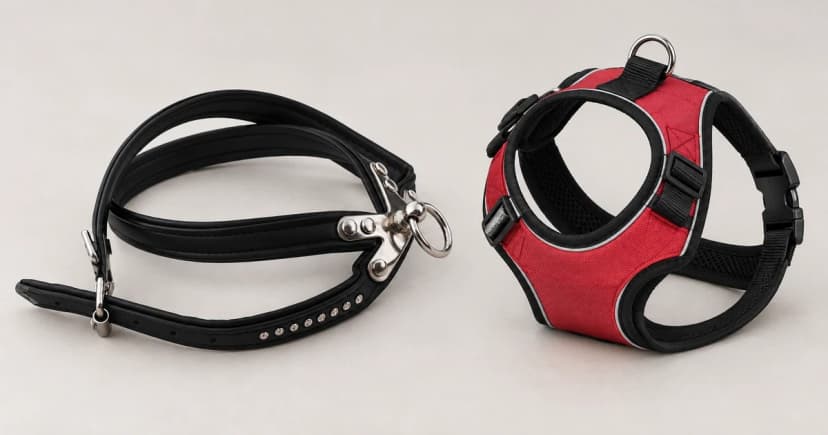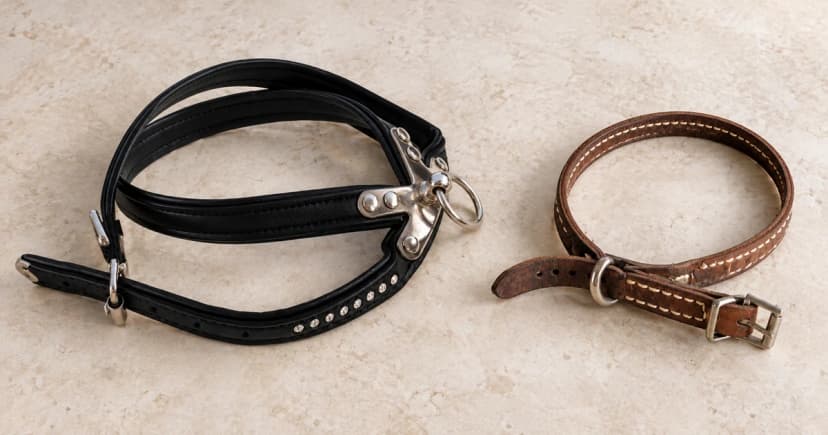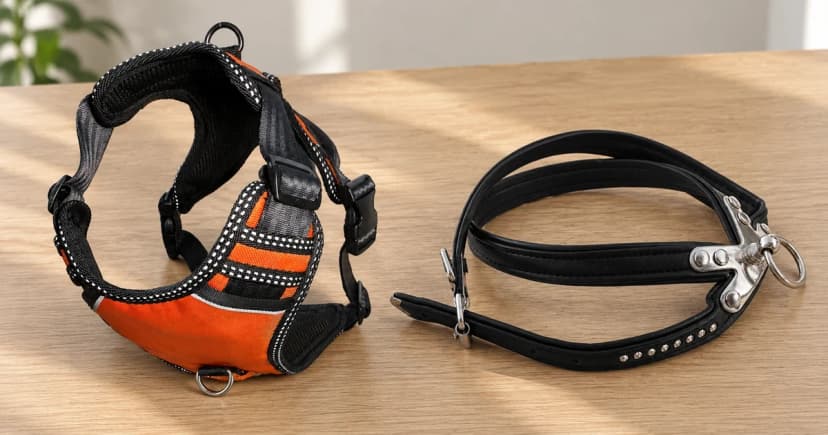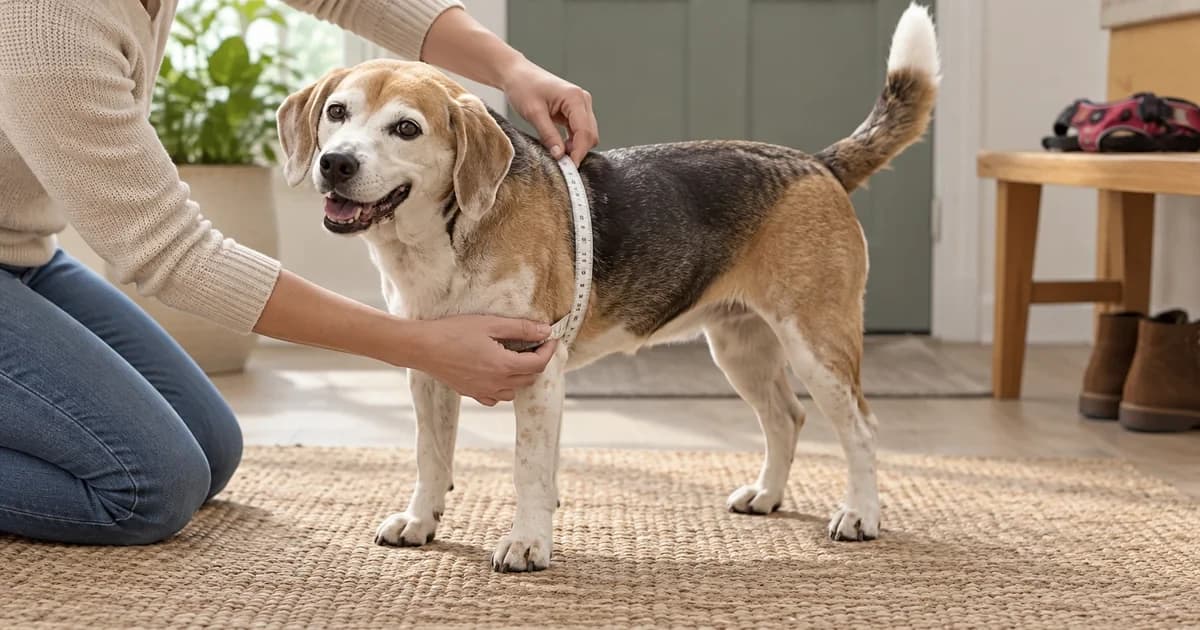
To measure a dog for a harness, wrap a flexible tape around the widest part of the ribcage, usually just behind the front legs. Measure the lower neck too if the harness manufacturer's chart asks for it. Compare those numbers with the chart for the exact model, then check the harness on your dog: a size-chart match alone does not establish a good fit.
For dog harness measurements, keep chest girth and any requested lower-neck measurement on separate lines. Match both to the same model’s chart before choosing a size, then check the harness on the dog. A chest measurement is a useful shopping record; it is not a substitute for the delivered item’s movement and fit checks.
The useful result is a small measurement record you can take shopping, followed by an indoor fit check before your first walk. This guide covers ordinary walking harnesses. It does not establish that a harness is suitable for vehicle restraint, lifting or leaving a dog tethered.
Start with the model's instructions
Open the size guide for the harness you are considering before measuring. Look for a drawing that shows each measurement, the units used and whether the chart describes the dog's body or the harness itself. A product labeled “medium” in one range can have different dimensions from a medium in another.
Ruffwear's measuring guide bases its harness sizes on chest girth. Kurgo's fit guide uses chest and lower-neck measurements alongside weight guidance. Those are instructions for those brands' gear; they do not create a universal pet harness chart. When browsing dog walking harnesses, save the exact chart with your measurements rather than carrying over a size letter from an older harness.
How to measure a dog for a harness: chest and lower neck
Use a soft, flexible measuring tape. A piece of nonstretch string can work when you mark its overlap and lay it against a ruler afterward. Measure in a quiet place on a surface where your dog can stand comfortably. If handling makes your dog anxious, pause and practice brief, comfortable contact rather than forcing the measurement.
- Find the widest ribcage. Look from the side and above. The chest measurement is usually just behind the front legs, rather than farther back at the narrow waist.
- Make a complete loop. Bring the tape around that part of the chest and back to its starting point. Check the hidden side too: a tape that slips toward the belly is measuring a different circumference.
- Follow the manufacturer's tape tension. Keep the tape against the coat without digging in. Do not add an automatic allowance unless the model's instructions call for one; a chart may already account for adjustment.
- Read the right scale. Record inches or centimeters explicitly. If you convert, 1 inch equals 2.54 centimeters. Keep the original reading so a rounded conversion does not decide a borderline size.
- Repeat to check the position. If the reading changes, reposition the tape and measure again. Write down the settled measurement and any uncertainty instead of averaging a chest reading with one taken around the belly.
- Measure the lower neck if required. Follow the model's diagram where the harness opening sits near the shoulders. That can differ from the narrower position of an identification collar. Kurgo and the AKC's harness selection guide describe this lower-neck measurement.
For a harness that must pass over the head, also check how its neck opening is put on and whether it opens with a buckle. A chest circumference does not tell you whether the dog will comfortably accept that fitting process.
Make a measurement record you can actually use
Copy this short worksheet into a note. It separates your dog's measurements from the seller's claims and keeps a missing dimension visible.
| Record | What to write down |
|---|---|
| Chest girth | Your reading, its unit and the tape position shown in the model's diagram |
| Lower neck | Your reading if required; otherwise mark it “not specified by this chart” |
| Model and chart | Exact harness name, chart link and candidate size |
| Adjustment ranges | Documented chest and neck range for that candidate size |
| Fit uncertainty | A borderline reading, an unlisted neck range or a concern about strap placement |
| After trying it on | How it sits, moves and adjusts on your dog |
Weight and breed can help identify what to investigate, but do not substitute them for the dimensions the manufacturer requests.
Handle overlapping sizes without guessing
Compare every required body measurement with the same candidate size. A chest that fits one row and a neck that fits a different row do not combine into a documented fit.
Here is an illustrative dog, not a measured test subject: chest 25 inches and lower neck 14 inches. The chart in Kurgo's linked guide gives small as chest 16–22 inches and neck 12–20 inches; medium as chest 18–28 inches and neck 16–25 inches. Small covers this example's neck but not its chest. Medium covers its chest but not its neck. Neither row documents both measurements, so “just go up a size” does not solve the mismatch.
Kurgo's advice to choose the larger overlapping size applies when both the neck and chest fall within both size ranges. Keep that condition attached to the advice. For another model, use its own instructions. Ruffwear also recommends using a puppy's current measurements; buying a size for a much larger future dog does not show that it fits today.
Check the delivered harness on your dog
Keep your dog in a secure indoor space while you adjust the harness according to its instructions. Do not begin the trial next to traffic or with an open door. Fasten the intended closures, and attach a walking leash only to a point the maker identifies for that purpose.
The AKC's guidance on fit emphasizes free movement, avoiding pinching and keeping the girth strap away from the elbows and soft abdomen. Use those observations with the model's fitting instructions:
- At rest: check that straps and panels sit where the maker shows them, without twisting or pressing into the throat.
- During movement: let your dog walk and turn normally. Watch the front legs, the areas behind them and whether the harness shifts substantially.
- Across adjustments: check whether the candidate fit depends on every strap being at its limit. If you cannot achieve the documented position, reconsider the size or design.
- After a short supervised trial: remove it and inspect contact areas for rubbing, redness or fur being trapped.
A finger-gap check is a rough fitting aid. Finger size, coat and harness construction vary, so it cannot guarantee that a dog will not back out. Stop using a fit that slips, pinches or interferes with normal movement. For persistent rubbing, pain or a medical condition affecting equipment choice, ask a veterinarian who knows your dog.
Keep the fit record current
Recheck after growth, a substantial grooming change or a change in body size. Keep the harness model and adjustment notes with the measurements so you can compare the same setup. An old size letter is less useful than knowing where the straps sat and which adjustment range worked.
When you compare the wider walking gear collection, separate three questions: does the chart cover the required measurements, can this design be put on comfortably, and does it fit during normal movement? A clear answer to each is more useful than a universal promise about a size or style.