To trim a cat's nails, first decide whether trimming is needed, prepare clippers made for cat claws and wait for comfortable, willing handling. Gently expose and inspect one claw, identify the tip and avoid the quick inside it. Clip only a clearly identified tip. Pause whenever your cat is uncomfortable, and ask your veterinarian or vet nurse for a demonstration if you cannot see what to cut or cannot handle the paw comfortably.
You do not need to finish every claw in one sitting. This is a source-based preparation and handling guide, not a substitute for an individual demonstration or advice about an injured or abnormal claw.
Check the need before reaching for clippers
Cats Protection's claw-care guidance explains that many cats maintain their claws through normal scratching. Some older cats or cats with mobility problems may need help. Do not make a fixed trimming schedule the starting point for every cat.
Look at the cat's usual condition and behavior. Claws catching on fabric, difficulty retracting them or a visible change deserve attention, but those observations do not diagnose the cause. Cats Protection advises veterinary assessment when claws change or may be growing into a paw pad. Blood, swelling or a suspected ingrown claw belongs with the veterinary team, rather than a more ambitious home trim.
Keep suitable scratching opportunities available. If the equipment question is how to choose and introduce a scratcher, see our separate guide to helping a cat use a scratching post. That does not replace checking an individual claw that concerns you.
Prepare the tool and the setting
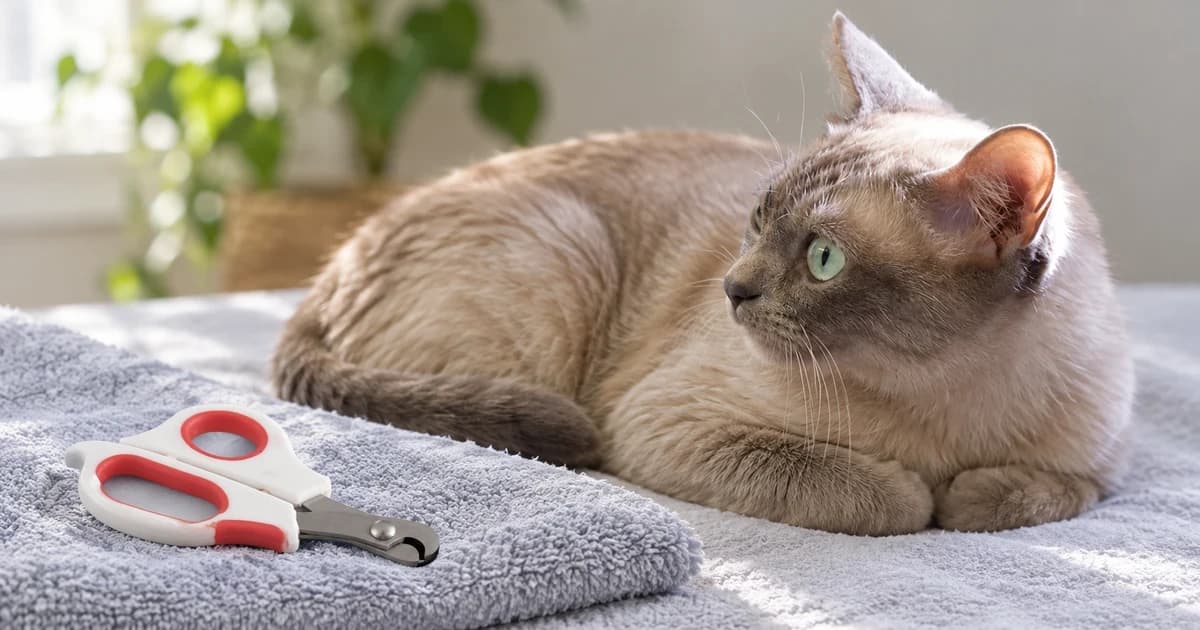
The PDSA veterinary team's cat-claw instructions call for cat nail clippers, rather than household scissors or human nail clippers. Cats Protection also recommends tools made specifically for cat claws.
Gather the clippers and the reward your cat normally accepts before beginning. Choose a quiet, familiar setting with a comfortable resting surface. Let your cat investigate the tool if interested; presenting it is different from immediately holding a paw and cutting.
Our nail-clipper category contains mixed dog and cat listings. A shared species tag, an LED or a guard claim cannot prove that a particular model fits your cat's claws or prevents cutting the quick.
Build comfortable paw handling first
In its 2020 veterinary Q&A on cat claws, PDSA recommends getting the cat used to gentle paw contact before clipping and stopping when the cat becomes uncomfortable or stressed. That article's handling advice is useful here; its pandemic-era access discussion and UK legal statements are not current US instructions.
Begin with brief contact your cat accepts, followed by an appropriate reward. If the cat withdraws, pause rather than tightening your grip. Being able to touch the paw comfortably is a useful preparation step; it does not guarantee that the cat will accept the clippers.
If another person helps, the job is to support a calm experience, not force completion. Ask your veterinary team to show an appropriate position for your cat when you are unsure. A photograph of someone holding a cat cannot establish that the cat was comfortable or that the restraint should be copied.
Expose and inspect one claw gently
- Check that your cat remains comfortable. If handling is becoming a struggle or the cat is trying to leave, stop before progressing.
- Hold the paw gently. PDSA describes gentle pressure on the toe to reveal the claw; Cats Protection emphasizes very light pressure without squeezing.
- Identify the tip and the quick. The quick contains blood vessels and nerves and may appear pink inside a light-colored claw. It can bleed and hurt if cut.
- Proceed only when the cutting area is clear to you. Use the cat clippers to remove the very tip while staying away from the quick.
Do not use a universal number of millimeters or a picture's drawn line as your cutting target. The actual claw, visibility and your ability to handle it matter. This guide does not supply a cut line for dark or unclear claws, and a tool light is not a substitute for knowing what you can see.
Choose proceed, pause or help
| Current situation | Decision | Useful next step |
|---|---|---|
| Your cat accepts paw handling and you can clearly identify the tip and avoid the quick | Consider one careful tip trim. | Observe the response before deciding whether another claw is appropriate. |
| Your cat withdraws, becomes uncomfortable or tries to leave | Pause. | Release the paw and let the interaction end; return to comfortable preparation another time. |
| The cutting area is unclear, handling is difficult or the claw looks abnormal | Ask for veterinary help. | Arrange advice or a demonstration rather than experimenting with grip, tool features or a deeper cut. |
This is a decision aid, not a test that certifies a claw or a handling position as safe.
A short session can be enough
The PDSA Q&A describes starting with one claw and stopping immediately if the cat is unhappy or trying to leave. Cats Protection also recommends spreading the work out and respecting the cat's response to a reward. A cat may prefer a treat, a familiar game or simply time alone.
Do not turn a count of completed claws into the goal. Stop if there is bleeding and contact your veterinarian for advice. This guide does not provide a home bleeding-treatment recipe, medication or sedation instructions.
Pawlivy has not performed a trimming test or claimed veterinary review of this article. Our editorial policy explains the distinction between linked veterinary sources and editorial guidance.