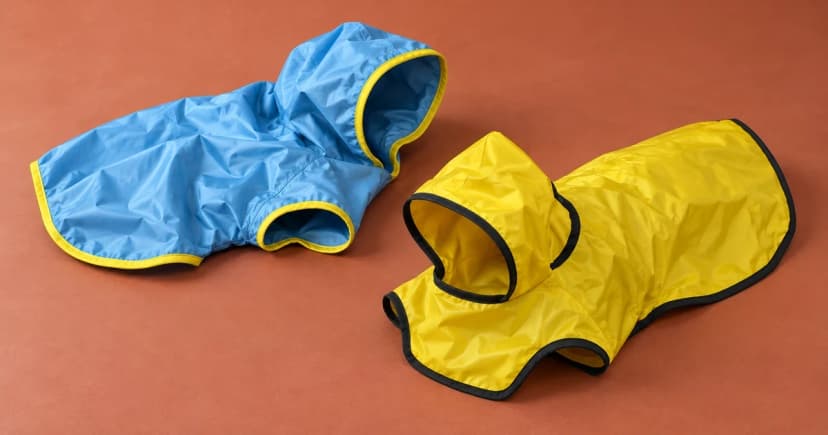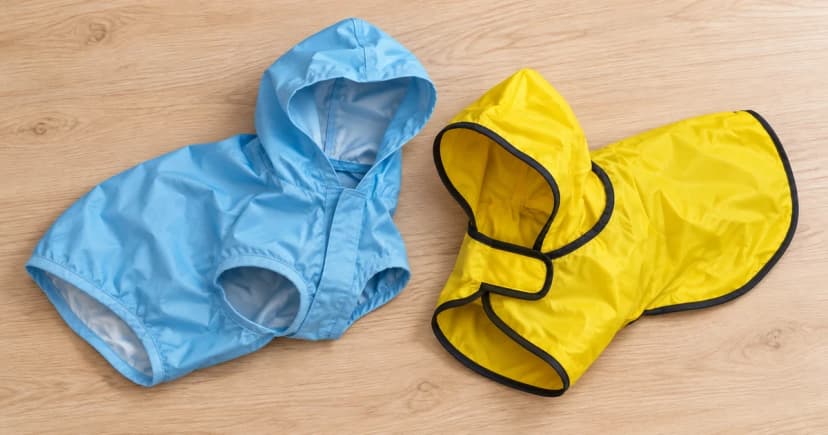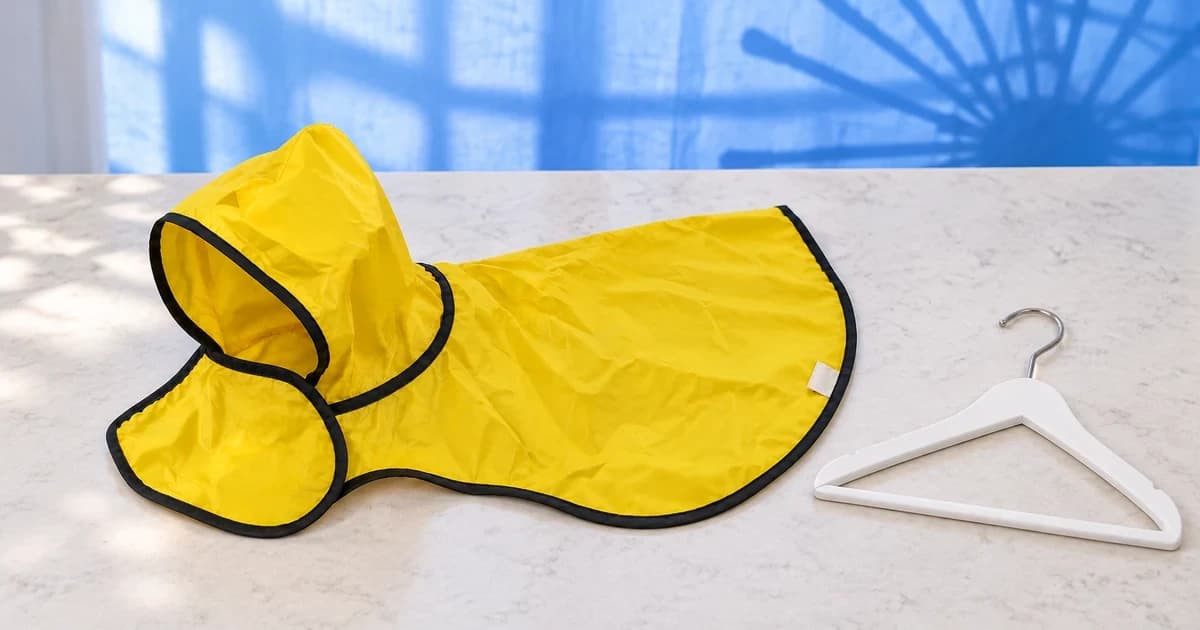
Wash a dog raincoat using the instructions for that exact garment, including its drying method. Some raincoats permit a cold, gentle machine cycle; others specify hand washing. Before adding water, identify the coat, read its sewn-in label and check the lining, closures and any removable pieces. A similar-looking shell is not enough to choose a laundry program.
The useful outcome is a clean, fully dry garment with a care method you can repeat. Start by separating two decisions: how the coat may be washed, and how it may be dried. If either instruction is missing, resolve it with the maker rather than borrowing the setting from another coat.
Two raincoats can need two different laundry plans
Consider an owner sorting two muddy coats. Both are sold as rain shells, but the manufacturer's instructions send them down different paths:
- Ruffwear Sun Shower: the current product care instructions specify securing the fasteners, washing in cold water on a gentle cycle with mild detergent, and hanging to dry. They prohibit bleach, ironing and dry cleaning.
- Kurgo Halifax Rain Shell: the inspected product page specifies hand washing. That page does not provide a water temperature, detergent choice or drying procedure; the owner needs the garment label or further model-specific guidance for those details.
This is an example based on published instructions, not a cleaning test or a recommendation to buy either coat. The owner's next step is to put them in separate care groups. A shared color, fabric description or “waterproof” label does not make the Sun Shower settings suitable for the Halifax.
Use this same distinction when browsing raincoats and rain suits: check whether the care information covers the complete garment, rather than assuming a shell-fabric description includes the lining, straps and hardware.
Find the instructions while the coat is still identifiable
Lay out the empty garment and locate the care label. Save a readable photograph of it alongside the product name and, when available, its model or version. A general brand washing article can help you understand the process, but the instructions attached to your particular coat are the starting point.
Hurtta's apparel care guide makes this distinction explicit: some of its products are hand-wash only, while others allow machine washing with the temperature and spin settings on the individual label. It does not establish one laundry program for all dog clothing.
Write a short care note before you begin. It should answer these questions:
- Which coat is this, and which label or current model page supplies the instructions?
- Does the method cover the whole garment, or a separately removable component?
- What wash method, temperature, detergent and machine settings are actually specified?
- What drying method is permitted, and where will the garment be supported?
- Which details still need confirmation?
For the Sun Shower example, the note can record cold water, gentle cycle, mild detergent and hang drying. For the Halifax example, it can record hand washing and leave the other fields unanswered until the label or maker supplies them. Filling those blanks is more useful than creating a plausible-looking recipe.
Prepare the whole coat, including the less visible surfaces
Open the garment enough to see its construction before following the maker's fastening instructions. Identify the outer shell, inner lining, belly panel, seams, closures and any loops or cords. If a pad or liner appears removable, check whether the instructions actually permit removal and describe separate care; do not take stitching or fixed hardware apart to make washing easier.
Hurtta advises removing loose hair, mud and sand before washing, then securing buckles, zippers and hook-and-loop strips. Follow the directions for your own coat's closures. Check folded edges and the underside as well as the large back panel, and note areas that need attention during the permitted wash.
This is also a good moment to distinguish dirt from a construction problem. A mark and a lifted seam edge are different observations. Cleaning instructions do not establish permission to glue a seam, replace hardware or alter an opening.
Run the wash method that belongs to this garment
If the label allows machine washing, translate its instructions into the available controls on your washer before starting. Confirm the water setting, cycle and any spin restriction separately. A cycle named “delicate” still needs to match the garment's specified settings; the name alone does not complete the care note.
If the label requires hand washing, keep that coat out of the machine-wash group. Use the model's instructions for water, cleaning product, treatment of dirty areas and rinsing. A hand-wash-only statement does not supply an approved soaking time or a stain-removal mixture.
Keep the instructions nearby until the washing is finished. If an unexpected lining, fixed attachment or conflicting instruction changes the plan, pause and resolve the question. There is no need to add an extra treatment simply because a stain remains; check what the maker permits for that particular surface.
Choose the drying support before hanging the coat
Drying deserves its own decision. For the named Sun Shower, the documented method is hang drying. Do not turn that instruction into permission to tumble dry, iron the garment or use a heated drying method.
For Hurtta apparel, its care guide recommends air drying on a hanger or clothesline and warns against hanging wet garments by their drawstrings or leg loops. Those small parts should not be mistaken for drying supports. Choose the support described for your own coat and allow access to its lining and folds.
Inside-out drying is another model-and-construction question. Hurtta discusses turning thicker waterproof garments inside out for drying, but gives separate handling instructions for thermal foil layers. Read the relevant label before changing the garment's orientation. You cannot settle that decision from the outer color or the word “raincoat.”
Check the dry garment before putting it away
Ruffwear's apparel cleaning guidance calls for complete air drying before storage. Check the less exposed lining, folded panels and areas around closures, rather than judging only the broad outer surface. A fixed drying time would leave out the differences between garments and drying conditions.
When the coat is dry, compare its construction with your earlier observations. Check that the closures operate as described and that no removable piece has been left out.
If laundering reveals a different fit or an awkward opening, use the dog clothing measurement and fit guide to reassess the garment. Extra washing does not solve a sizing problem.
Save the completed care note with the coat. That makes the next wash easier, and gives you specific questions to compare when choosing other dog clothing. These instructions are a source-based equipment guide; our editorial policy explains how we use manufacturer information and handle corrections.