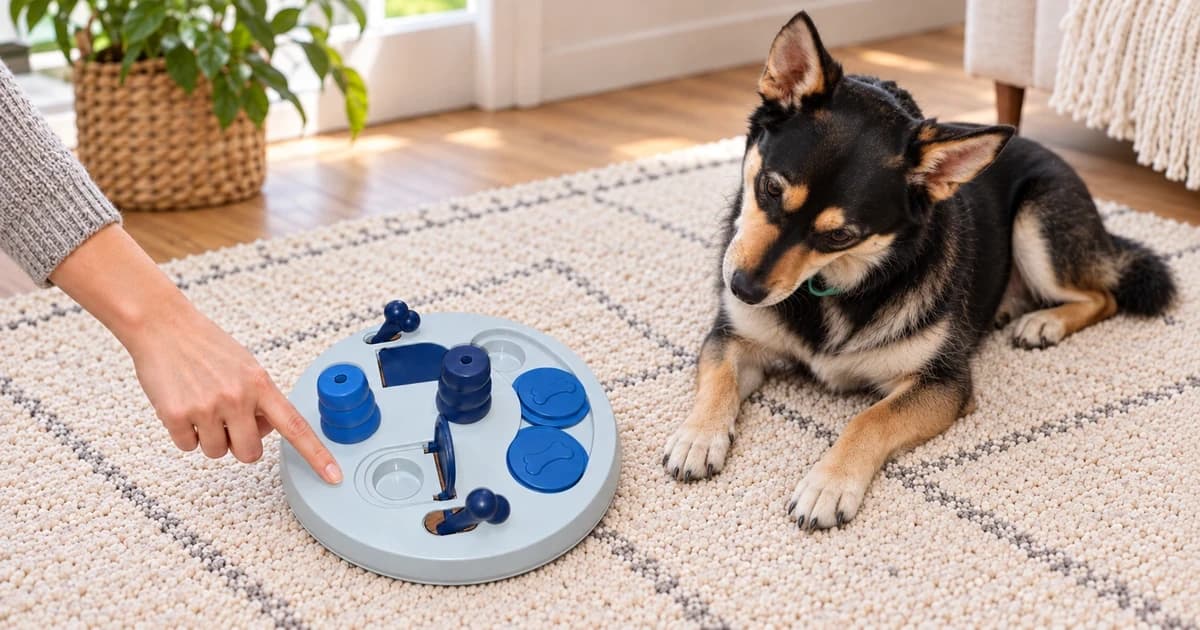
Introduce a dog puzzle by making one retrieval action clear before adding another obstacle. Identify what the original parts do, choose an easy configuration described by the maker, show the movement and let your dog investigate voluntarily. Increase the challenge only when the current action makes sense to your dog.
A printed level number does not tell you whether your dog already understands that movement. This guide focuses on first use and adjustment of mechanical puzzle equipment; it does not measure intelligence or prescribe a feeding or behavior-treatment program.
Map the action before loading the puzzle
Read the instructions for the exact puzzle and identify its original components while your dog is away from it. Which pieces remain attached? Which covers are designed to lift out? Does a handle open a path, move a paddle or release food somewhere else? Follow the mechanism by hand within its intended movement, without forcing or disassembling a fixed part.
Write the task as a verb and a result: “lift this cover to reach the well” or “press this handle to release food.” That description is more useful for an introduction than “advanced” or “three levels.” It also exposes a sequence: a puzzle may require moving one part before another can travel.
The Dog Smart instructions, for example, describe removable bone-shaped covers over compartments. The Paw N' Play instructions describe pressing handles to move its “paws” and release food. These are named mechanisms, not instructions for every item in Pawlivy's puzzle-toy category.
Check the permitted reward form and component condition as well. An opening that works with one product's recommended food does not establish compatibility with every size or texture. Do not invent a modification to compensate for a jammed or inaccessible mechanism.
Make the first retrieval obvious
Set up the maker's easiest permitted version and let your dog approach. For Dog Smart, the maker specifically suggests leaving some compartments uncovered at first. Food in those open compartments allows the dog to find it without already knowing how to remove a bone cover.
That first step separates reaching the reward from manipulating the mechanism. Watch what actually happens: your dog may approach, sniff and retrieve from the open well, or may only look. Neither observation proves readiness for several covered compartments.
Dog Smart also allows its bones to sit raised or flush with the board, with raised bones described as easier to remove. Those configurations belong to that model. A fixed slider on another board should not be pulled out to imitate a removable cover.
Choose a position where you can supervise the puzzle and see its components. Give the dog room to approach or leave. Keep another pet out of this first introduction so you can observe one dog's interaction without requiring the pets to share the equipment.
Demonstrate a movement, then give your dog room
Operate the relevant part yourself while your dog can see, then reset the permitted easy version. The aim is to make the connection between movement and access visible. Move the equipment rather than pushing your dog's nose against it or placing a paw onto the mechanism.
Paw N' Play provides a useful contrast with a covered board. Its maker tells the owner to demonstrate pressing the handles to move the internal paws. It also describes an easier placement beneath a paw so food can come out more readily. Opening a random cover on a different puzzle would not demonstrate that handle-release action.
After showing one movement, pause your assistance and observe. Can the dog repeat the relevant action and reach the food, or is the result still dependent on you? If the dog watches but does not participate, simplify or put the puzzle away rather than repeating a demonstration indefinitely.
Keep the introduction within your existing feeding arrangements. This equipment guide supplies no additional-food allowance and no reason to withhold ordinary food to make a dog engage. A successful puzzle introduction is voluntary interaction with a usable mechanism.
Add one challenge and keep the easier version available
Change one configuration at a time so you can tell what caused a difference. Depending on the actual instructions, that might mean covering one previously open compartment or changing the position of a removable cover. Adding several covers and another release step together makes the result harder to interpret.
The maker's puzzle-specific tips illustrate why the adjustment should follow the model: the named Dog Tornado is easier without its bone covers. That does not establish the same setting for another board, or mean that all attached pieces are removable.
A short setup record can help you repeat a useful configuration. The example below is a planning format based on Dog Smart's documented options, not a record of a test we conducted.
| Configuration | What to observe | Next decision |
|---|---|---|
| Some compartments left open | Can the dog retrieve from an open well voluntarily? | Repeat that access before introducing a cover. |
| One compartment with a raised original bone cover | Does the dog move the cover and reach the reward? | Keep this version or return to an open compartment. |
| A later permitted cover configuration | Is the new action understood without repeated owner intervention? | Keep the change only if the interaction remains appropriate. |
Record the component position and what you saw, rather than assigning your dog an intelligence score. Familiarity with one sliding or lifting action does not guarantee immediate understanding of a new paddle or multi-step board.
Distinguish a harder task from the wrong interaction
If your dog cannot reach the reward, check the setup before increasing the difficulty again. Is the intended opening clear? Is a part already at the end of its travel? Did you load the permitted food form? Return to a documented easier configuration if the mechanism works but the task remains unclear.
Chewing the puzzle is a stopping point, not evidence that the dog needs a tougher challenge. Dog Smart's maker explicitly calls for supervision, prohibits chewing and says to put the game away after use. Remove equipment that becomes damaged or no longer works as intended. Do not keep a session going while a dog tears at a cover or carries off a loose part.
Use original adjustments rather than adding string, tape or improvised inserts to create another difficulty level. This guide does not adopt such alterations, freezing instructions or comparisons between puzzle time and physical exercise. Those are separate permissions or claims, not necessary steps in learning a mechanical action.
Finish with every component accounted for
End the supervised interaction with the original pieces collected, inspected and stored according to the instructions. Remove remaining food and follow the puzzle's care directions before its next use. Our dog-toy cleaning guide explains why material and assembly affect that separate task.
If the equipment asks for an interaction your dog does not choose, consider a different activity from the dog-toy range. You do not have to progress through every level printed on a box. Keep the setup your dog can use appropriately, and change it when the observation supports the next step.
Our editorial policy describes the distinction between source-based guidance and hands-on testing.