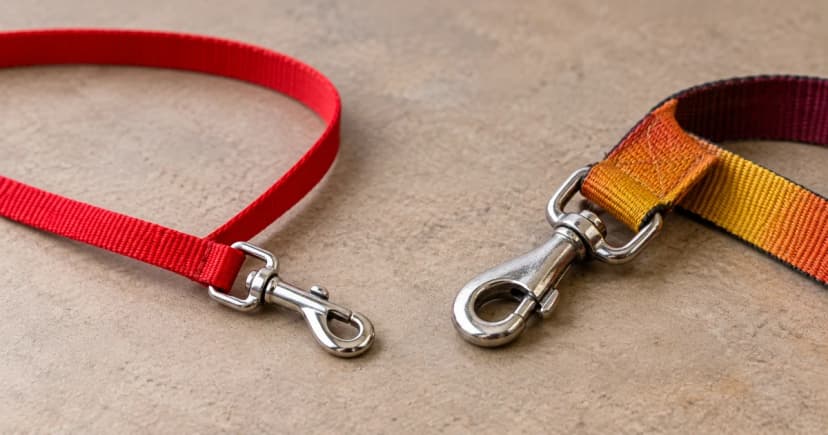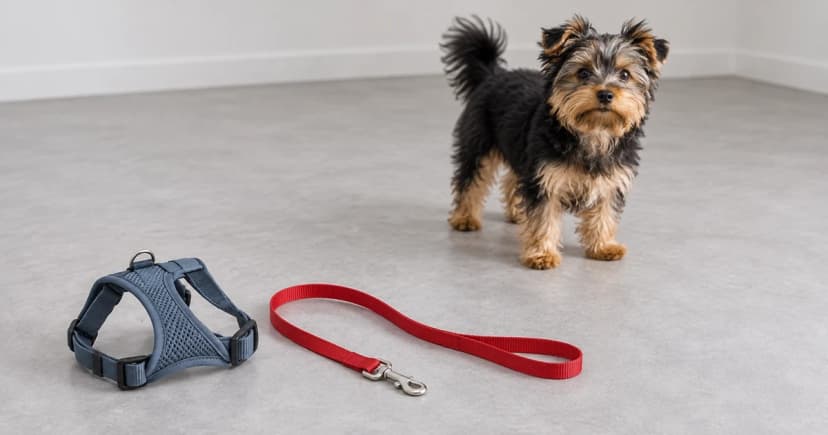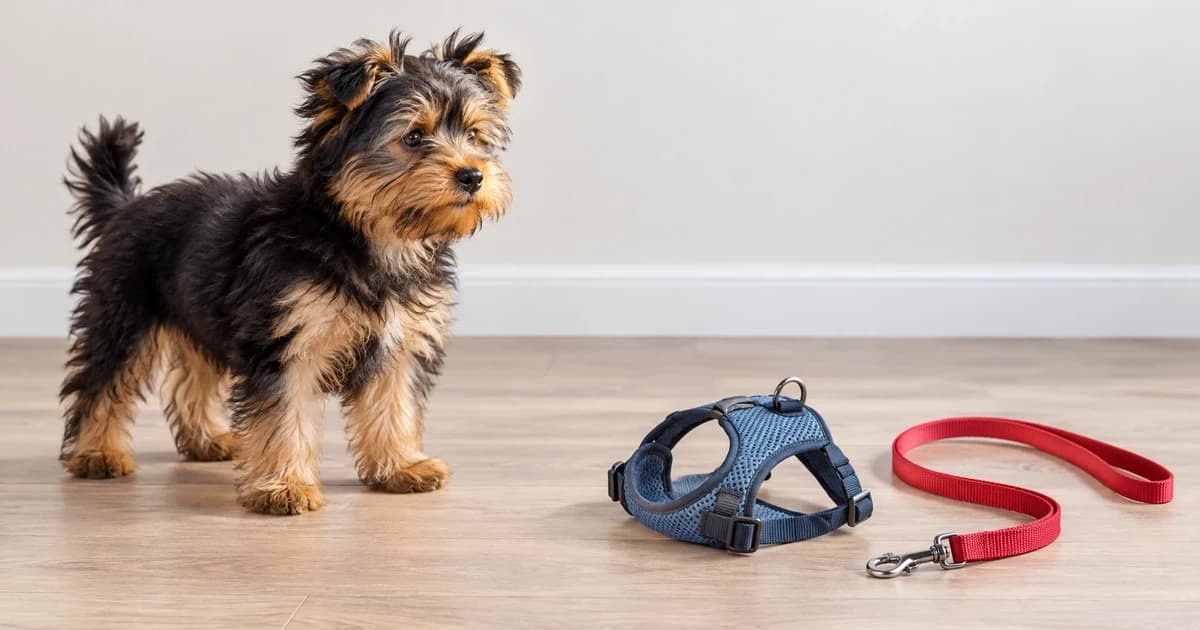
To leash train a puppy, start with calm, supervised introductions to the harness or collar and clip, reward a few steps near you while the leash hangs in a loose curve, stop walking whenever the leash tightens, and move forward again once slack returns. Practise in a quiet space first and progress at your individual puppy's pace without yanking the leash or demanding a rigid heel position. Accepting equipment, clipping the lead, and walking with slack are separate skills; completing one does not automatically establish the others.
Your first successful session may simply be a relaxed sniff of the harness and lead on the floor rather than a lap around the room. Separating equipment acceptance from walking lets you pick a small, achievable next step without a deadline.
Prepare the equipment and the setting separately
Use everyday walking gear adjusted to fit your puppy's current measurements according to the product's instructions. Our harness measuring and fit guide walks through that physical fit check—a puppy happily sniffing a harness does not confirm that the straps fit safely.
Pick a quiet, enclosed room or secure garden area with space for a few distraction-free steps, put loose floor toys away, and keep tiny, high-value treats in reach. Always supervise equipment sessions; never leave a puppy unattended with a trailing leash attached where it could snag or become a chew hazard.
Practising indoors or in a private yard is separate from readiness for public pavement walks. Ask your veterinarian when your puppy's vaccination status and development allow public outdoor walks; this guide does not supply a vaccination calendar or age-based mileage rule.
Let the puppy become comfortable before asking for movement
Dogs Trust's first-walk guidance introduces the collar, harness, and lead in small, unhurried stages at home or in the garden before heading out in public. It starts with letting the puppy investigate the equipment, rewards calm acceptance as you lift and clip the lead on, rewards standing or taking a single step near you, and allows puppies time to stop and sniff rather than pressuring them forward.
If your puppy backs away when you hold up the harness, trying to buckle it on and walk across the room stacks too many new demands at once. Drop back to the smaller step: hold the harness still, let your puppy approach voluntarily, and reward calm sniffing or head-through contact. Never chase a retreating puppy with walking gear.
Once your puppy is comfortable having the harness fastened and the clip attached, pause and reward before asking for movement. Clipping a leash on is never a cue to pull a puppy into position.
Reward a few loose steps and distinguish proximity from slack
Start with your puppy standing near you and the leash hanging in a relaxed curve. Reward your puppy for choosing to stay close, take one or two quiet steps, and reward again while the leash stays slack. Puppy leash training does not require a formal left-side heel or a fixed shoulder position.
Watch the curve of the leash as closely as your puppy's feet. Standing close to your leg is not the same thing as a loose leash:
| Leash & Position Scenario | What the Leash Line Shows | Handler Action (Without Pulling Back) |
|---|---|---|
| Scenario A: Close to your leg, but leaning into tension | Puppy is only a foot away from your shoes, yet leaning sideways or forward so the leash line is pulled straight and taut. | Do not reward tension even though the puppy is close; pause your feet quietly without jerking the lead, wait for the puppy to shift weight back so the line softens, then reward. |
| Scenario B: Slightly ahead or to either side, with a loose J-curve | Puppy is a step ahead or off to the right or left sniffing calmly while the leash hangs in a visible, tension-free curve. | Mark and deliver a treat promptly while the line is slack; no formal heel or fixed shoulder alignment is needed. |
PDSA's loose-lead training advice recommends practising in a low-distraction spot, rewarding walking while the lead is slack, and stopping forward movement as soon as pulling starts. Once the dog turns or steps back so slack returns, reward and walk on. PDSA explicitly advises against yanking the lead back or scolding a dog for pulling. (While PDSA's page also mentions adult-dog exercise and off-lead time, keep puppy practice focused on short, supervised on-lead sessions appropriate for your puppy's age.)
Whenever the leash tightens, simply stop walking without pulling back on the handle. Invite your puppy back toward you so the line loosens, reward the return to slack, and take one easy step. If the leash tightens on every step, make the task simpler—practise in a quieter corner or reward a single step at a time.
Choose between progressing, simplifying, and ending
Blue Cross's dog and puppy training guide highlights prompt rewards, minimal distractions, and short training sessions of roughly two to five minutes—ending earlier whenever a puppy loses focus or finds an exercise hard. Two to five minutes is a ceiling for short focus, never a requirement to keep a worried puppy working until a timer rings.
A few loose steps in the kitchen do not mean your puppy is ready for a busy hallway or front driveway. Change only one variable at a time—either add one extra step in the same quiet room, or practise the very first step in a slightly new spot:
| What You Observed | What to Record or Reconsider |
|---|---|
| Equipment encounter | Which item and action the puppy accepted comfortably: approaching, sniffing, lifting, buckling, or clipping the lead. |
| Movement | Where you practised and whether the puppy chose to take 1–3 steps near you voluntarily. |
| Leash slack vs. tension | Which moments kept a loose J-curve in the leash and what distraction appeared just before the line tightened. |
| Next attempt | One simpler step or one small increase in a quiet spot, rather than a deadline to finish leash training. |
If your puppy freezes, bites at the harness repeatedly, or seems frightened, ask your veterinarian to rule out physical discomfort and consult a qualified reward-based trainer who can observe your handling in person. See our editorial policy for how we use welfare sources.