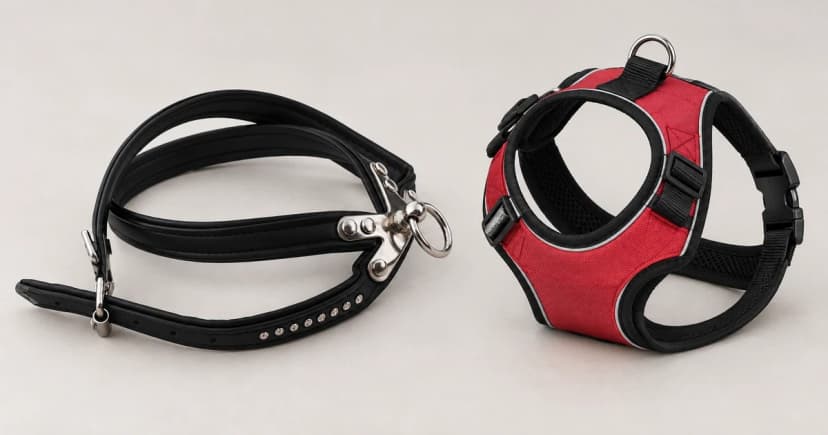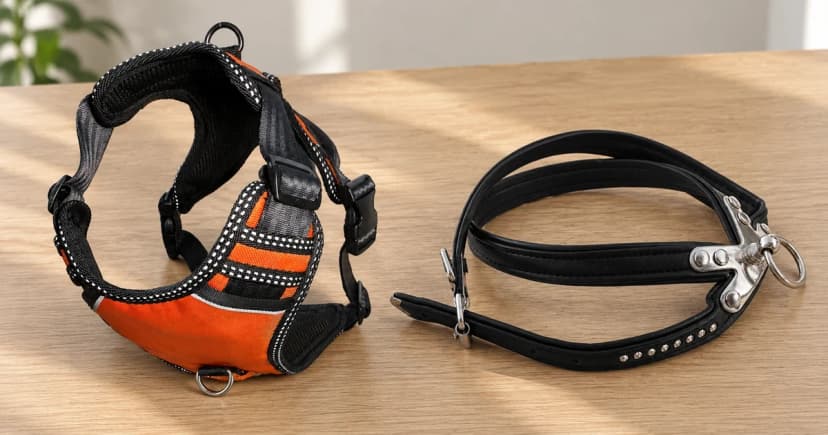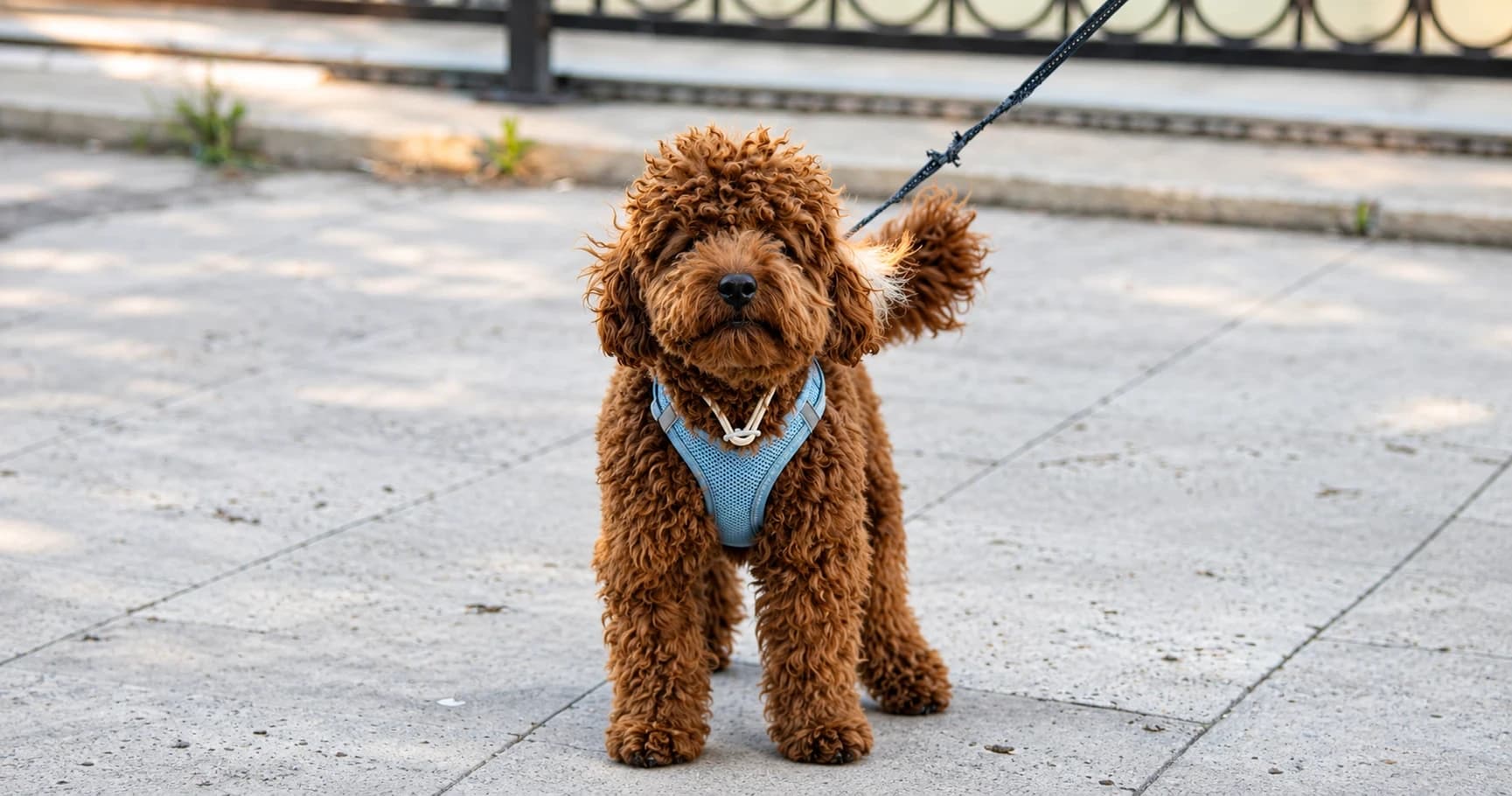
Knowing how to measure a dog for a harness starts with wrapping a flexible tape around the widest part of the ribcage just behind the front legs, then measuring the lower neck near the shoulders whenever the model's size chart includes a neck column. Both dog measurements for harness selection must fall within the same candidate size row on that exact model's chart—and even after a chart match, an indoor movement check determines how should a dog harness fit on your dog.
This guide walks through taking repeatable chest and lower-neck readings, resolving split-size chart conflicts, and checking strap clearance before your first walk. It covers everyday walking harnesses rather than crash-tested vehicle restraints, lifting slings, or unattended tie-out gear.
Start with the exact model's sizing diagram
Open the manufacturer's sizing diagram before picking up your tape. Check which landmarks the chart uses, whether dimensions are listed in inches or centimeters, and whether the table requires chest girth alone or both chest and lower neck.
Ruffwear's gear measuring guide sizes harnesses primarily by widest chest girth, whereas Kurgo's harness fit guide pairs chest girth and lower-neck circumference alongside weight references. When browsing dog walking harnesses, save the specific model's chart alongside your measurements rather than assuming a “Medium” fits the same across brands.
How to measure dog chest girth and lower neck step by step
Use a soft sewing tape—or mark a piece of non-stretch string and measure it against a ruler—while your dog stands naturally on a flat floor:
- Locate the widest ribcage for chest girth: Look from the side and wrap the tape vertically around the deepest part of the chest just behind the front elbows, making sure the tape does not slide backward toward the narrower abdomen.
- Keep tape tension level over the coat: Rest the tape smoothly against the fur without pinching skin or adding an arbitrary extra allowance unless the brand's instructions specify one.
- Record both inches and centimeters: Log the exact reading (1 inch = 2.54 cm) before rounding so borderline numbers remain clear.
- Measure the lower neck at the shoulders: As both Kurgo and the AKC harness selection guide note, measure around the base of the neck where the harness yoke sits on the shoulders—not higher up the throat where an ID collar sits.
- Check head-opening style: If the neck yoke does not unbuckle, verify that the closed loop can slip comfortably over your dog's head without forcing the ears.
Make a measurement worksheet you can reuse
| Record Field | What to Write Down |
|---|---|
| Chest girth reading | Exact ribcage circumference behind front legs, unit, and date measured |
| Lower-neck reading | Shoulder-base circumference (or note “not used on this model's chart”) |
| Target model & candidate size | Brand, harness name, chart URL, and candidate size row |
| Published chest & neck ranges | Both min–max ranges for that single candidate size row |
| Indoor try-on notes | Elbow clearance behind front legs, throat position, and strap adjustment margin |
If a product listing provides only a body-weight range without chest or neck dimensions, keep that candidate on hold until the strap adjustment measurements are confirmed.
Handle split-size mismatches and overlapping ranges without guessing
Every required body measurement must be covered by the same candidate size row. A chest reading that matches Medium and a lower-neck reading that matches Small do not combine into a valid fit.
Consider this illustrative dog example (hypothetical figures, not a tested animal): a 25-inch chest girth and a 14-inch lower neck compared against the size chart in Kurgo's linked harness guide:
| Candidate Size Row (Kurgo Linked Guide) | Covers 25 in Chest Girth? | Covers 14 in Lower Neck? | Covers Both Measurements Simultaneously? |
|---|---|---|---|
| Small (Chest: 16–22 in | Lower Neck: 12–20 in) | No (25 in exceeds the 22 in maximum) | Yes (14 in sits inside 12–20 in) | No — chest is too large for Small |
| Medium (Chest: 18–28 in | Lower Neck: 16–25 in) | Yes (25 in sits inside 18–28 in) | No (14 in is below the 16 in minimum) | No — neck yoke is too large on Medium |
Because neither Small nor Medium covers both measurements at once, “just go up a size” does not solve the mismatch—choosing Medium would leave the neck opening larger than the dog's 14-inch lower neck. Kurgo's rule to choose the larger size when between sizes applies only when both the dog's chest and lower neck fall inside the overlapping zone of both size rows. When a chart splits across rows like the illustrative table above, look for a harness design with an independently adjustable neck yoke or a different brand cut. For growing puppies, Ruffwear likewise advises sizing for the puppy's current ribcage rather than buying an oversized harness to grow into.
How should a dog harness fit during an indoor check?
Test the delivered harness indoors away from open doors, and clip a walking leash only to a designated leash ring. Many of the common disadvantages of a dog harness—such as underarm chafing, shoulder restriction, or backing out of a loose loop—trace back to a cut or adjustment mismatch that shows up during movement. Follow the AKC's well-fitting harness guidance alongside the harness manual:
- At rest: Verify that the front chest panel sits below the windpipe without pressing on the throat and that buckles lie flat.
- Behind the front legs: Ensure the girth strap sits clear of the sensitive armpit crease so it does not rub the elbows during a stride, while staying on the ribcage rather than sliding back onto the soft abdomen.
- Adjustment margin: Check that the fit does not rely on every slider sitting at its extreme minimum or maximum stop.
- Post-trial skin and coat check: Take the harness off after a brief indoor walk and inspect the shoulders, sternum, and behind the elbows for red marks or pinched fur.
Treat a two-finger snugness check as a general starting aid rather than a guarantee against backing out. Compare styles across our walking gear collection with your completed worksheet, and review our editorial policy on how we use manufacturer sizing documentation.