To measure a horse for a fly mask, choose the exact maker and mask style first. Follow that model's measurement routes and units, compare the results with its own chart, then assess the mask you receive. A familiar size label cannot establish clearance around the eyes, room inside ear covers or the position of the lower edge.
Keep the measurement, chart choice and observed fit as separate entries. That makes an unresolved size question easier to explain without treating an untried mask as a confirmed fit.
Identify the mask before measuring
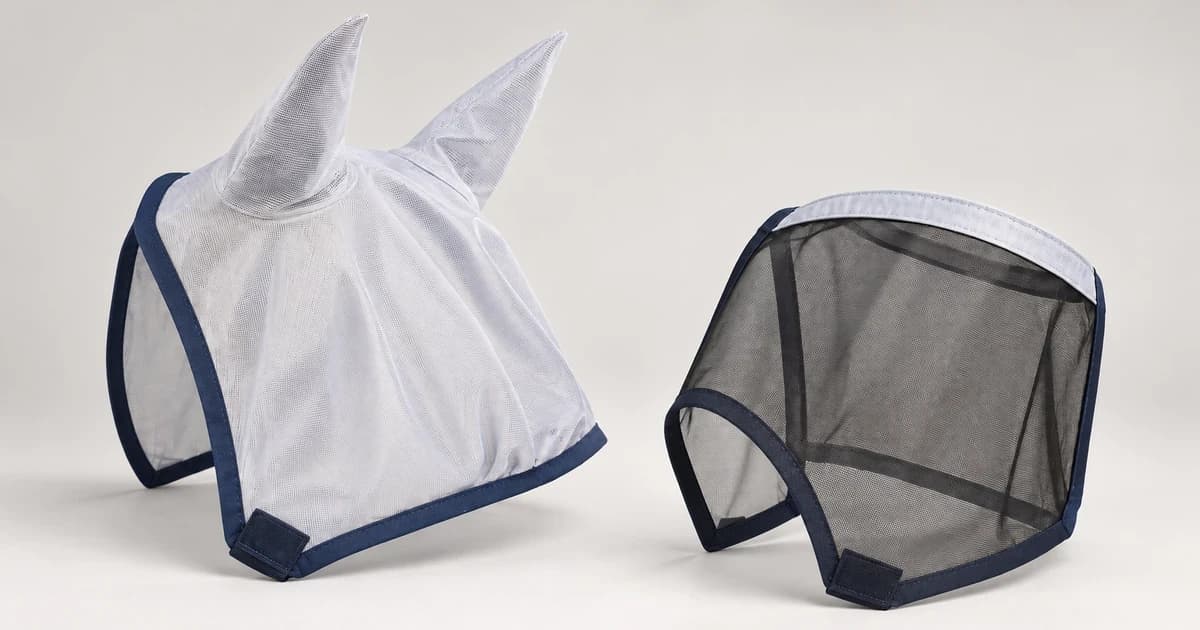
Record the product name and intended coverage: eye mesh, covered or uncovered ears, and any nose extension. Distinguish a mesh face covering from a strip fringe. Open the selected product's current size guide and check which measurements apply to that style.
Use a soft tape and write down the start, route, endpoint and units before taking each measurement. If an endpoint is unclear, clarify it with the maker or an experienced equine professional rather than choosing a convenient point yourself.
Keep the maker's measurement routes together
Kensington's measuring guide uses five labeled measurements in inches:
| Label | Route described by this guide |
|---|---|
| A: poll to nose | From the poll's top center between the ears, down the face center to the intended mask edge. |
| B: head circumference | Around the head, starting near the poll and passing under the jaw. |
| C: nose circumference | Around the nose where the mask's lower portion will sit. |
| D: ear length | From the ear's base to its tip, when choosing ear coverage. |
| E: nose length | From below the eye area to the intended nose-cover endpoint. |
Use the actual product listing's chart for the numerical comparison. This guide describes the routes but does not supply a complete numerical chart for every model. Its fit checks include mesh clear of the eyes, normal blinking, room inside ear covers and coverage ending where intended.
Do not transfer those letter labels to another maker's diagram. Save the diagram or guide reference beside the numbers so their meaning remains identifiable.
Resolve overlapping sizes and conflicting directions
Cashel's Crusader guide shows a different route: around the neck to the mid-jaw point, continuing to the corresponding point on the other side. Follow its original diagram rather than substituting a nose circumference.
The chart lists Medium at 38–40 inches, Large at 40–42 inches and X-Large at 42 inches. A hypothetical 42-inch result therefore does not identify one unique row. More importantly, the article's prose says to size up between sizes, while its embedded measuring graphic says to size down.
Cashel also describes an edge check allowing two fingers and eye darts that remain off the eye. An adjustable closure does not make every head shape fit.
Keep the answer with your sizing record instead of converting uncertainty into an automatic order size.
Check the delivered mask beyond its size label
Equilibrium's Field Relief guide treats bridle size as a starting point for its range. It describes a snug, two-finger fit around the face without excessive gaps at the poll or nose, while the eye area needs separate room clear of the eyes and eyelashes. The Field Relief Midi versions have adjustment over the poll and under the cheeks.
That face-edge check is not a numerical clearance rule for the eye mesh. Evaluate the selected model's structure and instructions separately; do not tighten a closure to compensate for mesh pressing toward the eye.
Use the actual mask's fastening directions, then record what you observe at the eye panels, ear sections, edges and closures. A different label alone may not answer the question.
Save a useful fit record
When browsing Pawlivy's horse care and tack, obtain the individual item's current size and fitting information. This is a related equipment category; it does not confirm that a particular fly mask or size is available.