Learning how to use a flirt pole safely combines four linked rules: verify that twisting chase movement suits your dog's age and joints before starting, trail the lure along the ground rather than waving it in the air for high jumps, give your dog regular wins to catch the lure, and pause rod movement immediately after each catch to cue a practiced release and rest break. Whether you use a rigid rope pole or a bungee-cord dog flirt pole, success is measured by controlled ground-level movement and calm releases—never by exhausting marathon rounds.
1. Game-stage guide: pole motion, catches, and pause decisions
Use this stage-by-stage table to coordinate how the pole, cord, and ground lure move together and what to do at each point in the session:
| Stage in the game | Pole, cord, and ground-lure motion | Dog's action & handler's next decision |
|---|---|---|
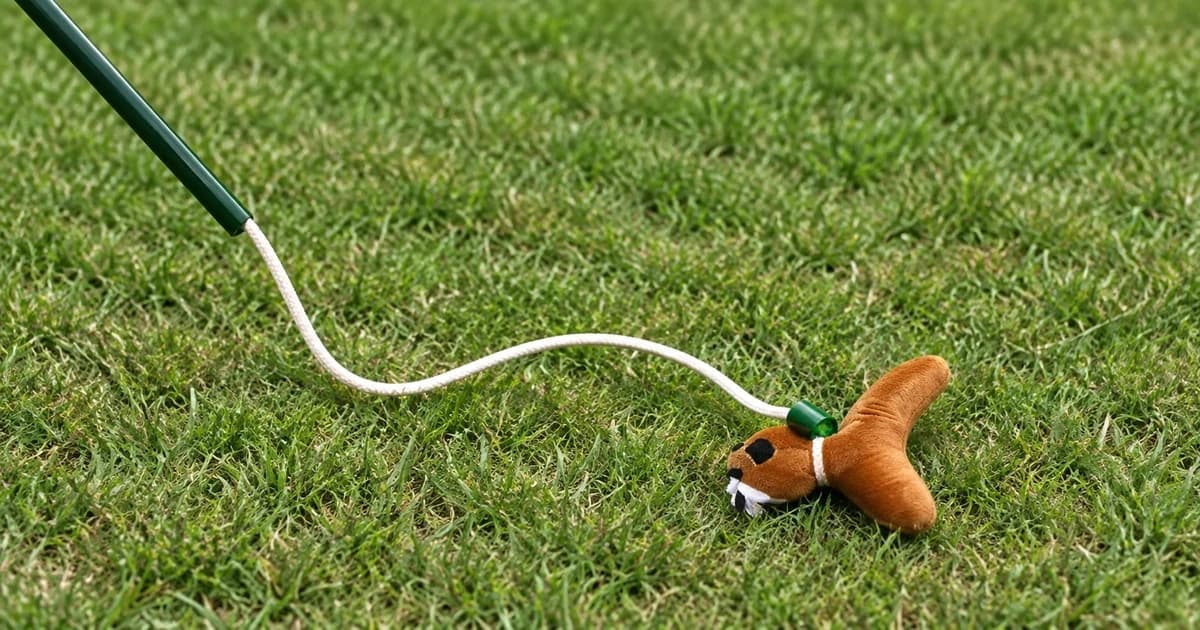
| 1. Starting setup (Stationary lure) | Cast the lure out flat on grass or earth opposite your dog; hold the pole steady so the lure rests completely still until you give your release-to-chase cue (Blue Cross). | Dog holds a familiar sit or wait, then begins chasing only after your invitation word. |
| 2. Ground-level chase | Sweep the pole tip smoothly so the lure skims across the grass or dirt in gentle curves—never lift the lure overhead to prompt vertical jumping, and avoid sharp hairpin turns at full sprint. | Dog tracks and chases the ground-level lure; keep rounds brief so arousal stays manageable. |
| 3. Lure caught (Immediate slack) | Stop sweeping the pole the instant your dog catches the lure and let the line go slack—never yank the pole away mid-bite or turn a flirt pole into a heavy tug-of-war contest. | Let your dog hold and enjoy the caught lure for a few moments before cueing your practiced "drop" or "leave" word. |
| 4. Release & arousal check | Keep the lure completely motionless on the ground while your dog releases it and steps back. | If your dog releases calmly, pause for a breath or water break (Squishy Face Studio); if letting go becomes hard, end the chase and practise the release cue separately at low excitement. |
| 5. Session finish & inspection | Cue a final release, allow a calm walk-off cooldown, inspect the cord and lure stitching for wear, and put the entire pole away out of reach. | Never leave a flirt pole out for solo chewing—retire any pole or lure with frayed cord or torn seams immediately. |
2. Check physical suitability and release cues before playing
Blue Cross's flirt-pole guidance states that flirt-pole chasing is not suitable for puppies that are still growing, elderly dogs, or dogs with arthritis or joint conditions. Because growth-plate closure varies by breed and size, check with your veterinarian if you are unsure whether rapid starts and turns are appropriate for your dog. Blue Cross also recommends warming up before play, cooling down afterward, and confirming that your dog already responds reliably to a "drop" or "leave" cue before introducing a fast-moving lure.
3. Plain-rope poles vs. bungee-cord flirt poles: model-specific cautions
When comparing equipment in the flirt pole category, check whether the cord is static rope or elastic bungee webbing. For its bungee models, Squishy Face Studio's instructions and Flirt Pole FAQ highlight three critical safety rules:
- Never let go of the pole handle while the bungee cord is stretched: If your dog holds the lure under tension and you release the shaft, the pole can snap toward your dog.
- Never attach hard or heavy toys as replacement lures: If a dog lets go of a heavy object while the bungee is stretched, the lure can recoil back toward the handler.
- Do not use a flirt pole as a dedicated tug toy: While a bungee cord absorbs minor shock when a dog catches the lure, Squishy Face Studio stresses that flirt poles are chasers rather than tug ropes. For dedicated pulling games, use a proper tug toy and follow our dog tug-play guide.
4. Put the pole away and vary your dog's daily activities
Both Blue Cross and Squishy Face Studio warn against leaving a flirt pole with an unsupervised dog, as chewing through the cord or swallowing lure parts poses a serious ingestion hazard. To balance high-focus chasing with other skills, see our fetch guide for retrieve training and our daily activity planning guide for lower-impact enrichment. See our editorial policy for how welfare and manufacturer sources are cited.