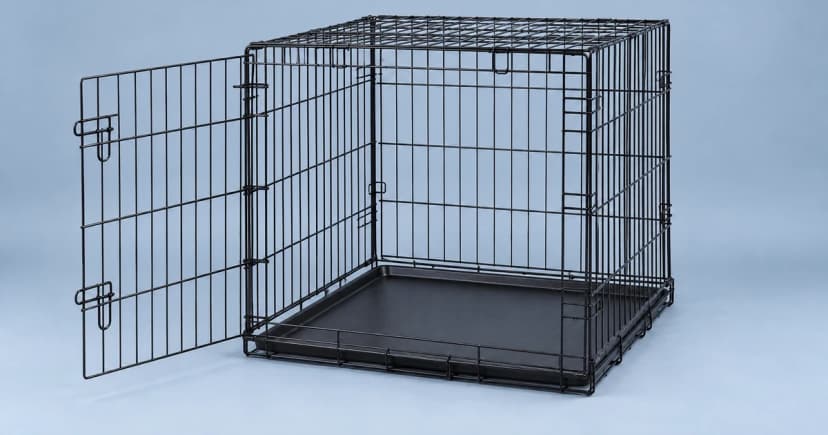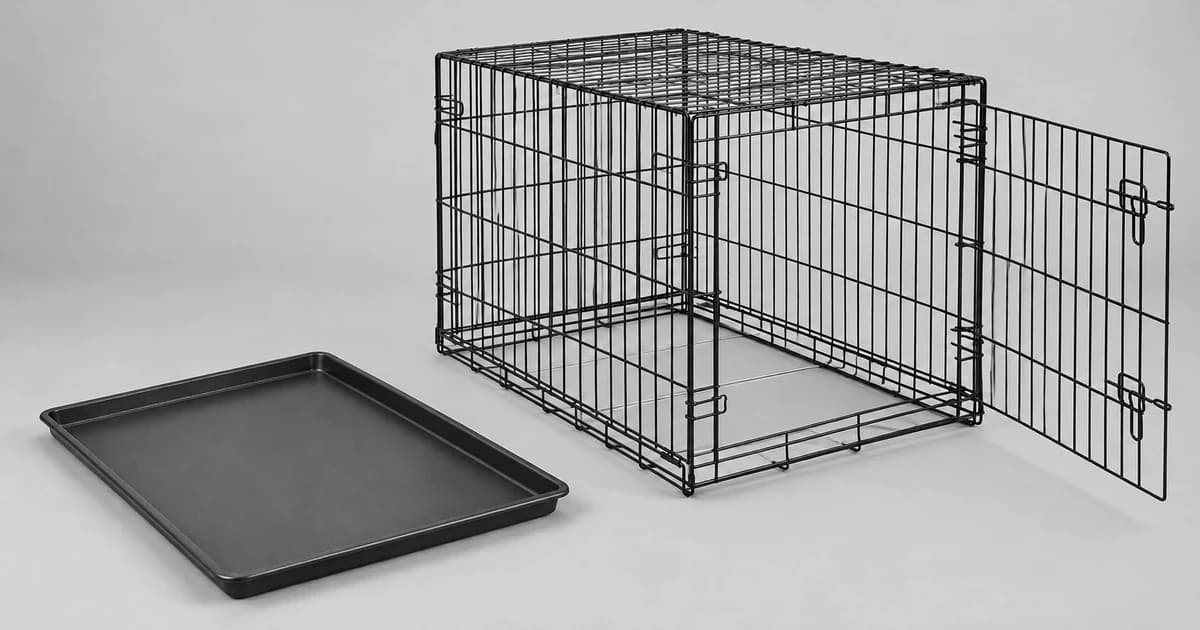
Clean a wire dog crate and its removable tray using the instructions for the exact frame, pan and retaining mechanism. Establish which cleaner and cleaning material the maker permits before starting, and how the pan releases and secures again. A metal-looking frame and a tray that appears to slide out do not establish one universal method.
This guide covers ordinary material care and the pan's return to its documented position. It does not provide a disinfection recipe or demonstrate that any crate has been cleaned or tested. Keep the dog elsewhere while working on the empty crate and follow the bedding's own care instructions separately.
Identify the surface and the pan before releasing anything
Find the maker, model and applicable manual. Check the parts list as well as the care section: the word “tray” does not identify its material, and a dark finish does not identify the coating on the wire. Keep an unidentified surface marked as unknown rather than choosing a chemical by appearance.
Then locate the documented pan stop or retaining device. Identify which part the instructions tell you to move. Lifting a pan, lifting a front panel and releasing a catch are different actions, even when the finished crates look similar.
Do not start folding the frame to improve access merely because it is sold as collapsible. Tray access and structural disassembly are separate operations. Use the complete directions for the intended operation instead of borrowing the most convenient step from another manual.
Read the permissions in three named manuals
These examples show differences to check; none identifies an unlabelled crate from its photograph.
The MidWest Solutions SL54 manual, marked INST_SL54 (195), permits mild, non-abrasive cleaners and water for the finish and plastic pan. It cautions that coarse scrubbing or abrasive materials can damage the finish, and prolonged direct sunlight can warp or damage the pan.
Its parts list identifies a removable plastic pan. Its assembly instructions place that pan through the space beneath the front door and secure it with the pan stop. The document does not identify the finish's chemistry or give a universal rinsing or drying method.
The Frisco All-in-1 Multi-Stage manual for models 247915–247917, issued by Chewy, specifies a mild, non-toxic cleaner and water. Its plastic-pan directions lift the pan above the latch, move the latch underneath and slide the pan forward; the return reverses those steps. It excludes removing or replacing the pan while the pet is inside.
There is an unresolved wording conflict: the parts and pan instructions say plastic, while a warning refers to a metal tray.
The Petmate PET9958 wire-crate instructions, a manufacturer-authored 2016 document hosted by Tractor Supply, call for routine cleaning but supply no cleaning-agent recipe. Their pan procedure lifts the front door panel so the retaining device can pass underneath, then reverses the sequence to secure it again. That is different from Frisco's pan-lift instruction.
Petmate requires the plastic pan and retaining device in place for use, excludes a broken pan, and calls for stopping use when a structural part is broken or missing. It excludes unauthorized repairs or modifications. The document does not establish a match to an unidentified current retail model.
Choose a permitted method for each surface
Keep the frame's finish permission beside the pan's material and care directions. Words such as “mild” or “non-toxic” in a named manual do not identify every suitable product, a disinfectant strength or a cleaning concentration.
Note visible residue around the pan rim, under its edges and near retaining parts without forcing access or scraping a finish. A difficult corner does not create permission to remove a structural panel.
These manuals do not supply a shared rinse-and-dry sequence. Resolve those requirements for the specific frame and pan before wet cleaning. Do not fill the gap with an assumed hose-down, soaking, pressure-washing, steam or machine cycle. A cleaner permission is not permission for every wet method.
Keep loose bedding out of this decision. Fabric covers, cushions and support parts have their own instructions; our soft-crate cleaning guide addresses that different construction. Its cover-washing examples do not authorize washing a wire frame or plastic pan.
Check the pan's return against the correct drawing
Keep the crate empty while following its documented return sequence. Check both the pan's position and the retaining device, rather than stopping when the pan appears to fit. Use the drawing for the exact mechanism: do not combine a panel-lift step from one manufacturer with a latch action from another.
Do not force a pan past an obstruction or reshape a retaining wire to make it close. Record a crack, changed shape, missing part or uncertain engagement and obtain the maker's applicable replacement or repair guidance. Removing visible dirt does not resolve a mechanical problem.
Keep a short record that will make the next session easier:
- The frame model, manual identifier and documented finish-care permission.
- The pan's identified material or part number, and its separate care requirements.
- The exact release and return instructions, including the retaining device.
When comparing wire crates, request those details rather than treating a removable-tray description as a complete care instruction. Our editorial policy explains source-based guidance.