Choose a cat tree by comparing its usable resting places, the space the complete structure needs, and the installation instructions for the exact model. Height alone does not answer any of those questions. Before ordering, identify a platform or den your cat could use, trace the route to it, and resolve missing measurements or fixing requirements with the manufacturer.
Deciding where to place a cat tree means checking its complete outline in the room as well as the route through its levels. Measure beyond the base where shelves or perches project, check the nearby passage, and read the exact model’s floor and wall-fixing requirements. Those details are part of what to look for in a cat tree before ordering; a tall top platform alone does not settle them.
Decide which part of a tree you actually need
Start with a particular use: an elevated resting place, an enclosed retreat, several climbing levels, or a combination. Compare those features with places your cat already chooses. A tree with many accessories can still miss the useful feature if its main bed is too cramped or its only resting platform is difficult to reach.
For a resting place, note the space your cat normally occupies on a familiar surface. Treat these observations as a personal comparison point, not a formula that certifies a product's fit.
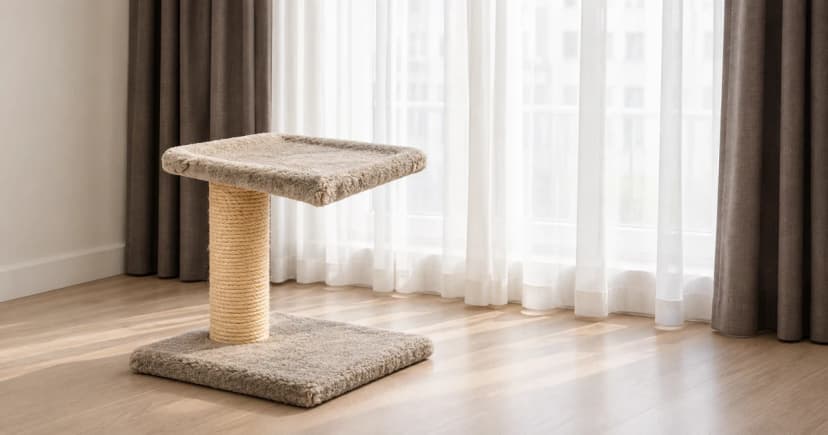
If scratching is the main goal, consider whether a simpler outlet would answer it. Our scratching-post selection and introduction guide covers scratching orientation, usable reach and voluntary introduction. Here, the decision concerns buying a complete climbing and resting structure.
Compare the specified geometry before the feature count
Product pages describe different kinds of measurements. Put the published figure next to the question it answers, then write down what remains unknown. The following are manufacturer-stated examples, not measurements taken by Pawlivy.
| Named example | Published information | What to confirm separately |
|---|---|---|
| Tuft & Paw Frond | Overall tree: 24 inches wide by 24 inches deep by 49 inches high. Top perch: 12.5 by 12.5 inches. Lower and middle usable surfaces: 12.5 by 9.5 inches, excluding the post. | Compare the actual resting surface with your cat's usual position. The pictured 12-pound cat is not a published maximum load. |
| Catit Vesper High Base | Overall specifications: 47.8 by 22.1 by 22.1 inches; multiple platforms and a den with two openings. | The page does not give numerical usable platform area, den interior or a maximum platform load. |
| Mau Cento | Base listed as 23 inches, height 45.5 inches, and cats up to 23 pounds each. The approximately 38-pound figure is packaging weight. | Confirm the full placement outline and basket space. Packaging weight is not assembled weight or a measured resistance to tipping. |
A missing useful dimension is a reason to ask a question. It should not be silently replaced by another model's measurement, a promotional photo estimate or the words “large cat.”
Check the space the cat can use inside each feature
A platform measurement can include a post, a raised edge or a padded rim. Frond's separate lower-perch measurement shows why the space left after accounting for the post matters. Do the same comparison for a basket or hammock: its outside frame and its supporting resting area need not be identical.
For an enclosed den, request the entrance width and height as well as the internal length, width and height. Check whether a cushion or structural support takes up part of that space. Catit's description of two openings explains its layout, but does not supply their dimensions or establish that every cat fits.
When more than one cat will use the tree, evaluate the intended resting places individually. A picture of two cats on a tower does not establish a two-cat load allowance. Nor does a maximum weight statement tell you whether a particular bed provides enough room to turn and settle.
Plan the whole outline and the route to the resting place
Measure the intended position in your room, including the height where platforms would sit. Look beyond the bottom panel: a shelf, basket or adjustable perch may extend farther out. Check the finished configuration against nearby furniture and the passage people actually use. Do not assume that a base fitting between two objects means every level above it will fit.
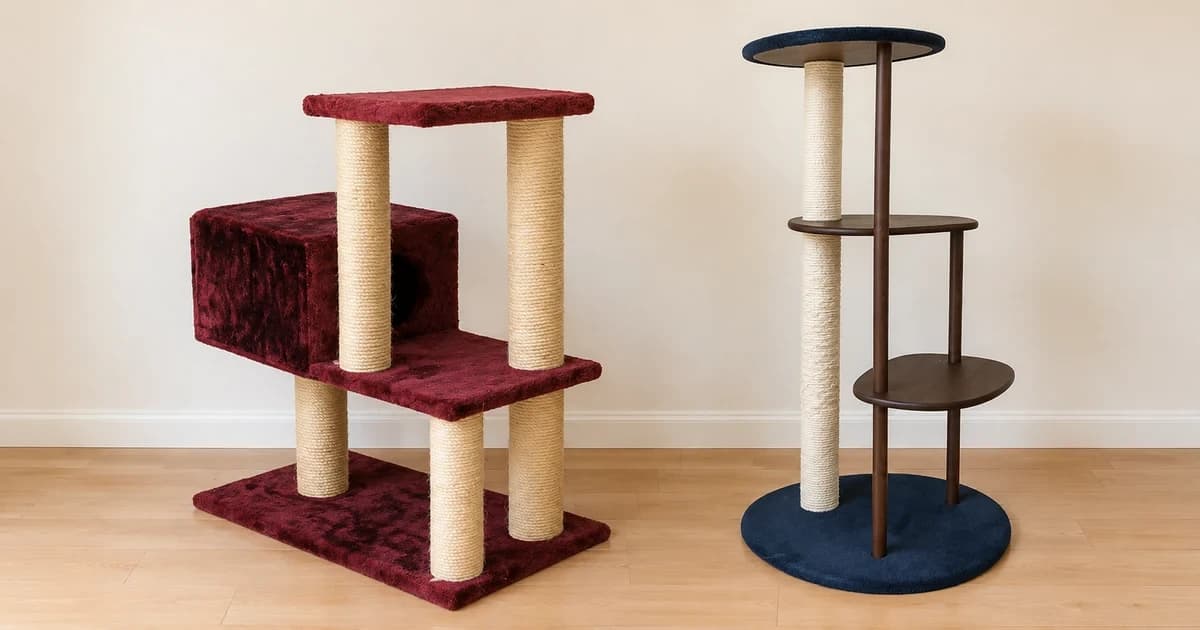
Read the assembly drawing as a route map. Identify the entry point, intermediate levels and return route. Compare that arrangement with steps and surfaces your cat already uses voluntarily. An impressive top platform contributes little if the route to it is unsuitable. Avoid turning a breed label or your cat's weight into a universal recommended tower height or jump spacing.
If a tree offers alternate platform positions, confirm which arrangements the instructions permit. Moving a supported platform to an unapproved location is a structural change, not merely a way to improve the layout. Leave unresolved access questions open while you compare another design.
Read load limits and floor instructions together
Mau's safety and securing guide says its weight limits apply per platform and assume correct assembly on a level, stable surface. It also warns that dynamic contact or play can cause tipping even within a stated limit. Do not add separate platform ratings into a new whole-tree allowance.
For Mau furniture, the guide recommends wall securing above 20 inches, and at every height in homes with children, dogs or other large or active pets. That is Mau's instruction, not a universal threshold for unrelated trees. It calls for hardware suitable for the wall and load, rejects adhesive-only fixing, and directs uncertain owners to a qualified installer. Check the exact model's requirements and whether you can meet them before buying.
Floor details can differ too. Frond's FAQ allows its supplied feet or no feet on hard surfaces, but advises against using those feet on carpet. Do not transfer that instruction to a different tree or assume that extra feet always improve support.
A wide-looking base, a heavy shipping box and a wall-attachment claim are incomplete substitutes for documented installation requirements. If the seller cannot identify the model, rating scope or permitted fixing, choose an option with information you can verify.
Check the parts and assembly information before ordering
Open the exact manual rather than relying on “easy assembly.” The Vesper High Base assembly sheet, for example, shows a parts inventory, separate column and platform attachments, and the supplied hex key. The drawing lets a buyer see that several connections form the finished structure; it does not provide a numerical load rating.
Look for a model identifier, the supplied parts, required tools and any fixing instructions. Confirm that an accessory described as optional is actually optional for your intended setup. Do not assume that instructions for another height or model in the same family are interchangeable.
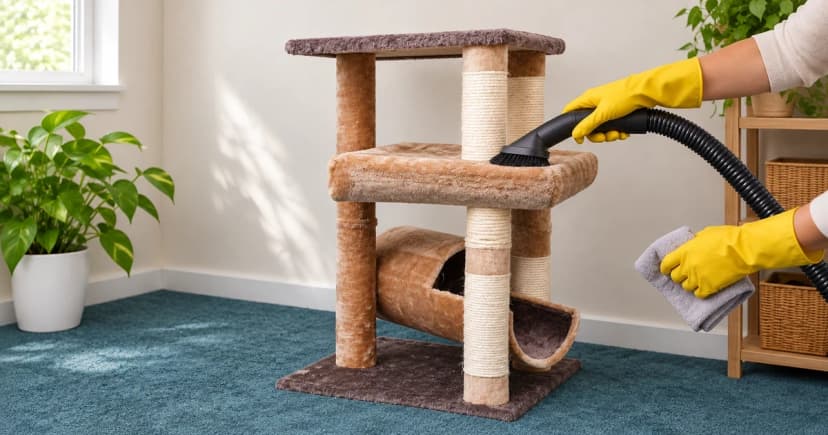
Catit lists separately replaceable Vesper components; that does not make a similar-looking part from another tree compatible. Care access is also a useful buying question. Our cat-tree cleaning guide explains why removable fabric and fixed panels require different care instructions.
Complete one specification card for each serious candidate
Use the following record to compare exact models. This is a buyer worksheet, not a certification, completed product test or set of required minimum dimensions.
| Decision item | What to record | When to pause the purchase |
|---|---|---|
| Model and configuration | Exact name, manual version and permitted platform arrangement | The pictured model or layout cannot be identified |
| Useful resting and den space | Clear surface dimensions, entrance and interior; comparison with your cat's usual resting position | Only outer dimensions or a “large cat” label are available |
| Placement and access | Complete outline, room clearance and route through the levels | The base fits but higher parts or access remain unresolved |
| Load and installation scope | Which component the rating covers, floor restrictions and required wall fixing | The rating is ambiguous or you cannot meet the installation instructions |
| Assembly and serviceability | Required tools, supplied hardware, exact replacement parts and care information | Missing instructions or parts would require improvisation |
Use that completed comparison when browsing cat trees and climbing furniture. Select the tree whose documented features answer your actual needs, rather than the one with the longest accessory list.
Our editorial policy explains source-based research. This guide reports no physical assembly, measured fit, load test or verified catalog-to-manufacturer match.