Choose dog toys by starting with the activity your dog already enjoys, then checking the exact item's intended use, size guidance and parts. A familiar shape or an enthusiastic product description cannot establish that a toy suits your dog. The useful purchase is one you can explain: what it is for, how you will oversee its use and when you will remove it.
Make a short record before browsing. What does your dog do with an existing toy: carry it, chase it, engage in a game with you or pull at its edges? Those observations give you a more useful starting point than a promise of the best toy for every dog.
Start with a play goal, not a breed label
Blue Cross's play guide suggests watching how your dog plays and trying appropriate toys that match those actions. It distinguishes games such as chasing and retrieving, tugging and searching. A toy considered for one of those activities still needs its own suitability checks.
Write down one intended use. For example, you might want an object for a familiar shared game, rather than an item the dog will work on alone. That decision changes what instructions you need to find. An interactive toy's appearance does not establish that it is intended for prolonged chewing.
Dogs Trust's enrichment guidance also asks owners to consider individual preferences, health and abilities. It recommends watching whether an activity interests the dog or leaves them confused or frustrated. Use those questions to narrow your choices; they do not establish that one type of toy will deliver the same benefit to every dog.
Keep a purchase worksheet for the exact item
Once you have a play goal, examine a candidate's own description and instructions. Keep the maker, model and selected size together in your notes. Guidance for a different size or a similar-looking item may not describe the object you are considering.
| Decision | What to record | When to pause the purchase |
|---|---|---|
| Intended activity | The maker's stated use and whether it matches your planned game | The item is described only with broad promotional language |
| Selected size | The exact size option and its own suitability guidance | You cannot tell which option the instructions describe |
| Parts and openings | Attached pieces, seams, accessible filling or other features requiring inspection | Important construction or inspection information is missing |
| Oversight | How you will remain present and observe the interaction | The plan depends on leaving the dog with an unassessed toy |
| Condition and replacement | What damage would make you withdraw the item and reassess it | You are relying on an indestructible or chew-proof promise |
This worksheet helps you identify missing information; it is not a safety certification. If a health or ability concern affects the choice, seek advice from a professional who can assess your dog.
Check size and accessible parts separately
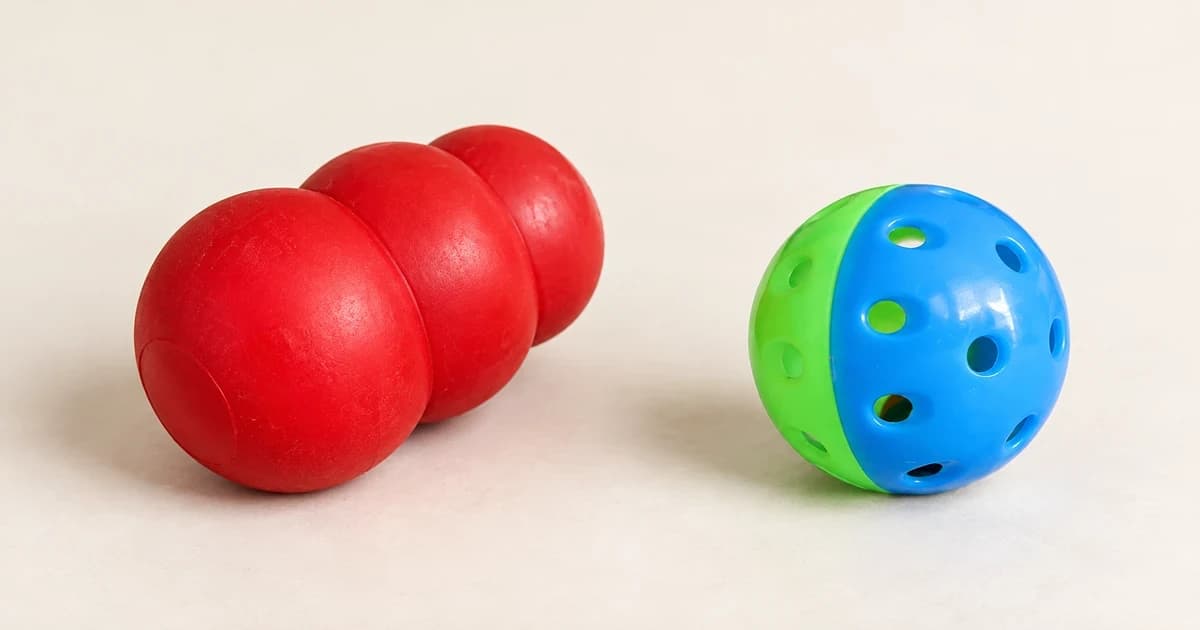
Blue Cross advises using appropriately sized toys and checking for pieces that could be chewed off and swallowed. Dogs Trust likewise identifies appropriate sizing and foreign-body hazards as selection considerations. Neither gives this article a universal ball diameter, weight band or material guarantee.
Keep those checks separate. A size description does not answer whether a seam, attachment or filling is becoming accessible. A robust-looking exterior does not establish that detached pieces are harmless. Inspect the item itself and its own guidance rather than applying a rule from a different toy.
Record the features you will need to watch before the first use. If an existing toy is damaged or parts are separating, stop using it while you decide what to replace. Do not treat a durability claim as permission to skip condition checks.
Choose a manageable introduction
Plan to observe how your dog responds to the candidate, without forcing participation. Blue Cross says play should remain enjoyable and should not be forced; its guidance calls for supervision during solo play, especially where ingestion of parts is a concern.
Battersea's play guidance emphasizes keeping excitement manageable. Buying another toy does not replace that interaction work. If the activity becomes too intense, pause rather than assuming a different shape will solve it.
For a toy activity that seems too difficult or frustrating, Dogs Trust recommends adjusting the activity. Keep room for rest and for the dog to disengage. These are observation decisions, not a promise that the purchase will cure a behavior or health problem.
Use categories to browse, then verify the candidate
The dog toys category offers a starting point. You can narrow your search to chew toys or puzzle toys when that matches the purpose you recorded. A category name does not confirm an item's intended use, current availability or suitability for your dog.
Keep the selection task separate from teaching a game. Our fetch guide covers pickup and return. If your dog generally shows little interest in toys, our guide to observing play preferences and changes addresses that different question.
Before choosing, return to your note: one observed play goal, one documented candidate and a workable plan for oversight and inspection. If a key detail remains unclear, resolve it before buying rather than filling the gap with a familiar brand name, shape or promotional claim.