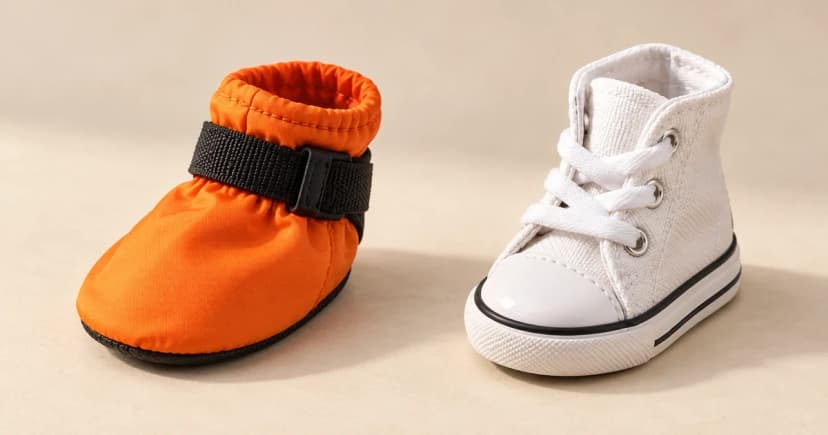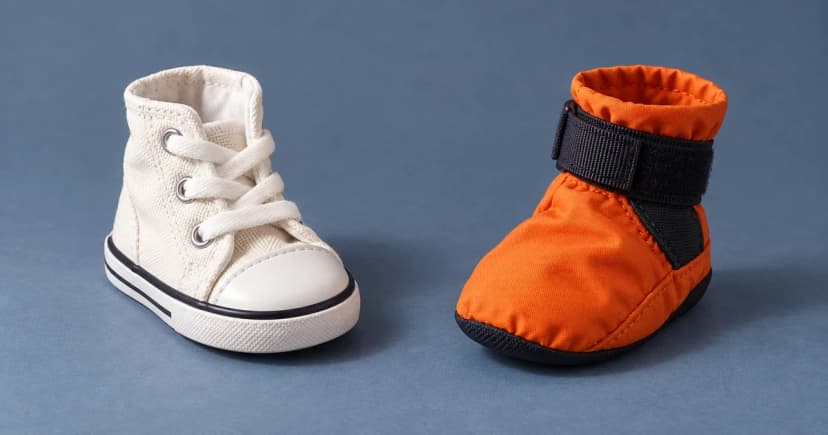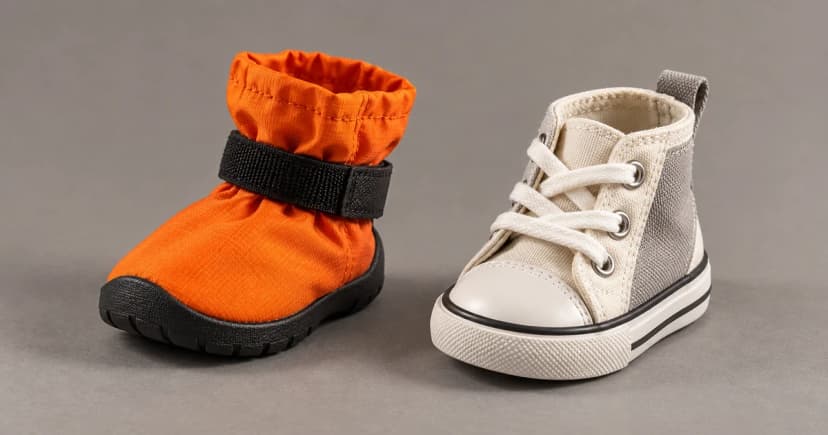
Measure your dog’s paws while your dog is standing and bearing weight, then compare the requested measurement with the chart for the exact boot model. Some charts use the widest paw width; others use a specified nail-to-heel length. Measure the paws separately, keep the units and endpoints in your notes, and use that model’s instructions for a reading between sizes.
A size letter, breed example or the dimensions of an old boot cannot supply that information. The useful result is a four-paw record that you can compare with a clearly labeled chart, followed by a supervised fit check. This guide covers measuring and size-chart decisions, rather than deciding whether boots are needed for a particular activity.
Read the chart before marking the paper
Open the maker’s current guide for the specific model. Check whether each number describes a paw measurement, an inside boot dimension or an outside product dimension. An exterior sole length does not establish the space available inside.
These manufacturer examples show why “measure the paw” needs a more precise instruction:
| Named boot model | Requested measurement | What to keep with the reading |
|---|---|---|
| Ruffwear Grip Trex | Widest paw width while bearing weight | Measure all paws; use its width chart and model-specific between-size advice. |
| Muttluks Original Fleece-Lined and Original All-Weather | Length from the longest toenail to a mark straight down the back of the leg | Include nails, exclude fur, and keep the maker’s defined rear endpoint. |
| Non-stop dogwear Protector bootie | Widest paw width | Use the product’s width chart or size finder; a length reading is a different measurement. |
| Hurtta Weekend Warrior Boots | Widest paw-print width while standing | Measure each paw separately and use this model’s fitting directions. |
The table summarizes Ruffwear’s Grip Trex chart, Muttluks’ sizing instructions, the Protector bootie product guide and Hurtta’s Weekend Warrior fitting section. It is not a universal conversion table or a recommendation that those models fit your dog.
Make a standing paw-width record
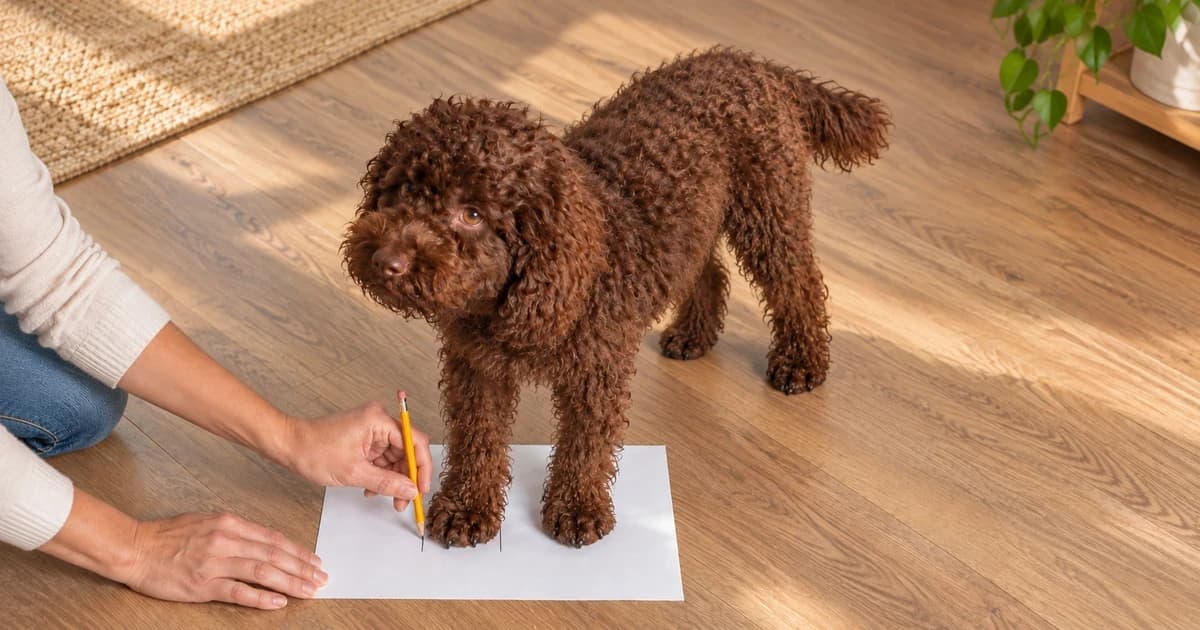
For a chart that requests width, prepare blank paper, a pen and a ruler or flexible measuring tape. Work on a stable surface where your dog can stand comfortably. If your dog repeatedly pulls away, pause instead of holding a leg in position and calling the resulting outline a settled reading.
- Label the sheet. Write which paw you are recording: front left, front right, rear left or rear right. Keep left and right consistent with the dog’s own sides.
- Place the paper under the paw. The paw should rest on the surface and bear weight. A lifted, curled or pad-up paw is a different position from a standing print.
- Mark the widest points. Follow the model’s diagram. Keep the pen upright beside the paw rather than angling it outward and adding distance to the mark.
- Measure between the marks. Move the dog away from the sheet, then read the distance with a ruler. Record the original unit explicitly.
- Repeat when the position changes. If the paw moved before you finished the marks, start again. Do not combine one side from a relaxed position with the other side from a different stance.
- Record the other paws. Keep the four readings separate before considering which sizes or pairs to order.
Ruffwear’s measuring guide illustrates placing paper under a front paw and lifting the opposite paw to load the measured one. It also specifies an upright pen and measuring the distance between width marks. Follow that maker’s method only when your dog can remain comfortable and stable; do not force an unfamiliar handling position.
Hurtta describes tracing the standing paw and reading the widest part of the print. Whichever approach your chosen model uses, the requested width is a straight distance across the paw. It is not the circumference around the leg.
If the chart requests length, change the endpoints
For the Muttluks Original models above, the maker includes the longest toenail and excludes fur. Its standing measurement puts one mark at the nail tip and another at the “heel,” defined by holding the pen straight down the back of the leg. Keep that definition with the record instead of substituting the end of a tuft of fur or the back of a visible pad.
Width and length can both be useful notes, but only the dimension requested by the exact chart should select its size. Record an unrequested dimension as additional information, not as a replacement when the requested one falls outside the listed range. Do not add a generic allowance for nails, socks or growth unless the chosen model’s instructions require it.
Keep front, rear and borderline decisions separate
Ruffwear and Hurtta explain that front and rear paws may differ in size. Grip Trex comes in pairs so front and rear sizes can be selected separately. That is a reason to measure; it is not proof that every dog needs different sizes. Check the actual package count and size combinations before ordering from a dog boots and shoes category.
There is no reliable cross-brand rule to always size up. The Grip Trex instructions say to choose the smaller size between sizes, and Non-stop gives that advice for the Protector bootie. Muttluks instead describes choosing the smallest size that accommodates the entire paw, including nails. Do not apply a width-based rule to a length-based chart.
Read model notes carefully when they appear inconsistent. Muttluks’ page includes a rear-one-size-smaller note for Snow Mushers and Mud Monsters, while its later steps also say to measure front and rear paws for those models. Hurtta’s closest-width guidance has additional 0.5-centimeter qualifiers but does not define the equality case clearly. A boundary question deserves clarification, not an invented size choice.
Save the measurements, then check the delivered boots
Mark a field “not requested” when appropriate. This is a blank worksheet format, not a set of measurements from a test dog.
Put on the delivered boots according to their instructions and check placement, closures and normal movement in a controlled indoor space. Recheck if a boot shifts, slips or rubs; a chart match cannot certify a comfortable fit. For Grip Trex specifically, Ruffwear advises checking the closure and adjusting fit as needed 15 minutes into an activity and throughout use. That timing belongs to the named model.
For other dog clothing, keep a separate body-measurement record. Our guide to measuring a dog for clothes covers garment dimensions; chest or back length cannot replace a boot’s requested paw dimension. This article is source-based guidance, with no hands-on boot test, verified Pawlivy model fit or availability claim. See our editorial policy for how sources are handled.