Choose an aquarium heater by matching the exact model's stated capacity and conditions to your tank volume and the temperature rise it must provide. A wattage printed on a similar heater, or one watts-per-gallon rule, does not resolve those conditions. Start with a short tank-and-room record, then compare the relevant manufacturer's sizing information.
This guide covers capacity selection. It does not prescribe a temperature for your fish or provide electrical installation, handling or repair instructions. The named examples below illustrate how to read specifications; they are not tested product recommendations. Source information was checked on October 15, 2026.
Write down the volume and its unit before comparing watts
Record the aquarium model, the volume stated in its documentation and whether that figure describes nominal tank capacity or the water volume you are using for the comparison. Leave the basis unresolved if the documentation does not explain it. Do not treat two tanks with the same advertised size as fully specified heating situations.
Keep the unit beside every number. US gallons, litres and a source's unspecified “gallons” are different entries. If a maker supplies both US gallons and litres, retain that named model's published figures instead of replacing them with a newly rounded limit. A heater's wattage describes its rated power; it is not itself a tank-volume measurement.
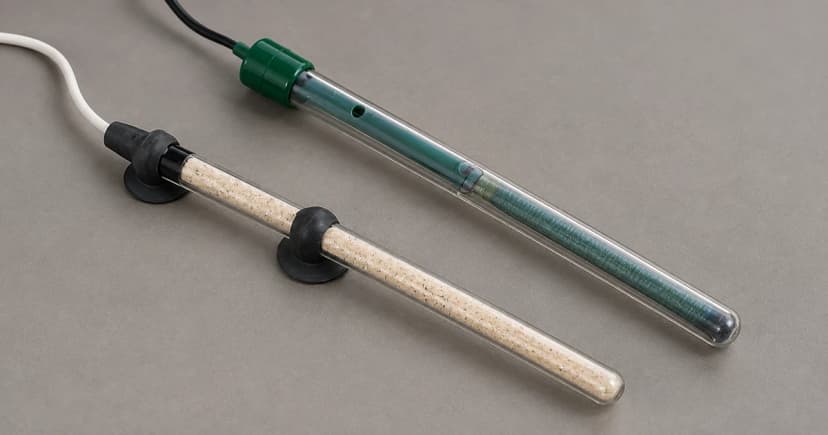
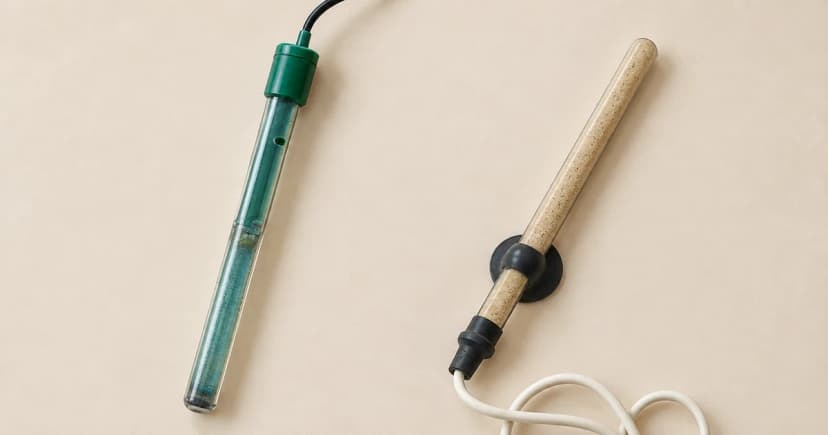
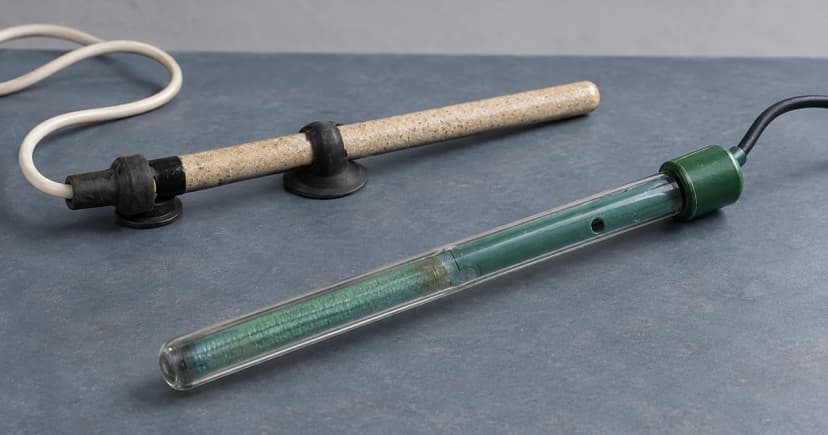
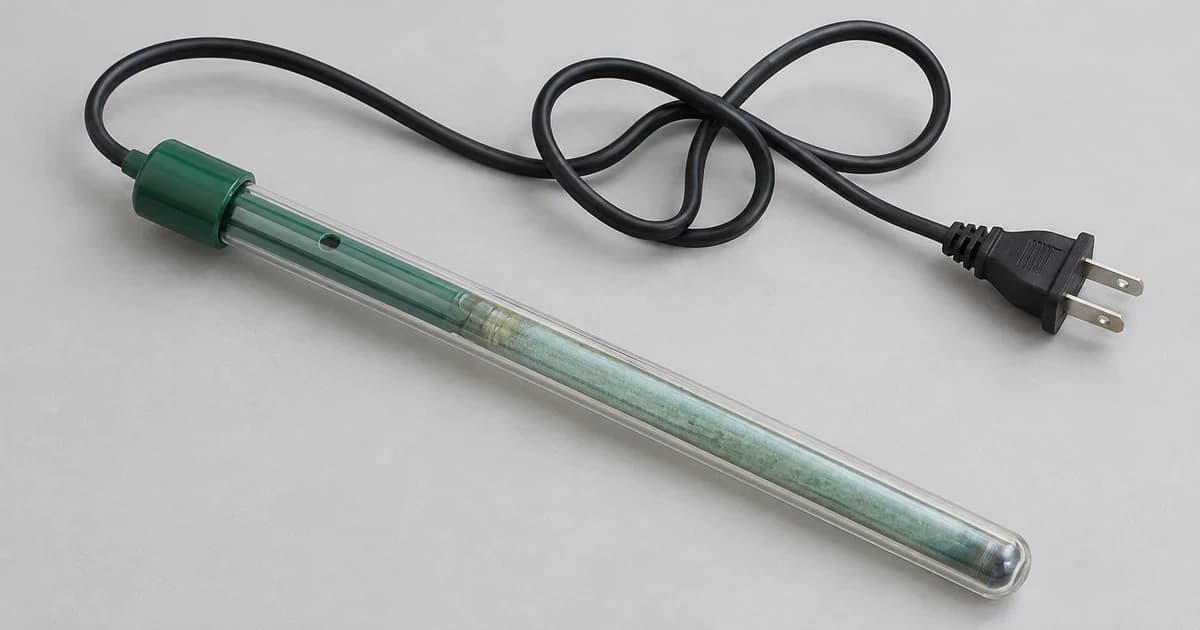
Next, identify the heater's complete model and regional version. A familiar brand name, green cap or glass tube does not identify a rating. The same product family can contain several wattages and electrical versions, so compare the actual item information with the exact regional documentation.
Keep the room-to-water temperature gap separate
Record the water temperature required by the appropriate care guidance for your aquarium, without choosing it from a heater's adjustable range. Record the room temperature expected at the tank's location too, including relevant colder conditions. If those conditions have not been established, mark them unknown and discuss them with the maker before choosing capacity.
Calculate a difference using temperatures expressed in the same scale: target water temperature minus room temperature. For example, a hypothetical 25°C target and 20°C room produce a 5°C difference. That is an arithmetic example, not a temperature recommendation. A temperature difference has no 32-degree offset: a 5°C rise equals a 9°F rise.
A thermostat setting and a separately observed water reading are also different records. Aqueon's cold-weather article identifies room location and ambient temperature as factors and distinguishes the heater setting from thermometer observations. Its wider article also contains handling and installation advice, which is outside this capacity worksheet.
Read the conditions attached to a named model
| Named manufacturer example | Published capacity information | Condition still to resolve |
|---|---|---|
| Fluval T300 | 300W, for aquariums up to 80 US gallons / 300L. | The T-series FAQ says additional heating capacity is likely necessary when the room-to-set-temperature difference exceeds its stated 10°F / 6°C threshold. |
| EHEIM thermocontrol 75, linked regional page | Approximately 60–100L; performance at 50Hz is listed as 75W. | The page does not state an ambient-temperature-rise basis. The applicable regional electrical version and any US equivalence require confirmation. |
The T300 product page and T-series FAQ belong together. “Up to” is a scoped product rating, not proof that the unit will achieve every target in every room. Keep the FAQ's paired threshold as published; do not substitute a different Fluval family's temperature-gap guidance.
The thermocontrol 75 description and specifications provide a different example. Its 60–100L range and 75W at 50Hz do not establish an equivalent US item or an unstated temperature rise.
Pause when two sizing charts disagree
Two Aqueon graphics headed “Heater Guidelines” contain a genuine difference. In the cold-weather article's embedded chart, the “75 Gallon” row at a 15°F rise shows 300W. The separate one-page heater guidelines PDF shows 250W in that position. The article's “90 Gallon” row shows 300W across the 5°F, 10°F and 15°F columns; the PDF shows 200W, 250W and 250W.
Those are source observations, not alternative recommendations for your tank. The graphics print a room basis of 68°–72°, but their room label and “Gallon” rows do not settle all unit and model assumptions. Their version relationship is unresolved. Do not silently choose the larger number, average the figures or construct a new universal chart.
Keep the answer with its date. Until the model and conditions are resolved, the chart disagreement remains an open selection question.
Keep a capacity decision record
| Record | What to retain |
|---|---|
| Tank | Model, volume, unit and whether the volume basis is nominal or actual water. |
| Temperatures | Required water target and its care source; expected room conditions; calculated difference and scale. |
| Heater | Exact model, regional version, wattage and its complete manufacturer rating conditions. |
| Unresolved fields |
Use this record to decide whether the documented model covers the stated situation. A larger rating, an indicator light or a product's protective-feature claim does not close a missing-condition question. Additional capacity mentioned by a maker is a reason to obtain model-specific guidance, not a universal instruction to install two heaters.
A listing does not establish current stock, electrical compatibility or equivalence with the named examples. This selection task is separate from automatic feeder setup and magnetic glass-cleaner selection. Our editorial policy explains source-based guidance and edited illustrations; the generic heater image is not a capacity or performance test.