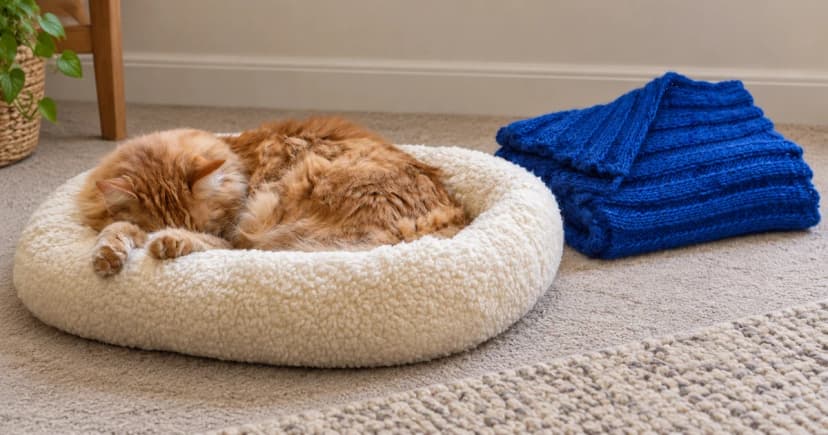
Cats spend much of the day resting or sleeping in separate bouts between activity. Conserving energy helps explain this pattern, even when a pet cat's active time involves exploring or playing rather than hunting for food. Frequent naps alone do not tell you that something is wrong.
A change from your cat's usual pattern matters more than comparing one afternoon with a fixed number of hours. Notice how the cat behaves during naturally awake periods as well as where and how often you see them resting.
Rest fits around bursts of activity
PDSA's explanation of cat sleep connects rest with the energy used in stalking, running and pouncing. Domestic cats still show these kinds of activity during play. Their routine can include many short resting periods rather than one long overnight sleep.
PDSA also describes cats as often active around dawn and dusk. Your view of the day may therefore catch the resting intervals more often than the activity. That does not mean every cat follows an identical schedule, or that a cat sleeping while you work has been inactive throughout the whole day.
The practical implication is to leave room for both voluntary activity and uninterrupted rest. It is not a reason to wake a sleeping cat for another game or keep them moving until they reach a quota.
Published sleep hours are rough context
Cats Protection gives approximately 12–18 hours a day as general context for domestic cats. That is a broad description, not a diagnostic boundary. Seeing a cat curled up also does not let you measure all of their sleep accurately.
Age, lifestyle and health can affect the pattern. Kittens and older cats may spend more time resting, but age should not automatically explain a new change. A familiar pattern in an otherwise normally active cat and a recent increase accompanied by other changes need different attention.
Do not combine estimates from several guides into a new “ideal” number. Nor should you assume that going above or below a range identifies a condition. Your observations of this cat's usual behavior are useful context to share with a veterinarian.
Look at the awake periods too
The question is not only how often the cat is lying down. During times the cat wakes naturally, do they engage with their usual meals, surroundings and preferred activities? A cat that enjoys familiar things between naps presents a different observation from a cat that has newly lost interest in them.
| What you observe | Useful next step |
|---|---|
| Frequent naps with the cat's usual awake behavior. | Allow rest and continue offering appropriate activities when the cat is awake. |
| Much more sleeping or hiding than is usual for this cat. | Contact your veterinary team and describe the change. |
| New stiffness, difficulty reaching a familiar spot or signs of pain. | Discuss the access change and discomfort with your veterinarian. |
This is a way to describe observations, not a checklist that rules illness in or out. There is no need to repeatedly wake or prod the cat to complete it. Use what you notice during ordinary interactions.
Offer a quiet place the cat can choose
A resting place should be comfortable for the individual cat and easy to reach. Cats Protection describes several possible places, including beds and a box with a soft blanket. A cat may choose different locations; purchasing a particular bed does not establish how much the cat will sleep or how well they will rest.
When comparing cat beds and resting options, think about where your cat already settles and how they get there. Check the actual item's instructions, condition and access requirements. The choice is a resource decision, not a treatment for a change in energy.
Cushion beds are one option for an accessible resting area. If a cat newly struggles to reach a favored place, describe that change to your vet instead of attributing it to laziness or assuming a different cushion resolves the cause.
Keep an observation record simple
When a pattern seems different, write down when you first noticed it and what changed. Useful examples include spending more time hidden, missing an activity the cat normally enjoys, eating differently or having trouble with a familiar route.
Distinguish observations from estimates. “Usually joins breakfast, but stayed in the resting spot today” is clearer than declaring an exact total of sleep hours from occasional checks. You do not have to disturb the cat to build a useful record.
For activities during awake periods, see the separate guide to playing with your cat. Keep those opportunities voluntary rather than using play to override rest or force a preferred sleep schedule.
When more sleep deserves veterinary advice
PetMD's cat-sleep guide, written by veterinary technician Nicole Zittritsch, advises contacting a veterinarian when sleeping habits change or other behavioral changes accompany them. It also identifies pain and mobility concerns as reasons for a veterinary visit.
PDSA advises speaking to a vet when a cat is persistently lethargic and does not want to engage in usual enjoyable activities. Cats Protection likewise recommends a check when sleeping or hiding increases. More sleep is an observation with several possible explanations; it is not enough to diagnose boredom, stress or a medical condition at home.
Let your cat rest without unnecessary disturbance, offer suitable opportunities when awake and contact your veterinary team about a concerning change. A bed, toy or altered routine should not replace that assessment.