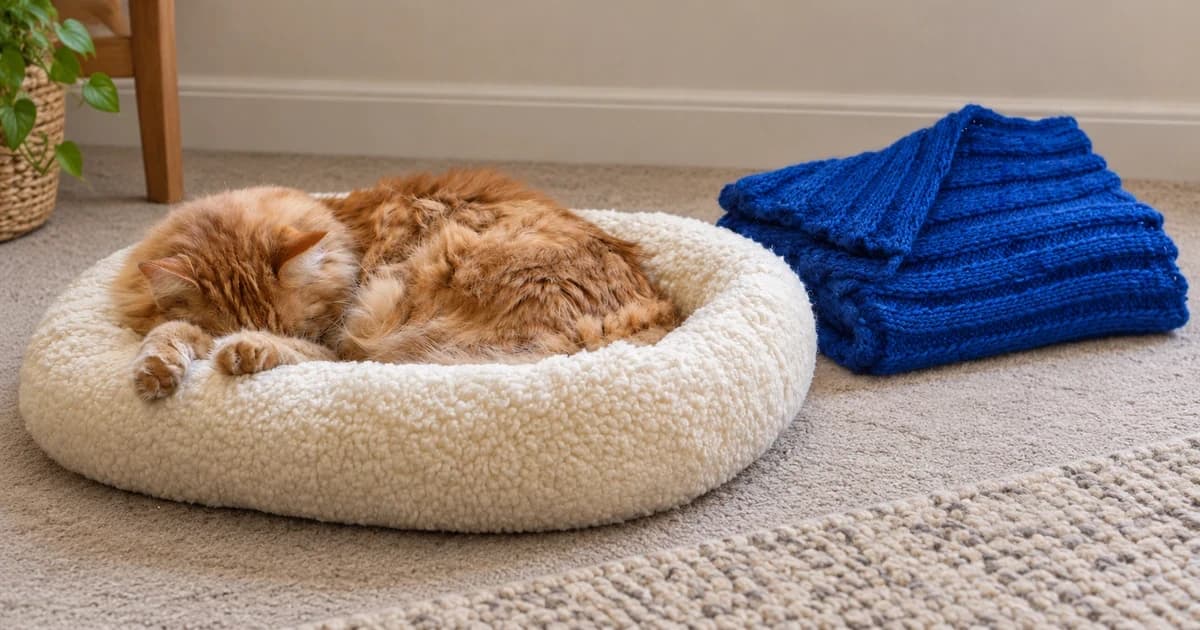
Build a cat bedtime routine around a predictable evening play invitation, storing equipment that requires supervision, and leaving familiar resting spots and resources easy to reach. Keep every part of the evening voluntary: your own bedtime prepares the household for the night rather than forcing your cat into one bed or onto a human sleep schedule.
Choose an opportunity while your cat is naturally awake
RSPCA Australia's night-activity guidance recommends offering interaction during the afternoon or earlier evening at consistent times when the cat is naturally awake and interested, and making any routine shifts gradually.
Offer an invitation when you have unhurried time. If your cat engages, follow our cat play guide so the game includes realistic prey movement, physical catches and calm pauses. If your cat prefers to stay curled up or walks away, end the invitation—an unused play window never creates a quota to make up before lights-out.
Close the supervised part of the evening: put away vs. left available
Battersea's Feline Behaviour Team separates interactive human-guided play from solo toys and instructs owners to put string, wand and fishing-rod toys out of reach whenever unsupervised; if any item's solo safety is uncertain, store it away.
Before going to bed, divide your cat's items into two explicit groups: put away (all corded teasers, damaged items or supervised gear) and left available (only intact items whose instructions permit unattended access).
Leave resting choices familiar and accessible
Cats Protection's sleep guidance notes that cats rotate among preferred sleeping spots and emphasizes leaving sleeping cats undisturbed—never force a cat to stay awake during the day to control nighttime activity.
Keep doorways to familiar beds, perches, water bowls and litter trays open. If you are comparing larger sleeping surfaces for your home, see our large-cat bed comparison to evaluate interior dimensions and bolsters.
Copyable evening handoff and morning observation card
Use the simple checklist below to separate what was stored, what remained accessible, and what you directly observed without waking your cat or guessing what happened during unobserved hours:
| Routine checkpoint | What to check or record | Boundary to keep clear |
|---|---|---|
| 1. Evening invitation & response | Time offered: ____ | Cat's choice: Joined / Watched / Rested / Left | An invitation is optional; declining play is a valid choice. |
| 2. Put away (supervised gear) | Stored in closed drawer/cupboard: [ ] Wand/string toys [ ] Other supervised items: ____ | Never leave corded, feathered or uncertain toys out overnight. |
| 3. Left available (unattended-safe) | Confirmed intact & permitted for solo access: ____ | Verify instructions and intact seams before leaving any item out. |
| 4. Familiar routes & resources | Open access checked: [ ] Resting spots [ ] Water [ ] Food arrangement [ ] Litter tray | Do not block pathways or move a sleeping cat to a chosen bed. |
| 5. Direct evening & morning notes | Seen at bedtime: ____ | Seen in morning: ____ | Overnight hours: Unobserved | Seeing your cat on a chair at 7 a.m. does not prove where they slept all night. |
Review the choices without imposing a sleep target
Use your notes to make one calm environmental adjustment at a time, and see our indoor-cat opportunity plan for daytime setup ideas. Both Cats Protection and RSPCA Australia advise consulting a veterinarian first whenever a cat sleeps or hides more than usual or begins restless night vocalizing, rather than treating behavior changes through a stricter schedule or new cat beds and resting equipment.