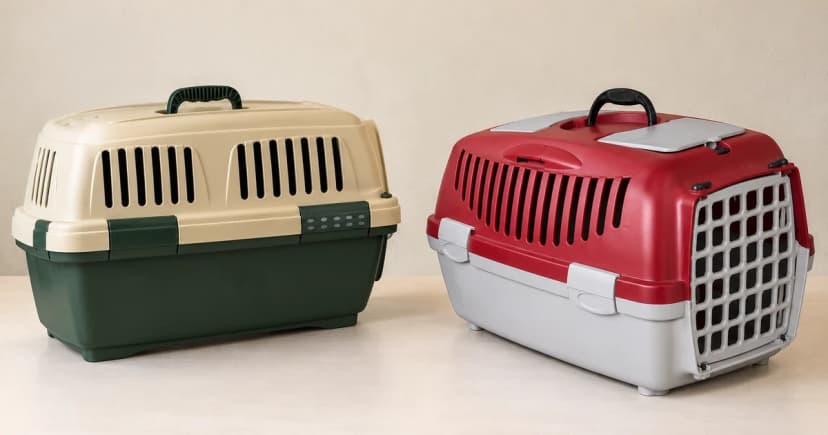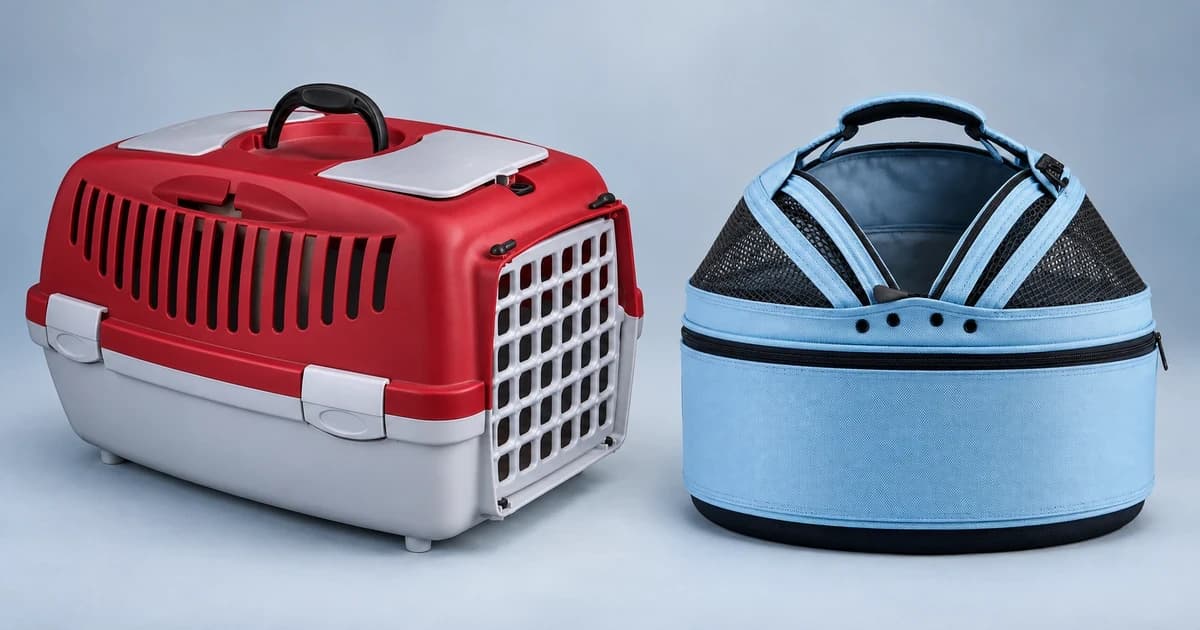
The hard vs soft cat carrier decision should start with the actual design and your trip. Compare the shell or fabric body, floor supports, openings, care instructions and documented transport restrictions. Neither a rigid appearance nor a padded bag establishes a suitable carrier for every cat or journey.
When choosing a cat carrier, hard or soft describes only the starting construction. Keep the opening arrangement, floor supports, removable bedding, storage and model-specific care beside the documented restrictions for the actual trip. Comparing a hard or soft cat carrier on those points produces an identifiable shortlist; it does not make either construction suitable for every cat or journey.
A useful comparison leaves you with two identifiable candidates and a reason for choosing between them. “Hard” and “soft” are starting descriptions; the model's construction and instructions supply the details.
Compare the whole design
Record the exact model and size on each side of your comparison. Look at the empty carrier in its normal assembled configuration, with its intended support parts and bedding identified. Keep what you can observe separate from what the maker documents.
| Decision point | Hard-carrier question | Soft-carrier question |
|---|---|---|
| Body and floor | Which shell sections and joining parts form the enclosure? | Which fabric, mesh, board or frame parts maintain its intended shape? |
| Entry and access | Is there a front door, top hatch or removable upper shell? | Which panels unzip, and what opening remains when they are fully opened? |
| Carrying and storage | What handles, empty weight and permitted storage configuration are documented? | What handles, empty weight and permitted folding configuration are documented? |
| Care burden | Which shell, window, door and cushion instructions apply? | Which bag, lining, pad and support instructions apply? |
| Trip conditions | What intended use or explicit exclusions does this model have? | What intended use or explicit exclusions does this model have? |
Do not fill a blank field with a category-wide assumption. For example, a removable-looking panel may not be intended for removal, and a fabric bag need not have a folding frame.
Keep access separate from the material
Cats Protection's carrier guide recommends a sturdy plastic or metal-wire model and prioritizes construction, manageable carrying, secure enclosure and ease of cleaning. That is an attributed welfare recommendation, not a comparative crash-test result.
The same guide distinguishes a top opening from a front-loading carrier whose entire top can be removed. It also calls for enough room for the cat to lie comfortably and change position, plus ventilation openings on at least two sides. Those are separate comparison fields: choosing a material does not answer them all.
Compare the actual clear opening and how much of the interior is accessible. Avoid choosing a front-only model while assuming that every hard carrier opens from above, or assuming that a top zipper releases a soft bag's entire roof.
Then use the separate cat-carrier space guide to assess usable interior space. This comparison supplies no breed chart, universal size allowance or forced-entry test.
Check what storage and cleaning will involve
The Sherpa FAQ illustrates how much structure a soft carrier can contain: it identifies a stability board and separate faux-lambskin liner, and describes a rear spring-wire frame for its airline-positioned carriers. Its folding instructions belong to that documented design, not every fabric bag.
The FAQ gives the carrier, liner and board different care permissions; the board is spot-clean only. It also describes a seatbelt/luggage strap while expressly warning that the product is not crash tested and is not intended to restrain the pet during a collision or sudden stop. A strap therefore must not become a claim of crash protection.
When comparing a soft cat carrier vs hard alternatives for storage, ask what the complete model can actually do between trips. Record any permitted folding or disassembly, where the parts will be kept, and what must be restored before use. Do not remove supports merely to make a bag smaller.
For care, compare the number of separately treated components and the methods you can complete. Use the detailed fabric-carrier care guide or hard-shell carrier care guide for that separate task. “Hard” does not mean dishwasher-safe, and “soft” does not mean the whole bag is machine washable.
Let documented trip restrictions narrow the choice
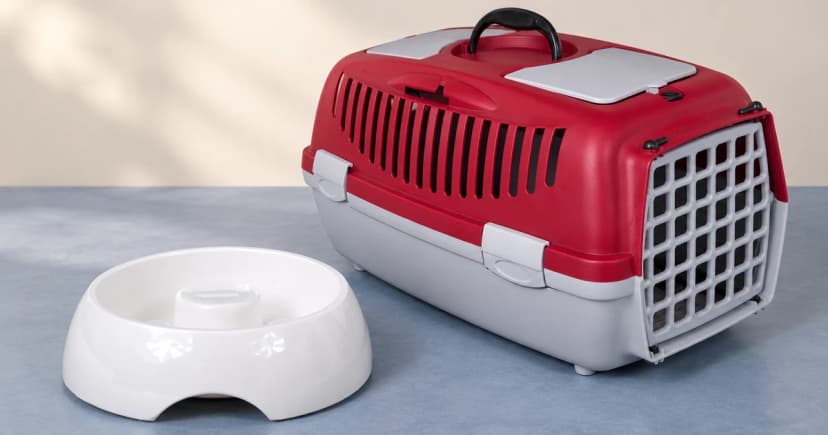
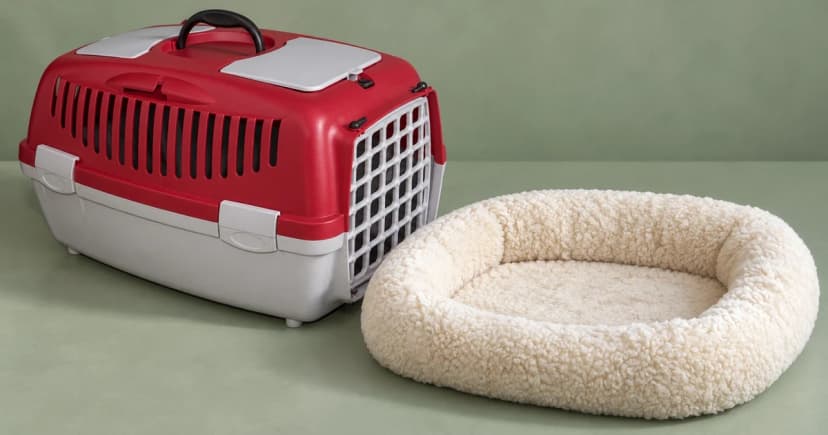
Catit's PIXI Mio, product 41390, is a named hard-shell ABS example with detachable front and top sections and a separate cushion. Its carrier and cushion have different care instructions, including spot-cleaning for the cushion.
Catit positions this model for home use and short car journeys, for an average-sized cat up to 6 kg and 30 cm tall. It explicitly excludes airplane travel. The separately mentioned 9 kg construction margin is not the permitted cat-weight limit. This example shows why a hard shell alone cannot establish suitability for a planned trip.
For a flight, confirm the cat and itinerary's eligibility, then the actual flight's carrier requirements.
Choose the candidate with fewer unanswered requirements
Keep the exact model, usable space, entry arrangement, support parts, carrying and storage information, care permissions and trip exclusions together. A carrier remains unresolved if a requirement important to your trip is missing or contradictory.
Use Pawlivy's cat carrier category to compare documented options and request missing information.