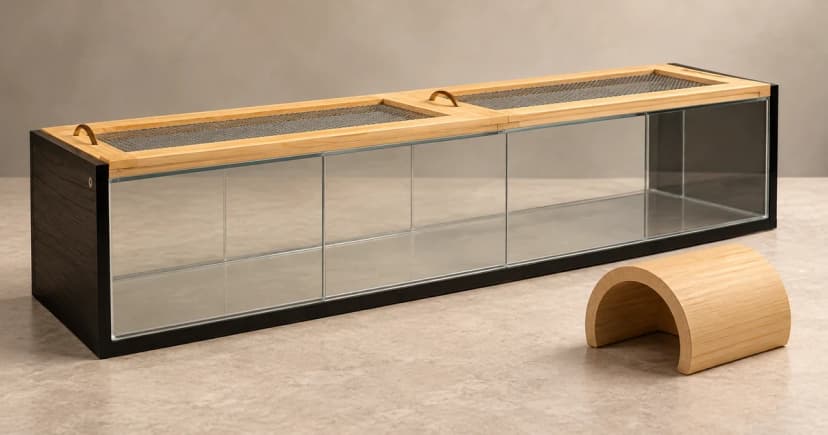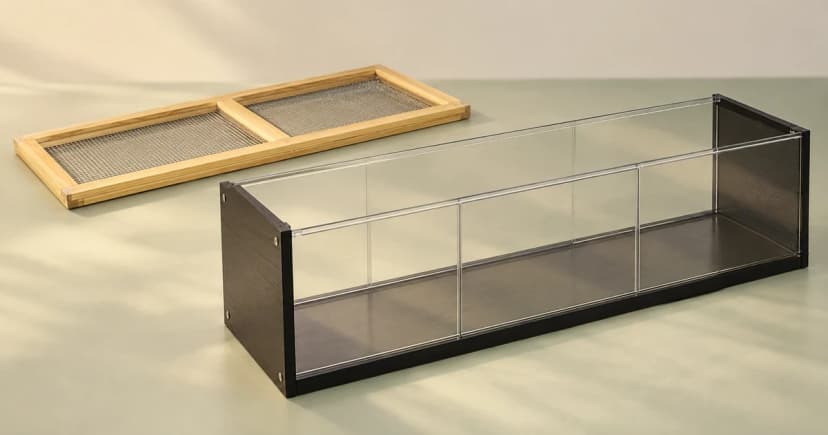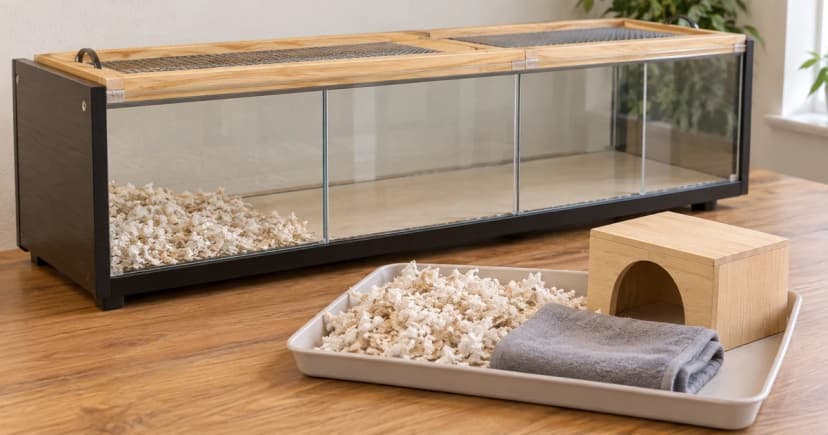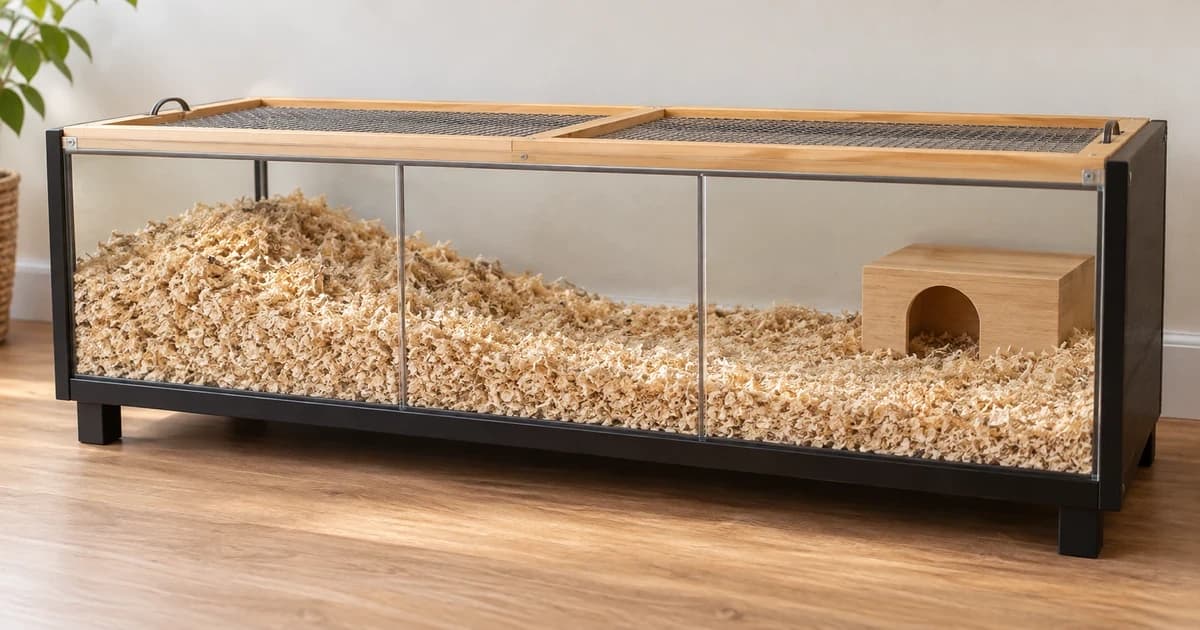
Choose a hamster cage by its usable floor dimensions, bedding capacity and enclosure structure, rather than its size label or overall height. A tall habitat with several small levels can have less continuous ground space than a lower, wider one.
When comparing hamster cage dimensions, keep continuous usable inner floor, bedding capacity and headroom as separate fields. An outside length or an added upper level cannot fill in a missing floor measurement.
PDSA and Blue Cross publish a 100 cm by 50 cm starting floor measurement in their guidance. Keep that recommendation attributed to those sources, then investigate the actual item's internal measurements. The number does not certify an unidentified cage or establish a universal US legal minimum.
Keep each source's measurement in context
The three guides below address ordinary pet-hamster housing. They are useful welfare references, but their numerical details and construction preferences differ.
| Source | What it states | What remains separate |
|---|---|---|
| PDSA: Hamsters as pets | Its December 2024 guide reports a 100 cm by 50 cm minimum, referring to the German Veterinary Association for Animal Welfare, and calls for at least 25 cm of bedding for burrowing. | PDSA also acknowledges limited evidence for an exact cage size. |
| Blue Cross: Hamster care | It gives at least 100 cm by 50 cm of floor space, 50 cm of height and at least 20 cm of bedding. | The displayed review date is March 30, 2023; its scheduled March 30, 2026 review date has passed without proving that a new review occurred. |
| RSPCA: Hamster environment | It describes room to move, thick bedding, a solid floor and suitable resting space. | This page does not supply a numerical floor minimum. Do not attach another organization's number to the RSPCA. |
These references do not support averaging the bedding depths into a new recommendation or treating one minimum as a best size for every individual. Read the complete guide you are using and provide room for the required equipment and ordinary activities as well.
Separate outside size from usable inner floor
Ask what a listing's length and width describe. Outside measurements can include wall thickness, framing or a projecting lid. A storage shelf below a habitat is not living space, and a raised platform does not extend the base's uninterrupted length.
For an empty rectangular base, record the inside length and width at the floor. Multiplying them gives the base area: for example, 100 cm by 50 cm is 5,000 square centimetres. This arithmetic does not account for partitions, unusable corners or equipment occupying part of the route.
Use actual measurements or explicitly supplied internal dimensions. Do not infer them from a product photograph, a “large” label or the animal pictured beside the enclosure. If the base narrows or contains separated compartments, sketch that shape instead of describing its outside bounding rectangle as fully available space.
When comparing hamster habitats, record a tall tower's base dimensions separately from its total height and shelves. A stackable or multi-species product title does not establish that any one living compartment meets the guidance you selected.
Check bedding capacity and headroom together
Floor area, bedding depth and height answer different questions. A high lid does not increase floor length; a deep base does not tell you how much space remains above the bedding for the actual wheel or shelter.
Find the maker's permitted bedding capacity and the intended placement of equipment. Check the usable height above the planned bedding surface, including the lid and any top fittings. Do not simply subtract a universal wheel height from the outside cage height: stands, bedding arrangements and measurement boundaries differ.
Keep the floor clear enough for movement between the resting place and other equipment. An adequately sized wheel can still be difficult to place in a short enclosure. Our hamster-wheel sizing guide addresses that separate diameter and voluntary-running check.
Do not place the hamster inside an unfinished setup to demonstrate that everything fits. Confirm the components and their assembly directions first, then observe ordinary use without holding the animal in a pose.
Resolve construction questions before buying
Blue Cross discusses glass or tank-style housing with a mesh cover, while the RSPCA page prefers mesh or barred sides. That difference should remain visible. A glass-sided enclosure is not endorsed by all three sources merely because each discusses hamster housing.
Follow the maker's instructions for the particular enclosure and its fittings. This guide does not supply a DIY bin, glass-conversion or ventilation-hole design, and a photograph cannot verify those properties.
Choose housing for the individual hamster. PDSA advises keeping hamsters separately; a large floor number should not be treated as permission to put unfamiliar animals together. Broad “small pets” tags also do not resolve an individual item's species suitability.
Keep a comparison record
- Exact model and the welfare source whose guidance you are using.
- Outside footprint and separately confirmed inner ground length and width.
- Partitions or upper levels, recorded separately from continuous base space.
- Permitted bedding depth and usable headroom above the planned surface.
- Equipment placement, clear routes, lid/access details and unanswered material or ventilation questions.
Resolve missing internal dimensions before treating the cage as a match. On delivery, check the model and supplied measurements and follow its setup instructions. Record an unresolved fact as unknown instead of replacing it with a guess from a marketing image.
Our editorial policy explains how we distinguish a source-based comparison from a firsthand product test.