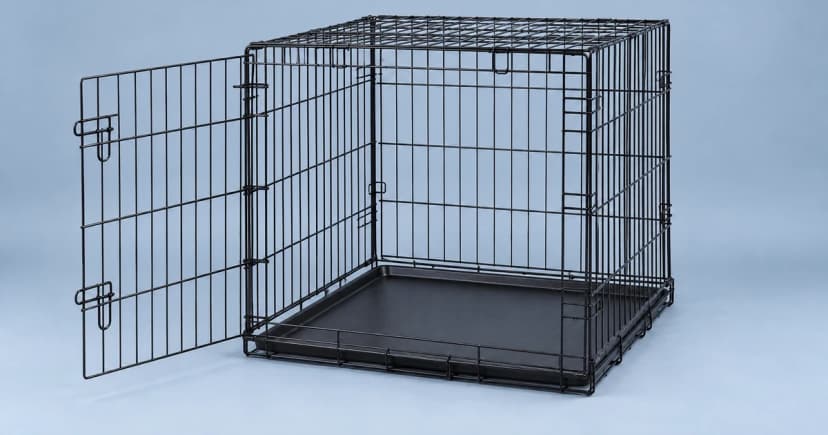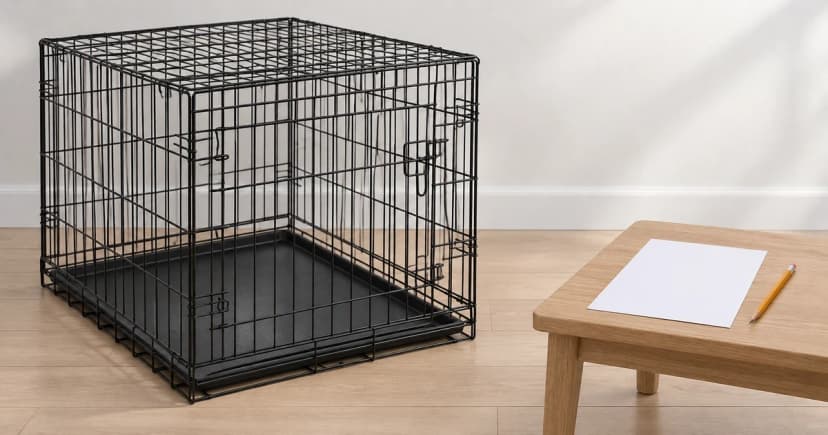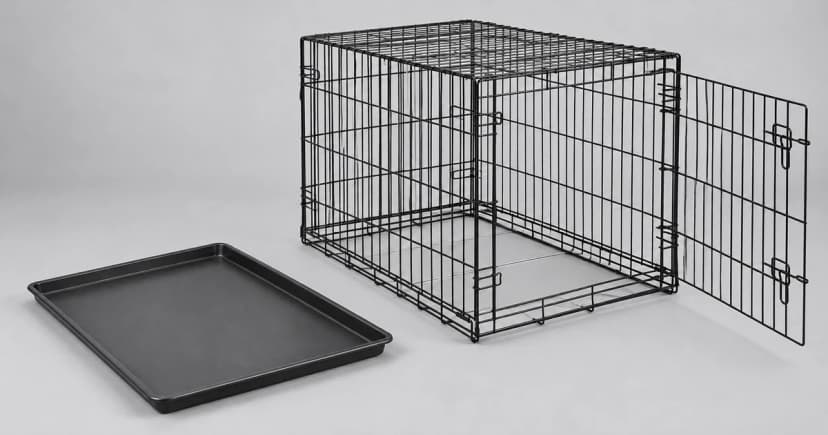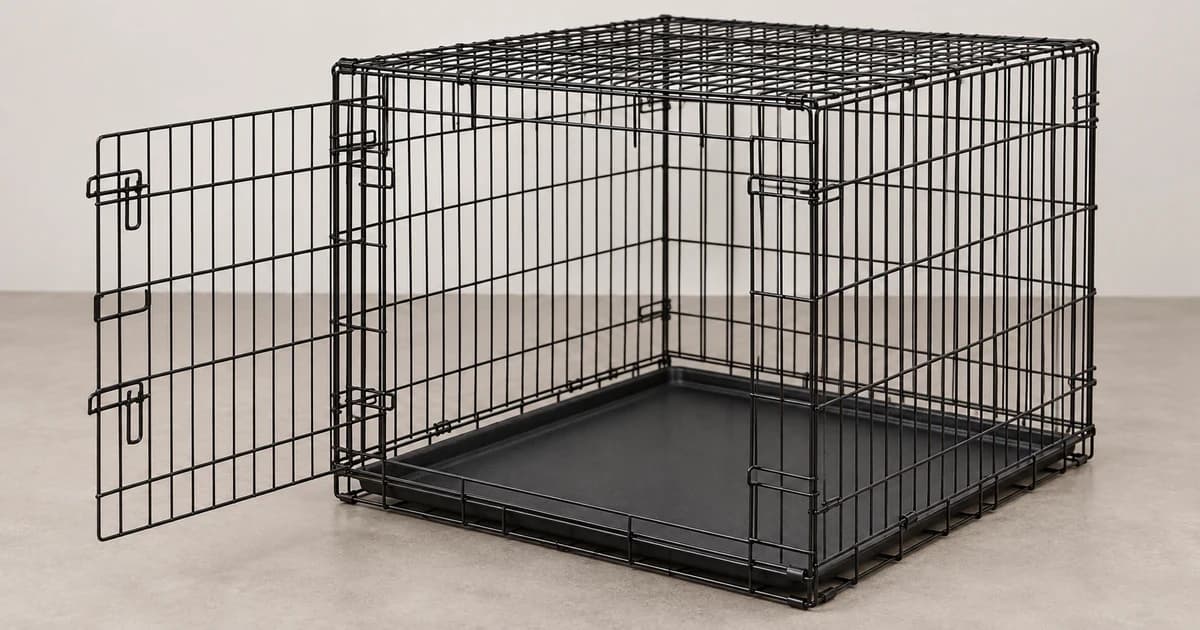
The crate your dog needs is one with enough usable interior room to stand and sit upright, turn around, lie down and stretch out fully. Check that space with the intended bedding and other belongings considered, and revisit it as a puppy grows. A size name or the crate's outside measurements alone cannot answer those questions.
A dog crate sizing chart is useful only when its dimensions describe the usable interior you are comparing. For a Labrador, Golden Retriever or Goldendoodle, the breed name still does not supply that interior measurement or show the room left after bedding is added. Use the same standing, sitting, turning, lying and stretching checks for the individual dog; this guide does not assign one crate length to every member of a breed.
Start with the particular dog and the exact assembled crate.
Check the movements the interior must accommodate
PDSA's crate guidance says a dog should be able to stand and sit without touching the top. It also calls for room to turn, lie down, wag their tail and stretch fully. These are separate requirements: a dog fitting through the door or lying curled up does not establish that the other movements have enough room.
The Dogs Trust guide likewise considers both the dog's movements and the space occupied by their bed, blanket and water arrangement. Look at the interior as a usable space, not simply an empty rectangle before anything is put inside.
Observe your dog's ordinary upright and resting positions outside the crate before comparing equipment. Do not push them inside or close the door to obtain a sizing demonstration. If they are already entering voluntarily, their usual movement can help you notice restricted headroom or stretching space; reluctant entry does not prove the dimensions are wrong, either. Introduction and door stages belong in our puppy crate-training guide.
Establish which dimensions the listing actually gives
Find the exact model and size in the manufacturer's documentation. A product name such as “large” or a single length in a title leaves that distinction unresolved.
When checking an empty crate you already own, assemble it according to its instructions before recording the interior length, width and height. Note the points between which each measurement was taken. If a shape or internal component limits part of that space, record that separately rather than treating the greatest measurement as available everywhere.
Keep all measurements in the same units when comparing models. If the maker supplies only external dimensions, request interior measurements rather than subtracting an assumed frame thickness. Neither the sources used here nor a photograph of a similar crate establishes that missing allowance.
This documentation check also applies to wire crates and soft crates. Category names help locate equipment; they do not establish its internal clearance, suitability for a particular dog or transport approval.
Record the room left after the intended setup
PDSA includes space for a bed, bowls and toys in its sizing advice. Blue Cross's puppy guide also accounts for growth and belongings. Choosing a crate around the dog's outline while ignoring those items misses part of the decision.
Use the following worksheet to organize a comparison. It is an original record format, not a formula for a certified fit or an instruction to add a fixed number of inches.
| Question | What to record |
|---|---|
| What exact crate am I comparing? | Maker, model and size; the manual or dimension drawing used. |
| Are the dimensions usable interior measurements? | Length, width, height and units; write “not established” if the listing only identifies exterior size. |
| What will occupy the interior? | The intended bed or bedding, water arrangement and other appropriate belongings, with their positions. |
| What room remains for the dog? | Whether upright standing and sitting, turning, lying and full stretching remain possible after that setup. |
| What still needs checking? | Missing interior information, an obstructed area, uncertain room for a movement, or growth that will require another comparison. |
If a thick bed changes the available headroom, or an item occupies the area needed for turning or stretching, include that in the comparison. Do not solve a shortage of room by disregarding the dog's water or resting needs. The arrangement needs to work as a whole.
Make a growth decision you can revisit
A puppy's current size is temporary. PDSA describes considering the dog's adult size or increasing the crate size as they grow; Dogs Trust also notes that growth can require a larger crate. Whichever approach you take, assess the room the puppy actually has now and check it again as their body changes.
Keep the model record so a later comparison uses the same interior measurements. Revisit the setup when the dog grows or the bedding and belongings change. An adult-size label is not a reason to stop checking, and a predicted adult size is still an estimate.
This guide does not set a divider position or prescribe the smallest possible space for housetraining. Nor does it apply a universal extra-inch allowance. The posture, belongings and growth criteria are the decision points supported by the sources here.
Separate adequate space from other suitability questions
Enough interior room does not establish that a dog accepts a closed door, how long they may be confined, or whether a crate is approved for a vehicle journey or clinical recovery. Those questions need their own guidance. If your dog appears uncomfortable or their needs are unclear, reassess the setup and seek individual advice rather than relying on a size chart.
For an existing soft crate, component care and assembly are separate checks: our soft-crate cleaning guide explains why cover, floor and frame instructions can differ.