Some dogs like squeaky toys because the noise catches their attention, responds immediately to a bite, or brings a person into the game. A common explanation is that a high-pitched squeak resembles prey sounds. These are source-based explanations for possible interest, not a way to read your dog's thoughts. Dogs differ, and a dog who prefers a quieter toy is not missing a required kind of play.
The useful distinction is between what you can observe and what you can infer. A dog turning toward a squeak is an observation. Saying that the dog thinks it has caught an animal, needs that noise for mental health, or will use the toy without damaging it goes beyond that observation.
A squeak can attract attention without explaining everything
In PetMD's explanation of squeaky-toy interest, veterinarian Jennifer Coates describes prey-like sound as one reason dogs may respond. The American Kennel Club's discussion of toy preferences also connects some toy appeal with prey-like features, while emphasizing individual differences.
Use that explanation cautiously. The cited pages are explanatory guidance, not a controlled sound experiment with your dog. They cannot tell you that every squeak triggers the same sequence or that every dog interprets the sound in the same way. Shape, texture, movement, setting and previous play can accompany the noise.
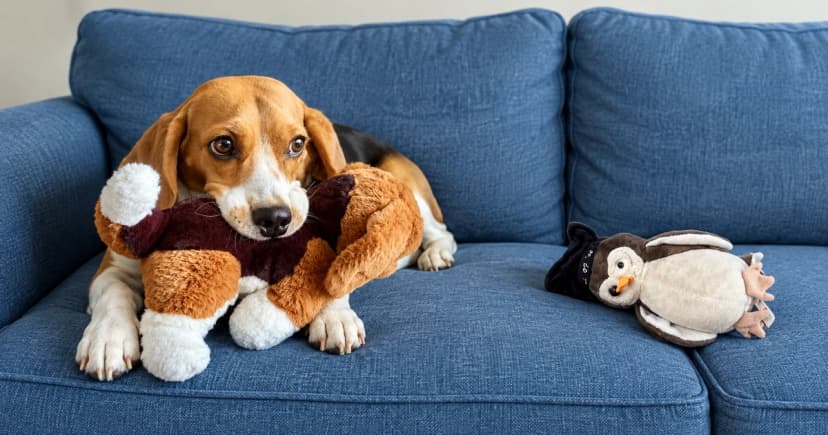
A photograph supplies even less information about sound. A dog beside a toy may be resting, watching or waiting. Neither the toy's appearance nor the dog's expression verifies what the toy sounds like or why the dog approached it.
The response to a bite may be part of the appeal
Coates also describes the squeak as immediate feedback: the dog acts on the toy and hears a response. That can help explain why some dogs return to a noisy object. It is different from proving a neurological reward mechanism or measuring how satisfying the sound is for an individual dog.
A squeaky toy's response is not the same as a training cue deliberately paired with a reward. Do not assume that squeezing it will teach a particular behavior, calm anxiety or improve cognition. Those outcomes would need their own evidence and, where appropriate, individual professional advice.
The toy maker Nylabone discusses sound and shared play in its own explanatory article. Its perspective adds context, but its product promotion and psychological analogies are not independent tests of a Pawlivy item.
Your reaction can become part of the game
PetMD describes a third possibility: attention from people can reinforce noisy play. If squeaking regularly leads to a person looking over or joining in, the interaction may be part of what maintains the dog's interest. This does not establish that the dog is deliberately tricking someone or that attention is the only reason for the behavior.
Notice the existing pattern without turning it into a challenge. Does your dog bring the toy toward you, or stay with it alone? What usually happens next? A brief note about the actual sequence is more useful than assigning a motive from a single episode. You do not need to provoke repeated squeaking or increase the noise to get an answer.
Keep the observation separate from the explanation
| What you notice | A possible explanation | What it does not establish |
|---|---|---|
| The dog turns toward a squeak | The sound has attracted attention; prey-like sound is one cited explanation. | What the dog thinks, whether it wants the toy, or whether it will enjoy prolonged play. |
| The dog bites the toy and it squeaks again | The action produces immediate sound feedback. | A measured brain response, therapeutic effect or permission to chew off parts. |
| The dog brings a noisy toy to a person | Previous attention or shared play may contribute to the pattern. | A universal social intention or proof that the noise alone explains the preference. |
This is an interpretation guide, not an experiment or diagnosis. Several possibilities can coexist, and one brief observation may not distinguish them. Keep uncertain explanations uncertain.
Preference is individual; a squeak is not a requirement
The AKC describes dogs that favor different textures or games, including dogs that engage more when people participate. PetMD also makes clear that not every dog enjoys squeaky toys. Choose an activity your dog willingly joins rather than treating a reaction to noise as a measure of normality.
If the practical problem is a dog ignoring toys, use our separate guide to a dog who does not play with toys. That task involves changes from the dog's own history and suitable invitations. It is different from explaining why a squeak might hold attention.
When browsing squeaky dog toys, check the exact maker's intended use and sizing, and inspect the whole toy for damage or loose parts. Continued interest does not establish that an object remains suitable. Our rubber-toy material guide addresses formula and label evidence; our dog-toy cleaning guide covers model-specific maintenance.
These explanations come from the linked sources. Pawlivy has not tested squeaker sounds, measured canine preferences or verified a photographed toy's performance.